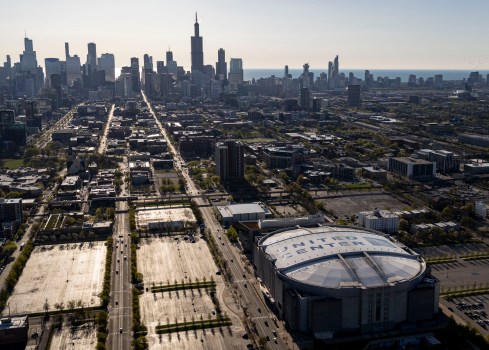
Hustle and bustle have long been synonymous with trips downtown. It’s part of the fun and excitement of being in Chicago. Learning how to handle yourself in a crowd was a badge of honor, as was memorizing the train schedule and charting the most efficient routes to the station. On days when you had a little extra time, maybe you took the route along the river to take in the skyline, or strolled along State Street to appreciate the shop windows.
We savored the Loop and all it had to offer because we were here five days a week. That version of downtown depended on transit that mostly worked. With the start of the new year, many office workers will soon be living this experience once more, and they’ll need the trains and buses to get them there.
Employers such as Morningstar, headquartered at Washington and Dearborn, are ratcheting up return-to-office expectations for 2026, meaning thousands of employees will be trekking to the Loop more frequently. Morningstar isn’t alone. Other large employers, such as NBCUniversal, are requiring workers to be in the office four days a week beginning this month.
This is not an endorsement of strict return-to-office mandates or an endorsement of absolute worker flexibility, though we will say it’s a good thing to see more people downtown during the week. What we’re simply saying is that commuters need to be able to get to the central business district reliably and efficiently, as they did before the pandemic. The Loop’s future health will depend in no small part on people’s ability to get in and out with ease — and safely.
True, public transit here always has had its issues. Folks coming downtown from the suburbs know Metra trains long have run 10 minutes late (or later) too often, and the CTA can be hit or miss.
The collapse in demand during the COVID years exacerbated those annoyances, leaving those running the systems and the people who use them in an awkward chicken-and-egg dance: If service expands, will demand match it? And what happens if demand spikes but service levels don’t keep up?
Before the pandemic, Metra made roughly 281,000 weekday trips to downtown Chicago. Ridership remains below pre-pandemic levels, but is steadily rising, especially midweek. Metra reports weekday ridership at roughly 62% of pre-COVID levels in November 2025, with Mondays through Thursdays all reasonably well-trafficked. Those trends mirror the return-to-office mandates many employers are rolling out for 2026. What many riders say has not rebounded as quickly is service. Metra has restored many trains since pandemic service cuts, but overall service still lags full pre-COVID schedules across several lines and times, and riders continue to report delays.

Still, for suburban commuters, Metra is critical to a more robust return to downtown, and reliability remains its biggest challenge. (We’d like to note here: That’s no knock on Metra’s conductors, whom we consider the professional and friendly backbone of the agency.)
Reliability is only half the equation; riders also need to feel safe to travel. Any of us who takes Metra regularly can tell you that things are dicier than they used to be near the city’s main stations. To get to the Loop proper from Ogilvie, there are pockets best avoided, where people experiencing homelessness — and, in some cases, untreated mental illness — congregate. Most of the time, nothing bad happens, but we know firsthand that there have been instances in which people simply walking to the office have been threatened with violence.
Thankfully, people generally feel secure on board the Metra trains themselves.
CTA presents a different and more troubling challenge. Riders routinely report robberies and assaults, and a string of violent incidents over the past two months has only heightened concerns. In early November, a rider was stabbed on a Blue Line train following a confrontation. On Dec. 16, a woman allegedly attacked multiple passengers with a glass bottle on a CTA train near the Lake Street Red Line station. And no one will forget the Blue Line case, in which a man set a 26-year-old woman on fire aboard a train car.
In response to growing concerns over transit crime — further propelled by scrutiny from the White House — CTA announced plans Dec. 18 to increase police and K-9 guards.
The Trump administration called the agency’s plan “materially deficient,” after threatening last month to withhold $50 million in federal funding, a move that would further strain service and undermine riders’ commutes — the opposite of what CTA, which as of fall 2025 had recovered to roughly 61% of pre-pandemic levels, needs as it works to attract more riders and improve safety.
Given all of this, alternative modes of transportation will be tempting for some, but driving is an unappealing prospect, especially given toll hikes are on the horizon. Remember, our traffic congestion is ranked the worst in the nation.
So if people need to get to work, they need trains. And, frankly, CTA and Metra are now out of excuses following the state’s financial rescue package for mass transit passed in Springfield in October and signed by Gov. JB Pritzker last month.
The Loop won’t return to its heyday overnight, but as more workers are being told to head back to the office, the city needs to make sure its transit systems are ready to bring them here (and back). If Chicago wants the Loop to thrive again, transit can’t be the weak link. Getting people downtown safely and on time isn’t optional — it’s foundational.
Submit a letter, of no more than 400 words, to the editor here or email letters@chicagotribune.com.