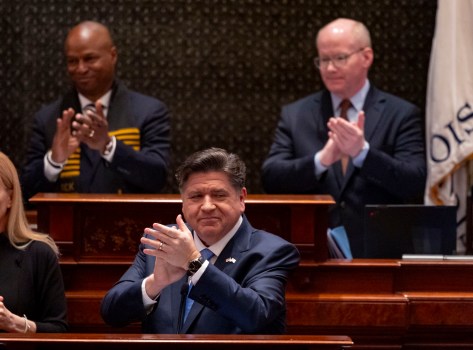
In 2019, Illinois became the first state in the nation to legalize the commercial sale of recreational cannabis via legislation rather than a public vote. Gov. JB Pritzker and lawmakers decided by themselves, promising that legalization would eliminate the black market, pose minimal public health risk and generate tax revenue.
Today, the only promise fulfilled is money, as Pritzker and the Democratic legislature exchanged public health for profits. Since recreational cannabis became legal, the state has realized hundreds of millions of dollars from taxes. This windfall and the attendant political benefits for the governor have come at public expense, as the dangers of marijuana become tragically apparent.
The money has rolled in — more than $2 billion in cannabis sales in 2024, a 2.5% increase from 2023, and $490 million in tax revenue in 2024. Meanwhile, an ominous trend has developed: 7.7% of Illinoisans ages 16 to 64 now have a likely cannabis use disorder, up from 6.5% in 2022, Illinois’ fifth “Annual Cannabis Report” said. An additional 11.9% meet the criteria for hazardous cannabis use. Before the adult use cannabis law took effect in 2020, fewer than 2% of adult Illinois residents met the same criteria, and cannabis use is now especially common in those with severe mental illness.
The profits also come from beyond Illinois borders. In Iowa, Wisconsin and Indiana, cannabis use is illegal, but out-of-state customers currently account for more than one-fifth of Illinois sales. This is also true of illicit cannabis; legalization has not eliminated that market as promised. Chicago is a hub and distribution point for Midwestern drug trafficking, with Chicago-based gangs dominating the regional retail market. In 2021, estimated illegal cannabis sales in Illinois reached $2.23 billion, far surpassing the $1.37 billion in legal sales. Illinois essentially realizes huge profits from both legal and illegal cannabis, while neighboring states must deal with the adverse health consequences.
Specifically, what are those adverse consequences the public was assured were minimal?
Approximately 10% of Illinois adults surveyed in 2024 reported cannabis-related problems requiring medical attention from medical providers or emergency rooms. A little more than 30% of cannabis users surveyed reported experiencing an adverse event. The most dramatic emergency room diagnosis was cannabinoid hyperemesis syndrome: severe, uncontrollable vomiting after chronic cannabis use. The incidence of this formerly rare syndrome has skyrocketed over the last five years with about 7% of past-year cannabis users reporting symptoms consistent with cannabinoid hyperemesis — more than 6,000 emergency room encounters. Cannabis-positive toxicology findings in fatal vehicle crashes continue to rise. In Illinois, 30.3% of tested drivers in fatal crashes tested positive for cannabis in 2023, the highest level among the numbers reported for neighboring Midwest states.
The marijuana movement is a national bipartisan debacle. President Donald Trump recently signed an order requiring the Drug Enforcement Administration to recategorize cannabis from Schedule I, the strictest enforcement category under the Controlled Substances Act, to Schedule III, reserved for substances with moderate to low potential for physical or psychological dependence. On a federal basis, cannabis still will be illegal for recreational use but approved for use in regulated medical settings. The banking and tax implications may make it easier for cannabis companies to sell their wares. The lobbying efforts and campaign contributions from the cannabis industry have finally paid off.
With the reclassification, more cannabis research will go forward, although a recent review in the Journal of the American Medical Association (JAMA) of 15 years of research concluded: “Evidence is insufficient for the use of cannabis or cannabinoids for most medical indications.” Even if future research identifies conditions in which cannabis is effective treatment, the medical benefits of marijuana have clearly been oversold and overpromoted in Illinois — to progressively fewer patients. In 2024, there were 56.3 million individual sales for cannabis in Illinois; 87% represented adult recreational use and only 13% medical use, even though Illinois has over 50 qualifying health conditions for medical cannabis. Compare that with 16 in Utah and 11 in California. In retrospect, medical marijuana was basically a camel’s nose in the tent to legalize recreational use.
The long march to marijuana legalization has been supported by a cynical propaganda campaign, designed to convince the public that marijuana is benign. Adam Goers, chair of the Coalition for Cannabis Scheduling Reform, recently said, “Cannabis has low abuse potential and proven medical use.” The DEA’s chief administrative law judge in the 1980s called marijuana “one of the safest therapeutically active substances known to man.” Both claims, like others by cannabis supporters, are being debunked.
But those claims ultimately succeeded — legalized marijuana has broad public support, and any serious attempt to roll back legalization will certainly fail, reminiscent of Prohibition. However, rather than blithely dismiss the consequences of legalization with eye-rolling contempt for the puritans, supporters should confront the adverse societal effects of cannabis — the pervasive urban stench, the traffic deaths and the pernicious effects on youth.
If Pritzker makes a presidential run, some reporter on the campaign trail should remind him of his promises for cannabis legalization and ask him what does it benefit a man if he gains the whole world and loses his soul.
Dr. Cory Franklin is a retired intensive care physician and the author of “The COVID Diaries 2020-2024: Anatomy of a Contagion as It Happened.” Dr. Jerrold B. Leikin is a medical toxicologist and adjunct clinical professor in the Division of Environmental and Occupational Health at the University of Illinois at Chicago. He formerly served on the Illinois Board of Health from 2016 to 2019.
Editor’s note: This op-ed was edited to clarify that Illinois was the first state to legalize the commercial sale of recreational cannabis via legislation rather than a public vote.
Submit a letter, of no more than 400 words, to the editor here or email letters@chicagotribune.com.