
In recent months, Chicago and communities across Illinois have experienced something that renews hope: signs of progress in the fight against opioid overdose deaths and poisonings.
The Cook County medical examiner’s office recently released preliminary data for 2025. One of the most significant highlights was the dramatic decrease in opioid overdose deaths recorded in the county.
While results from approximately 180 toxicology tests remain pending, 683 deaths throughout Cook County were attributed to opioid overdoses last year, down from a record high of 2,001 in 2022. The dramatic decrease represents lives not lost, families spared grief and futures still intact.
This also raises an important question: Who deserves the credit?
The most honest answer is that progress such as this is never the result of a single action or institution. It reflects sustained effort across enforcement, public health, education, policy and community advocacy, working in parallel toward the same goal.
At the Drug Enforcement Administration’s Chicago field division, our responsibility is to enforce our nation’s drug laws by reducing the supply of illicit fentanyl before it can poison another family member, another classroom or another neighborhood. Over the past year, DEA agents and our task force partners seized nearly 2 million illicit fentanyl pills and 915 pounds of fentanyl powder in Chicago and across Illinois, Indiana and Wisconsin. Those are record-level seizures, but their real significance lies in what never happened: fatal drug poisonings that did not occur because lethal drugs never reached the street.
Our work represents one piece of the equation in combating illicit supply and trafficking. It disrupts criminal networks, raises the cost of doing business for traffickers, and removes dangerous substances from circulation. Just as importantly, it creates space for the other parts of the equation to work.
Strong law enforcement and prosecutorial partnerships remain essential to this effort. Local, state and federal agencies work side by side every day, from street-level investigations to long-term conspiracy cases. Prosecutors ensure traffickers are held accountable and that fentanyl distribution is treated with the seriousness it demands. These partnerships weaken supply chains and reinforce the rule of law.
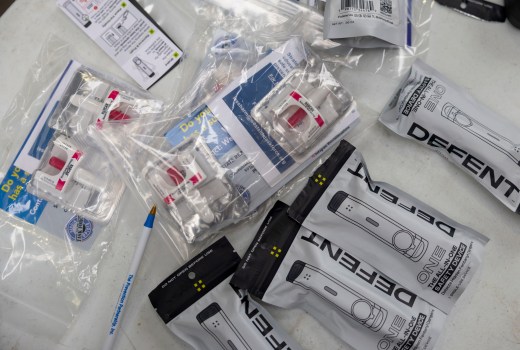
At the same time, lives are being saved because public health professionals focus on survival and access to care. The Chicago Department of Public Health has expanded naloxone distribution and overdose response efforts, placing lifesaving medication into the hands of those most likely to encounter an overdose.
Education has become another critical line of defense. Illinois took a forward-looking step by making fentanyl awareness education mandatory in classrooms statewide. This policy reflects a hard reality: Fentanyl is appearing in counterfeit pills and substances young people mistakenly believe are safe. Accurate, age-appropriate information empowers students to make informed decisions and helps prevent tragedy.
Policymakers also play an important role in shaping the environment in which prevention succeeds. At the federal level, the HALT Fentanyl Act strengthened the ability of law enforcement to respond to a rapidly evolving drug threat by ensuring fentanyl-related substances are treated with urgency. At the state level, legislation supporting education and prevention has reinforced local efforts. Policy does not replace enforcement or public health; it enables both to operate more effectively.
These efforts are being aligned through the DEA’s Fentanyl Free America campaign, a national prevention initiative designed to bring enforcement, education, public health and community engagement together. The campaign reflects what experience has shown repeatedly: Progress is strongest when institutions and communities move in the same direction rather than in silos.
And then there are the angel parents.
No dataset can capture the courage of mothers and fathers who have lost children to fentanyl poisoning and refused to let their grief be the final chapter. We’ve seen firsthand how parents throughout Chicago have transformed loss into purpose — educating other families, advocating for accountability and pushing for change so no parent, family member or friend has to endure the same pain.
It took all these efforts to reach this moment, and it will take continued collaboration to sustain it. Fentanyl remains the deadliest drug threat this country has ever faced, and progress can reverse if attention fades.
The recent decline in overdose deaths is encouraging, but it is not a finish line. It is a reminder that when enforcement, public health, education, policy and community advocacy operate together, lives are saved. The task ahead is not deciding who gets credit but ensuring that no family ever has to grieve losing someone they love to a drug poisoning. That responsibility belongs to all of us.
Todd C. Smith is the special agent in charge of the U.S. Drug Enforcement Administration Chicago field division, which covers Illinois, Indiana and Wisconsin.
Submit a letter, of no more than 400 words, to the editor here or email letters@chicagotribune.com.