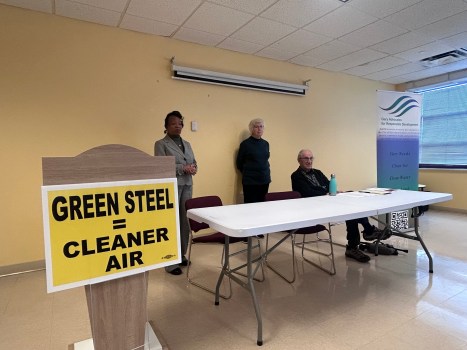

Gary Advocates for Responsible Development unveiled its new report on the future of steelmaking in Northwest Indiana, continuing to say that the region needs a greener process to ensure the industry’s long-term survival.
“This region was built on the steel mills,” said Jack Weinberg, a member of GARD and report author. “The people who live here are largely descendants of steelworkers. People have put up with the pollution because of the good jobs the steel mills provide. Now, we’re at a point in history where the steel industry in the United States is going to have to become cleaner and greener.”
The nearly 40-page report claims that the future of the region’s steelmaking is in jeopardy and says modernization would benefit the steel facilities and public health regionwide. Weinberg has wanted to complete the report since 2024, he said.
The report found that Northwest Indiana’s iron and steel mills are among the top emitters of fine particulate matter nationwide, according to its findings. Exposure to the pollutants can cause respiratory illness, cardiovascular disease, cancer risk and premature death, according to GARD’s report.
The American Lung Association, in April 2025, announced that Hoosiers are breathing some of the nation’s most polluted air, according to Post-Tribune archives. The organization gave Lake County failing grades in three categories: ozone pollution, 24-hour particle pollution and annual particle pollution. Porter County only received a passing grade for annual particle pollution.
The American Lung Association found that, in 2020, Indiana had a lung cancer rate of 72.5 per 100,000 people, with Lake County as one of the state’s counties with the highest cancer mortality rates. A 2016 report from the JAMA Network also found Gary as one of the five U.S. cities with the lowest life expectancy at one point.
Dr. Janet Seabrook, Gary’s health commissioner, attended GARD’s news conference and said the group is “near and dear” to her heart.
“The residents of Gary and the residents of Lake County should have clean, fresh air to breathe,” Seabook said. “The environment should be safe for them to work and play and raise their families.”
According to the report, GARD believes that direct reduction furnaces will one day replace blast furnaces. Weinberg believes that direct reduction is more efficient than blast furnaces, he said, and he thinks it can be used to create iron for steelmaking in Northwest Indiana.
According to the Association for Iron and Steel Technology, direct reduction creates sponge iron, which “is produced in a reactor by direct reduction of iron ore in solid form, utilizing natural gas as the reducing agent to produce pellets or briquettes.” Direct reduction cannot create steel.
Direct reduced iron, or sponge iron, is consumed by electric arc furnaces rather than blast furnaces, and instead uses pig iron, which is created at Gary Works. According to U.S. Steel’s website, the company has electric arc furnaces at a facility in Alabama and another in Arkansas.
U.S. Steel responded to GARD’s study in a Wednesday statement. Like GARD, U.S. Steel is committed to excellent environmental performance, the statement said, calling it the company’s primary focus, along with safety.
“We are investing at historic levels to secure the future of the facility and its jobs for generations to come by producing safer and more environmentally friendly steel,” the statement said. “And while the GARD study never directly says it, but what it’s really calling for is this: U.S. Steel should tear down the existing blast furnaces and steelmaking facilities at Gary Works and rebuild the entire site around a completely different technology — using (direct reduced iron) to make iron and (electric arc furnaces) to make steel.”
In the statement, the U.S. Steel spokesperson also said the study leaves out “the enormous cost of doing that,” saying GARD’s capital estimate is too low because direct reduction plants cannot make steel, and the company would have to build a new electric arc furnace-based steel shop “from the ground up.”
“On top of that, our mining operations would need major upgrades to produce the specific type and volume of iron ore pellets required for DRI and EAF steelmaking,” the statement said. “Those costs are not accounted for either. The study also overlooks a major issue: the availability and price of hydrogen, which will be needed for long-term efficient and environmental improvements. Right now, hydrogen at the scale required simply isn’t accessible or affordable.
“Once again, GARD has produced a ‘study’ that showcases its ignorance of the steel industry and steel production. Meanwhile, we are already investing billions of dollars at Gary Works and across our operations to modernize our facilities, improve the quality of the steel we produce, support thousands of good-paying jobs, and ensure we remain efficient, environmentally compliant and financially strong for the long term.”
The report also found that Northwest Indiana’s mills are the leading producers of high-performance flat-rolled steel, Weinberg said, which is steel in flat, rectangular sheets or strips and is used in various markets, including manufacturing, construction and agriculture.
Weinberg believes the market for high-quality flat-rolled steel is becoming more competitive as foreign companies are coming to the U.S. According to the report, Hyundai Steel has plans to build an integrated iron and steel mill in Louisiana, and South Korea’s POSCO is exploring a partnership with Cleveland-Cliffs.
As they move to the U.S., those companies might see an opportunity to become “major investors in the modernization of U.S. integrated iron and steel mills,” according to GARD. The organization calls on Nippon and U.S. Steel to do the same.
In September 2025, U.S. Steel announced that its board approved the next phase of the company’s capital investment plan, according to Post-Tribune archives. The plan includes a $200 million investment into Gary Works’ hot strip mill, part of Japanese-based Nippon Steel’s $11 billion investment.
A previous U.S. Securities and Exchange Commission filing said Nippon Steel plans to invest $3.1 billion in the Gary Works facility between 2025 and 2028. In 2026, the company plans to invest $900 million, followed by $800 million in 2027 and $1.1 billion in 2028.
In late 2024, a Nippon executive said Gary Works would receive about $1 billion, some of which would be dedicated to relining the facility’s blast furnace. GARD and other environmental groups have opposed the blast furnace relining since its announcement.
In October, U.S. Steel responded to a previous GARD study that focused on the health costs and community impact of steel mill pollutants. The group also supported direct reduction furnaces when presenting the previous study.
“U.S. Steel has robust systems and equipment in place (to) control the emissions involved in the steelmaking process and adhere to all environmental regulations,” the previous statement said. “At Gary Works, our processes and environmental control equipment and systems are monitored extensively by our environmental teams. Third parties are used for sampling water discharges and for opacity observations to ensure compliance with air and water regulations.
“Gary Works has achieved an environmental compliance rate exceeding 99%. Gary Works also produces Pig Iron, an important feedstock for U.S. Steel’s electric arc furnaces. Our more than 3,400 Gary Works employees put safety and environmental compliance first. We are proud of their work and the Northwest Indiana community we call home.”
Valerie Denny, another GARD member, said it’s urgent for region residents and leaders to start advocating for cleaner and greener iron and steelmaking processes.
“Our concern is many people in the region don’t understand that steel mills are in jeopardy,” Denny said. “We have to get out there and get people to really learn about this problem.”
mwilkins@chicagotribune.com