
There’s a popular quotation from writer Wayne Gerard Trotman: “As long as there is chocolate, there will be happiness.”
But how much does the average person really know about chocolate? The Morton Arboretum’s annual Chocolate Weekend expo, taking place Jan. 31 and Feb. 1, is an opportunity to indulge both the mind and the taste buds. Though the Lisle arboretum has no cacao trees — the Midwest isn’t a hospitable growing climate — there will be a number of workshops and plenty of chocolate on sale.
Some workshops are included with the price of admission to the arboretum. One such workshop, at 11 a.m. Jan. 31, will focus on sustainability issues and will be led by Matthew Krystal, a professor of anthropology at North Central College in Naperville. He is also North Central’s associate chair for something called the Coffee Lab, which is affiliated with the international organization Enactus, a nonprofit “dedicated to employing entrepreneurial action to promote social good,” Krystal said.
Despite the title, the coffee lab has a broader focus that includes textile making, ceramics and, yes, chocolate. “We started visiting Guatemala in 2005. Initially, the focus was on coffee. As we worked and built relationships, we encountered additional possible partnerships,” he said, hence the addition of a focus on chocolate production.
Too often, said Krystal, the conversation around sustainability focuses on ecology and the physical environment without taking into account what is financially sustainable over time. But money isn’t the only consideration. “If (an idea for sustainability) disrupts social relationships that are critical to a community’s well-being — for example, care for children and elders — it is not socially sustainable,” he said. “If it conflicts with a people’s shared values, beliefs, worldview, aesthetics and so forth, it is not culturally sustainable.”
Though Kyrstal’s focus is on chocolate from Guatemala, most chocolate comes from the west coast of Africa and there is currently a global chocolate crisis.
“Several factors seem to be driving up cacao prices, including climate change,” he said. “Folks from Chocolate Doña Pancha, our partner in Guatemala, inform us that they are paying significantly more for dried cacao beans. Apparently, Guatemalan cacao, normally consumed just in Guatemala, is now making its way into the global system. This seems to be a result of declining global supply and resulting higher export prices.”
And in the U.S., tariffs have created additional costs and uncertainty.

A workshop at 1 p.m. Feb. 1 will focus on rare cocoa beans. It’ll be led by Kim Hack, founder of Cocoa + Co. Tastings, which she said “focuses on educating people about all things chocolate through tastings, events and classes.” Hack also founded the Cocoa + Co. Cafe in Old Town 10 years ago, but has since sold it; they are now separate operations.
For the non-connoisseur, chocolate tends to be thought of as a monolithic flavor, Hack said.
“But chocolate is made from a fruit, and just like wine, the flavor of chocolate varies based on factors like the varietal of cacao, where it’s grown and the harvest and post-harvest practices,” she said. “The French have a term for this uniqueness: ‘terroir,’ often translated as ‘the taste of place.’”
Hack’s workshop costs an additional $52 to attend because it includes tastings. “If you look at a flavor wheel for chocolate, you’ll see a ton of descriptors grouped loosely in categories like ‘fruity,’ ‘earthy,’ ‘spicy,’” Hack said. “Texture can vary too. Some bars are dry on the tongue, others are unctuous. It’s this unending variety of taste and texture that keeps it so interesting for me.”
Hack said most chocolate that we encounter is some form of the Forastero variety.
“It’s a favorite for mass-market producers because it’s a disease-resistant and higher-volume cacao,” she said. “And since most of the chocolate candy bars we’re all familiar with are made primarily from sugar and actually use very little cacao, the fact that many Forasteros are bitter matters little. That said, not all genetic variations of Forastero are bitter, or common. One of the bars we’ll be tasting is made from a very rare wild Brazilian cacao that is its own unique genetic cluster, and one of the most interesting bars I’ve encountered.”
As for the chocolate crisis, “Climate change is having a major impact, not just on the chocolate industry, but with many of our favorite foodstuffs,” Hack said. “And, when I say major impact, I don’t just mean skyrocketing prices. I mean likely near-term extinction if left unaddressed.
“Cacao is naturally an understory tree (which grows under the larger forest canopy of trees) that likes to keep its roots damp and protect its leaves from the sun,” she said. “But most of the industry’s fruit grown in West Africa uses mono-crop models that already strip the trees of their protection, stressing the trees and requiring the use of chemicals to compensate. Exacerbating the problem, unpredictable rainfall cycling between drought and floods further devastates the region. As climate changes the degree of heat these vulnerable trees are subjected to and causes wild swings in precipitation, yields will remain sharply reduced.”
The process of turning cacao into chocolate is difficult, she said, with tons of choices along the way that can each negatively impact flavor if you don’t get it right. “When you add all the challenges up, a craft chocolate bar is nothing short of amazing,” she said.
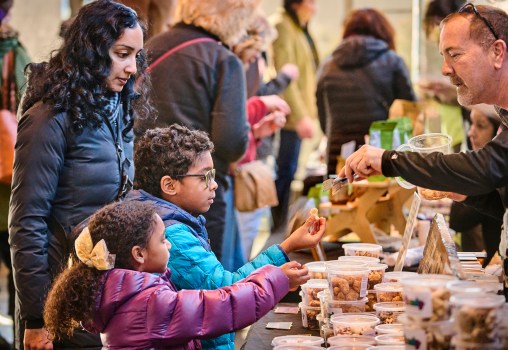
Chocolate Weekend, now in its 15th year, features local artisans, said the arboretum’s special events planner Kate Fitzgerald, and the lead-up to Valentine’s Day is the obvious peg.
Vendors this year will have some unexpected offerings, including chocolate-infused cheese, a cherry-chocolate mead, a hot sauce with chocolate in it and nonedible chocolate soap.
Krystal said his fascination with chocolate began in childhood and deepened as he was doing field work for his dissertation in Guatemala, where he “encountered hot chocolate as K’iche’ Maya people prepare it.”
At the time, he lived and conducted research in a large K’iche’ town called San Miguel Totonicapán, locally known as Toto. “Early in my fieldwork, as I was adjusting to life in Toto, I found that a cup of hot chocolate with breakfast boosted my energy and focus,” he said. “I later learned that the hot chocolate that I was consuming, because of its relatively high concentration of roasted cacao, had long been noted for positive mental effects.
“As I got to know the town better, I encountered hot chocolate served in diners, bakeries and homes,” Krystal said. “People served it in a variety of social and religious contexts.”
It’s a way of thinking about chocolate not only as an indulgence or treat, but as a cultural agent.
The Chocolate Weekend expo will be open from 9 a.m. to 4 p.m. Jan. 31 and Feb. 1 at the Morton Arboretum, 4100 Illinois Route 53, Lisle. More information at mortonarb.org.