

The first question Mina Rajaei asks her family when she is able to reach them back home in Iran is: “How many of us are killed?”
It’s the grim reality for Rajaei, a computer science student at Northern Illinois University, and others in Chicago’s Iranian community who are facing uncertainty about their loved ones after deadly, anti-government protests erupted in late December.
Since then, it’s been nearly impossible to contact those in Iran after a communications blackout, Iranians in Chicago say. People in the U.S. are unable to call into Iran, though people there may call out, they said. Even so, the calls are usually brief and vague out of fear the government is monitoring them.
“We actually don’t know what’s happening to our family,” said Rajaei, 30, of Iran, who attended a rally last Saturday in Chicago against the Iranian government’s crackdown. “Whether my brother is alive or not.”
Since then she has spoken to her mother for a brief two minutes and knows her brother is unharmed.
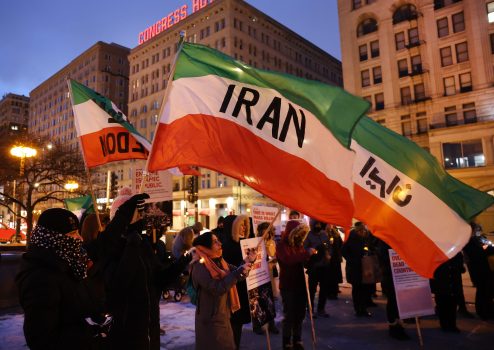
Rajaei is one of about 9,000 Iranians in Chicago stuck in a communications blackout and feeling helpless as the crackdown in Iran continues. She joined about 60 people gathered in downtown’s Congress Plaza on Saturday night at the rally organized by Chicago4Iran.
Despite the freezing cold and fears of immigration enforcement, they marched toward Federal Plaza with roses and electric candles as organizers passed out hand warmers and hugs. Many are looking West for help despite a history of failed interventions in the Middle East, and new travel restrictions from the U.S. on Iran.
In late December, thousands of protesters in Iran took to the streets against the government of Supreme leader Ayatollah Ali Khamenei and worsening economic conditions. More than 4,000 were killed, the U.S.-based Human Rights Activists News Agency said, and communications services including internet, phone and text services were shut down by authorities on Jan. 8, although some communications have been restored.
On social media, President Donald Trump expressed his support for protesters in Iran telling them that help would be “on its way.”
“Iranian Patriots, KEEP PROTESTING – TAKE OVER YOUR INSTITUTIONS!!!” he posted on Truth Social on Jan. 13. “They will pay a big price. I have cancelled all meetings with Iranian Officials until the senseless killing of protesters STOPS. HELP IS ON ITS WAY.”
Yet Iranians and nationals from 18 other countries remain largely banned from travel to the U.S. since an updated June policy took effect. On Jan. 14 the State Department announced it would suspend the processing of immigrant visas for citizens of 75 countries including Iran, furthering travel restrictions.
Rajaei came to Chicago four years ago fleeing Iranian government censorship that affected her everyday life. As an English student in Iran she could not express her views freely because they could be considered anti-Islam, she said.
In 2022, she got her master’s degree in English studies at NIU and is pursuing a second master’s in computer science. She dreams of seeing her brother and parents at her upcoming graduation this year. But the travel ban has made it impossible: She cannot travel to Iran and her parents cannot travel to the U.S, she said.
“If I leave the country for my visa, I cannot come back,” Rajaei said.

Before coming to the United States, she attended protests in Iran to advocate for greater freedom. Now she rallies from the relative safety of the U.S., but she does not know how long that will last after graduating.
“I don’t even know whether I am welcome to stay here anymore,” she said.
Immigrant advocacy groups have denounced the June travel ban as discriminatory against Muslim-majority and African countries. In June, the National Immigrant Justice Center called the ban a “cruel and racist proclamation.”
NIJC Policy Director Azadeh Erfani said the Trump administration’s travel ban on Iran and other immigration policies have made it harder for Iranians to obtain protection in the U.S. or reunite with family.
“The reality is the travel ban is layered on top of other bans,” Erfani said, referencing earlier restrictions on border crossings.
She is also worried about Iranians possibly getting deported. “The U.S. is so focused on getting them out of here,” she said.
Last year, the Trump administration deported a plane full of Iranian citizens. As of September, around 300 Iranians were in detention and about 2,500 faced the threat of deportation from the U.S., The New York Times reported.
At last weekend’s rally was Farzad Ahmadpour, who left Iran 20 years ago but still remembers the bazaar in his hometown of Rasht where he used to buy vegetables. It’s now destroyed, he said. The 57-year-old said he constantly checks his phone for news of his family in Iran including his father who has cancer. He barely sleeps, he said. As of last Saturday, it had been more than a week since he was able to check in on his father.
“I cannot pick up the phone and ask them: Are you doing OK? Are you alive?” he said.

Ahmadpour called for an end to the repressive regime in Iran even if it meant a U.S. intervention.
“We are desperate,” he said.
Chicago4Iran co-founder Sepideh Sanie, 35, said she wakes up in the morning and “cannot breathe.” She has struggled to speak with her family and other loved ones in Iran.
In 1979 the country witnessed an Islamic revolution that overthrew the Shah of Iran and replaced the monarchy with a theocratic government. Iran’s Supreme Leader Khamenei, 86, has been in power for the last 37 years leading a largely repressive regime.
People have been calling for change. In 2022, the “Woman, Life, Freedom” movement gained international attention when 22-year-old Mahsa Amini died after being arrested by Iran’s so-called morality police for improperly wearing her hijab, sparking large-scale protests. Now the protests seem to be geared toward a systemic change of the current regime.
“It’s complex and really spread out this time,” said Kaveh Ehsani, associate professor of international studies at DePaul University. “It seems like protesters are objecting to the very existence of the Islamic Republic.”
Many Iranians in Chicago also say they are fed up with the government there.
“People want regime change,” said Chicago4Iran co-founder Tirdad Kiamanesh, noting decades of economic mismanagement, human rights violations and political repression. “They are incompetent to run the country.”

Yet should the regime come to an end, Ehsani wonders what it will be replaced by and if the new regime may be worse. He wonders if a U.S. intervention could bring more strife to the country, like in the case of Iraq. He considers the possibility of a civil war.
“You can’t just say let’s kick out these people and everything will be fine and dandy,” he said, noting the U.S. intervention in Iraq that helped prop up militant groups like Islamic State. “It won’t be. If anything it would be a lot more disastrous.”
Ahmed Rehab, executive director of the Chicago office of the Council on American-Islamic Relations, said he had little trust in the U.S. government’s hand in Iranian affairs and called the travel ban on Iran and other countries a “debilitating” punishment for ordinary people.
Dena Delpazir, a civil engineer from Iran who was at the rally last weekend, said that her biggest fear is when the internet comes back on.
“We’re gonna hear all the names and we’re gonna see all the faces,” Delpazir said of the people who were killed. “I bet a lot of my friends, they won’t be here anymore.”
At the height of the protests in Iran, Sanie’s friend in Iran was able to send her a voice message. From her home in Chicago, Sanie could hear the gunshots through the phone and anxiously texted him back asking if he was safe, she said.
The message still shows as unread.
“We have not heard from him,” she said.



