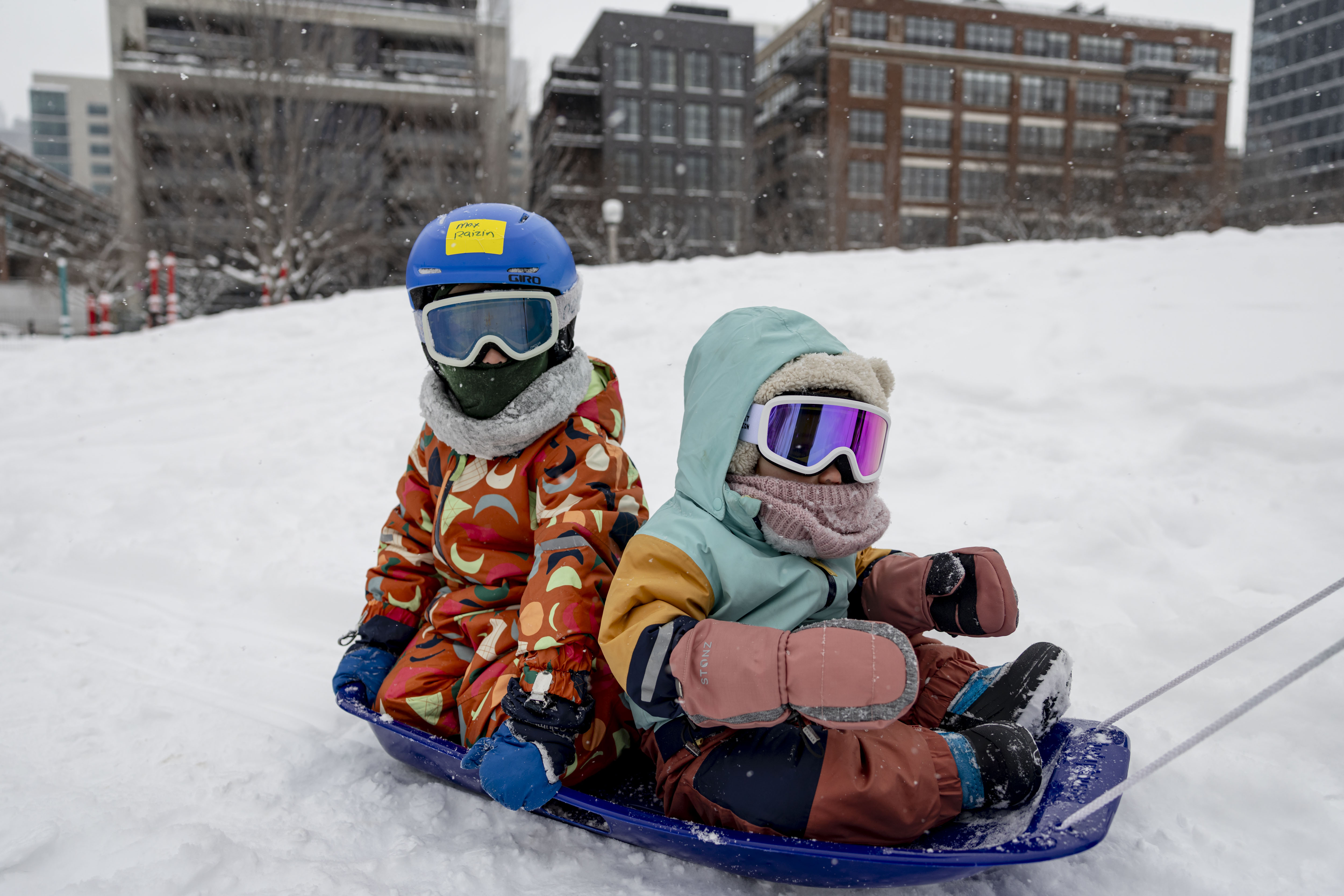


On the tail end of a polar blast followed by a massive winter storm that has hit over 200 million people across the country and covered the Chicago area with several inches of snow, officials warn that the extreme weather won’t let up, even if the snowflakes stop falling as forecast by early Sunday evening.
Between midnight and noon on Monday, Cook County will again experience “dangerously cold” wind chills as low as minus 25 degrees, and even colder away from the lake.
“We’re just stuck in this wintertime pattern where we have this Canadian air racing into the Great Lakes, and we just have another push of that Canadian air moving in,” said Brett Borchardt, senior meteorologist at the National Weather Service office in Chicago. “Thankfully, this push of cold air is going to be somewhat shorter-lived compared to what we already endured.”
People with exposed skin could experience frostbite in as little as 30 minutes, so experts urge staying indoors, and say those who must go outside should dress in several layers, including a hat, face mask and gloves.
After Monday, when daytime highs will only reach 12 degrees, the rest of the week will be less cold and windy, though temperatures will remain below freezing. Tuesday and Wednesday’s highs will be between 10 and 20 degrees, with wind chills of minus 5 to minus 15. Meteorologists are also forecasting a 20% to 30% chance of snow Wednesday afternoon.
“It does look like we’re going to get another shot of Canadian or even Arctic air Wednesday night into Thursday,” Borchardt said, “and that’s going to be another time to watch for those wind chills dropping down toward minus 20.”
As of 6 p.m. Sunday, O’Hare International Airport had received 28.5 inches of snow this season, compared with a normal of 18.5 inches by this date, according to the weather service. The weekend’s storm system dropped 4.4 inches. O’Hare is the weather service’s official observation site for Chicago weather records.
“I will say, the actual city of Chicago itself — because there was some lake-effect snow (Sunday) — close to the lakeshore, along the I-94 corridor through the city, (local reports) were actually closer to 8 to 10 inches,” Borchardt said.
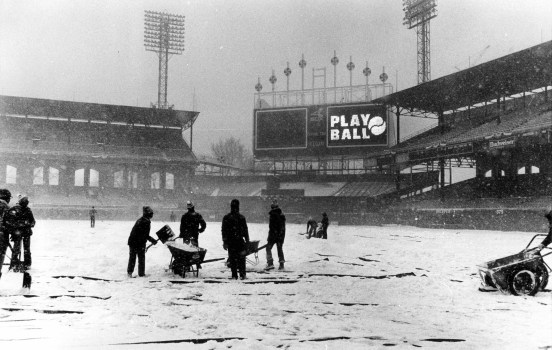
By the afternoon, snow accumulation totals ranged between 2 and 10 inches of snow across the city and surrounding suburbs, according to a map of local reports from the National Weather Service. For context, O’Hare had accumulated 73.1 inches by this date in the winter of 1978-79, the snowiest on record for the area, with a final tally of 83.7 inches.
The city’s Department of Streets and Sanitation deployed its fleet of 250 snow plows and salt spreaders over the weekend, and announced plans to shift from clearing main roads Sunday evening to residential streets overnight and through the day Monday.
Lake-effect snow like this weekend’s occurs when cold air moves across the open, warm water of the Great Lakes, picking up heat and moisture. Made less dense, the air then rises, cools and condenses into clouds, which produce heavy snow in narrow bands downwind.
After years of little snow across the Chicago area, record-breaking snowfall and below-freezing temperatures earlier this winter — as well as the weekend’s massive storm — might seem to contradict scientific reports of winters getting warmer.
But trends in recent decades point to an overall warming of average temperatures across all seasons from human activities such as fossil-fuel burning that release heat-trapping gases into the atmosphere. And that overall warming doesn’t rule out some occasional outliers, including extreme cold and winter storms.
These usually occur because of a weakened polar vortex, which is a constant cold, low-pressure system of air circulating counterclockwise around both of Earth’s poles like a wall that contains cold air.
When unstable, the polar vortex can cause the jet stream — a band of strong wind that generally travels from west to east and acts as a boundary between cold, polar air and warmer air farther south — to buckle, sending bitterly cold air from the Arctic southward into North America.
There is hope for milder winter weather ahead, however. Borchardt said early February could start relatively warmer.
“And when I say that, I’m not saying, like, 60s,” he said, “but certainly not as cold as we’ve been.”
Chicago Tribune’s Christy Freitag contributed.