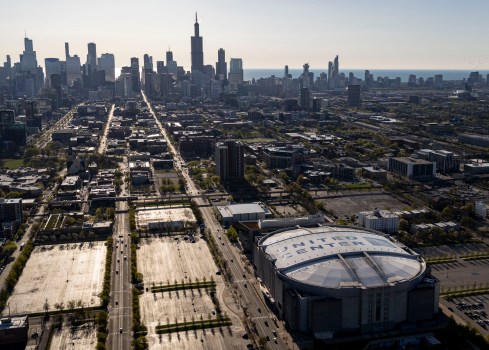
A century ago, bootleggers were roaring down Chicago’s newly paved streets and the shops that once served horse-and-buggies were adding gas pumps and offering mechanical repairs. In 1926, with automobiles on the rise, a patchwork of roadways between Chicago and Los Angeles got a new designation.
Route 66 was born.
Today, America is preparing to celebrate the 100th anniversary of a historic road that united a huge swath of the country and shaped car culture into the 21st century. For all that has changed since then, however, one depressing fact remains.
Driving Route 66 was dangerous back in its heyday, earning it nicknames such as “Dead Man’s Alley” and the “Bloody Road.” Traveling by car along the highways that succeeded Route 66 still presents a deadly hazard — much more dangerous than need be.
Nationwide, fatalities among motorists have remained stubbornly high. Interstate 55, which has largely replaced Route 66 in the Chicago area, is notorious for being one of the most dangerous routes in Illinois.
The good news is that 100 years after Route 66 got its name, America has the technology and experience to make driving much less deadly. Yet progress is coming slowly, mainly for one reason: Us.
Human error is the No. 1 reason for carnage on the highways. And people-proofing cars has proven harder than anyone might have imagined when Chicagoans were taking out their Model T’s for Sunday drives on the Mother Road.
As the Chicago Auto Show prepares to open Feb. 7, this is a good time to ask why roughly 40,000 people still die each year in wrecks that are seemingly avoidable, especially given so many new safety features.
Slipping behind the wheel of the new models with all their advanced technology at the Auto Show can make an ordinary driver feel like a Top Gun pilot. High safety scores have become a key selling point for new vehicles. Three-point seat belts, antilock brakes and air bags became standard equipment long ago, and fully autonomous driving could very well be the future.
So why aren’t fatal crashes a thing of the past, like Route 66 itself?
Car and Driver magazine recently evaluated the latest technology that keeps drivers in their lanes, detects blind spots and automatically hits the brakes in emergencies. Today’s state-of-the-art sensors, cameras and radar equipment can indeed contribute measurably to safety.
Yet the magazine’s test driver found that active safety systems, as they’re known, are “somewhat of a mixed bag,” highlighting a difference between the systems “working as designed and actually doing any good.”
The average age of America’s 300-million-strong passenger vehicle fleet on the road today is almost 13 years, a record. It takes a long time for new technology to penetrate.
Crash and injury rates are starting to come down again after spiking between 2011 and 2020, an increase frequently blamed on stepped-up cellphone use and related distractions.
Fatality rates, a separate measure, are coming down more slowly. Could that be due to higher speeds? Larger and more powerful vehicles? A surge in impaired drivers from legal cannabis? Those are all possibilities.
It’s also worth asking to what extent the roads themselves contribute to fatalities.
Studies funded by the insurance industry and personal-injury law firms regularly cite I-55 as among the state’s most dangerous arteries, with Safe Roads USA ranking it in the top four. From 2019 to 2023, I-55 saw 108 fatal crashes, according to the National Highway Traffic Safety Administration, and it’s no wonder.
In the Chicago area, the traffic is often dense, mixing trucks and cars traveling at different speeds, with merging traffic and lanes that become turn-only. Around Springfield, too, I-55 is congested and hazardous, while in rural areas its monotonous straightaways invite motorists to floor it. Of those fatal I-55 crashes, more than 40% occurred in central Illinois.
Last year, the Illinois Department of Transportation completed one of its busiest construction seasons ever, making hundreds of safety improvements, including upgrades to I-55. Road design and engineering have improved dramatically since the days of Route 66, and through the Rebuild Illinois capital campaign, the state is making big investments to modernize driving infrastructure.
On the downside, speed limits nationwide are higher than ever. Some highways have posted limits of 80 mph and up. Stricter federal guidelines would help.
But let’s face it: The high fatality rates mostly come down to driver error, or, to put it more broadly, driver irresponsibility.
We need to slow down, especially on highways, and most especially during bad weather. Stay off the phone. Wear those seat belts. Never drive under the influence of alcohol or weed. Be mindful of the vehicles around you. Use directional signals. And considering how many old beaters are on the road, spring for new tires and brakes.

In its recently published guidebook celebrating the 100th anniversary of Route 66, Illinois’ Office of Tourism recommends a little time traveling. Motorists can come close to the original route by following a 300-mile course from Chicago through Willowbrook, Pontiac and Bloomington-Normal, on past Springfield and into St. Louis.
In some places, the original is inaccessible, paved under I-55, for instance, or on private property today. Even on the marked historic route, the conditions vary, from a four-lane divided highway south of Joliet that feels like an interstate to two-lane straightaways through quiet small towns.
The state’s No. 1 piece of advice for getting your kicks: “Take it slow.” At 300 miles start to finish, “You could cover it in a day,” the guidebook allows. But please don’t — for all the reasons enumerated above.
Submit a letter, of no more than 400 words, to the editor here or email letters@chicagotribune.com.