
Stephen Foltin, a 14-year-old high school freshman from Arlington Heights, is an avid Blackhawks fan. He’s passionate about his role as a broadcast announcer for various Prospect High School sports.
He’s also raising awareness and funding for pediatric cancer research. Stephen is one of five children — ranging in age from toddlers to teenagers — to be named this year’s ambassadors for St. Baldrick’s Foundation, a nonprofit that funds childhood cancer research grants.
“Representing a wide range of ages, diagnoses, and stages of treatment, they share their stories to highlight the urgency of funding the most promising childhood cancer research,” Jane Hoppen, St. Baldrick’s director of family relations, said in a statement. “Each Ambassador is far more than a diagnosis — they are kids with distinct personalities, strengths, and dreams, reminding us what’s at stake.”
As an ambassador, Stephen will travel across the country to share his experience with cancer.
“I get to represent 400,000 kids worldwide diagnosed with cancer every year,” Stephen said. “I also get to be the voice for them.”
Stephen said he was diagnosed with Ewing sarcoma — a type of cancer that most often affects children and young adults in their legs or pelvis — in late 2023. He then began treatment, which consisted of inpatient and outpatient chemotherapy, red blood cell and platelet transfusions, and a leg amputation, which resulted in a second revision surgery.
Stephen and his mother, Jennifer Black-Foltin, said doctors gave them options other than amputation, like a limb salvage surgery. But that surgery would lead to a less active lifestyle because the bone would likely be weakened, Stephen said, so he brought up the idea of amputation.

Stephen said he leaned on his family for support during treatment. If he wasn’t feeling well, a family member would pick him up from school and stay home with him.
“Having their support made me feel that I needed to beat this so I could thank them later when this was over,” Stephen said.
Black-Foltin said Stephen remained positive through treatment. Friends and family joined Stephen to celebrate a going-away party for his leg, she said, complete with a cake that read, “We had a good run,” and party hats decorated with stickers of legs with wings.
“Stephen truly comforted us and was more of a rock and support to the rest of us during (his treatment), especially leading up to his amputation,” Black-Foltin said.
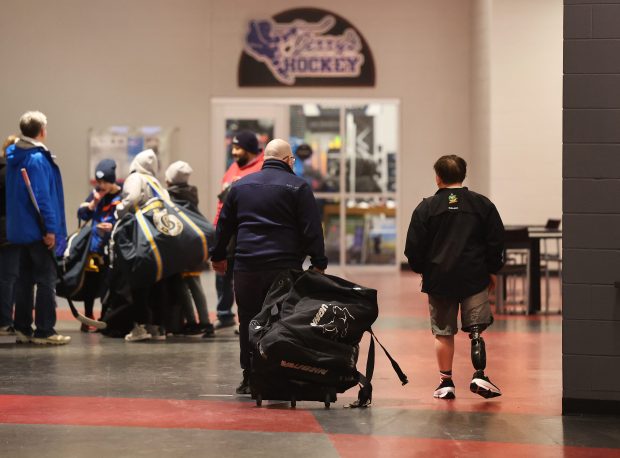
His mom added that Stephen researched prosthetics and knew what type of leg he wanted even before his fitting appointment. He also researched sled hockey teams, Black-Foltin said. Sled hockey follows most rules of traditional ice hockey but has special equipment, like sleds resting on blades and hockey sticks with metal picks on the end, to allow players with disabilities to play on the ice. Stephen said he now plays for the Hornets.
Today, Stephen is in remission and said he uses his prosthetic without crutches. He dreams of playing sled hockey in the Paralympics and then coaching hockey before becoming a broadcast announcer.

For now, he said he’s going to Washington, D.C., to advocate for pediatric cancer research funding and to Louisville, Kentucky, to promote a Sports Clips campaign against cancer in the coming months. Stephen added that he’ll also speak closer to home in March at a St. Baldrick’s event in Franklin Park.
Sharing his experience has helped some of his friends, who are also amputees, become more comfortable telling their stories, Stephen said. He added that he views his cancer journey as a “rough patch.”
“I don’t give up,” Stephen said. “If I was a professional fighter or boxer, I wouldn’t tap out. I’d be knocked out before I’d ever tap out.”