
The national tour of David Adjmi and Will Butler’s “Stereophonic” cut through the cold Wednesday night to open in the American city that should best understand what it is all about.
This is an extraordinary piece of theater. It’s a deep cut into the agony and ecstasy of collaboration, and a profound meditation on the personal price you inevitably pay, and what you benefit, when you work with a combustible, volatile, insanely driven visionary.
Many of us have spent professional time with such people. Some of us look back on it fondly, or come to look back on it fondly once the price of pervasive mediocrity becomes clearer as you age. Some vow, never again. I’ve seen Daniel Aukin’s superbly directed production three times now; that should tell you on which side of the fence I reside. Which is not to say I did not feel the thorns in the green grass.
This much-admired show’s album cover is the music industry: Over three hours, you watch a British band that recalls Fleetwood Mac holed up for months in U.S. recording studios to create something that sounds a lot like “Rumours,” as released in 1977. Especially in scenes featuring a band’s de facto leader and a willful drummer, there are also thematic echoes of Peter Jackson’s documentary about The Beatles, another example of the above dichotomy.
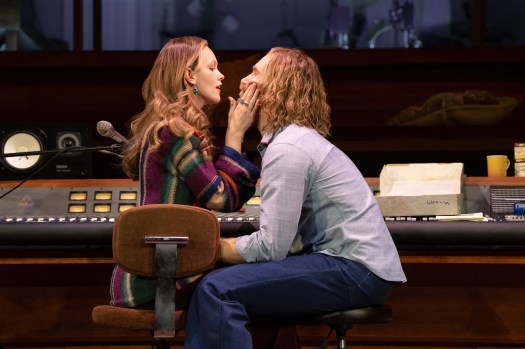
The fictional group’s leader, Peter (Denver Milord), is obsessive, driving his bandmates, especially the lead singer-songwriter Diana (Claire DeJean), to greater heights. Everyone is fueled by drugs and ego, loneliness, insecurity and regret. Everyone already is famous, although Adjmi is not much interested here in the trappings of fame, restricting it to a few moments of conversation between tracks. He’s interested in the creative process itself — most specifically, in the line between the rocket fuel that ignites from the talents of others, if you have the right people in the room, and the consequences, for good or ill, of falling in love with your own vision.
The show, if you are not familiar, has a couple of other distinctive features. Butler, formerly of the very real band Arcade Fire, has written an original score that melds in truly innovative fashion into the dramatic action. That score, which is both cool and, given all the musical Easter eggs here, also a notable technical achievement, is played and sung live by the actors, who are all credible as belonging to a rock band that already has a No. 1 album. Some of Butler’s songs are mere snippets, some are full-length numbers, often with vocals in the three-part harmony familiar from the time. Although some here seem happier working alone (though not really).
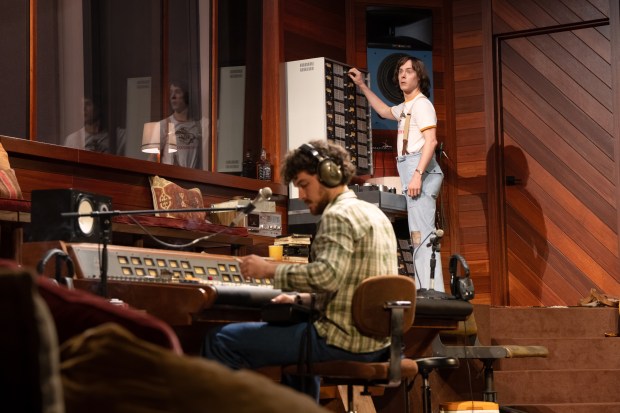
The set, designed by David Zinn and lit by Jiyoun Chang, is a kind of hyper-realism. That’s an era-specific mixing board you can see in the mock-up of the studio and control room, and Chang’s subtle lighting design is animated by exactly the kind of lighting that would have been present. Unless some shortcuts were taken for the tour that got by me, everything you hear is authentically analogue within our digital world.
Adjmi also wrote in two Chekhovian observers for all this. One is Grover (Jack Barrett) the ambitious young engineer who begins as the play’s normative character but who matures (if that’s the word) as he jostles with the members of the band (Cornelius McMoyler is Simon, Christopher Mowod is Reg and Emilie Kouatchou is Holly) as the show progresses. Grover’s assistant, Charlie (Steven Lee Johnson), is like a young take on the servant Firs in “The Cherry Orchard,” widely ignored but a wide-eyed witness to painful change nonetheless.
‘Stereophonic’ arrives in Chicago, telling the story of a band through its songs
One lives vicariously with the band through the agony of the days when creativity was limited by how much tape was available or how much space there was on a single album without making the perilous leap to double. (You listen to them work on original Butler songs that eventually get “cut” and you might find yourself wanting to shout “not that one!” at the stage.)
But you also come to a new understanding of how that long-gone limitation actually helped bands throw away their lesser songs and work to make every available minute as close to perfection as possible. This put me in mind of a recent critique I read of The Atlantic that noted how the historical distinctiveness of that magazine came in part from what it did not publish. I left thinking a lot about that — how unlimited time and space can be the enemy of excellence and how scarcity of one thing or another can prod you to be better.



I admit to some trepidation walking into this tour, given the quality of the original Broadway cast, who were part of an exhaustive process. I have my favorites but I don’t want to compare actors, which is hardly fair to an ensemble here that is sufficiently similar to their predecessors to convey the same ideas, but also distinctive. DeJean is especially vulnerable in this cast. And although it took me a while to warm up to Barrett’s Grover (he had one heck of an act to follow), he linked his engineer in the end far more closely to the ambitious alpha milieu of the band, and the show is all the more resonant for that. Goofiness was downplayed; visceral ambition was at the core of Barrett’s work.
The play was rendered somewhat shorter for the tour, which is a shame in my view, although you may well find it long enough.
I prefer the original cut. Also, don’t be late for the curtain since the running time clearly is an internal issue, for reasons I find perplexing. The curtain went up at 7 p.m. right on the nose Wednesday, followed by an unnecessary seating hold that stranded some frozen souls in the lobby even as the dysfunctional British rock geniuses straggled into place to try and wrestle something spectacular from their forlorn souls.
Chris Jones is a Tribune critic.
cjones5@chicagotribune.com
Review: “Stereophonic” (4 stars)
When: Through Feb. 8
Where: CIBC Theatre, 18 W. Monroe St.
Running time: 2 hours, 50 minutes
Tickets: $40-$135 at 312 977-1700 and broadwayinchicago.com