
A bright orange whistle has become the symbol of resistance to federal immigration agents in Minneapolis, Chicago and other major cities.
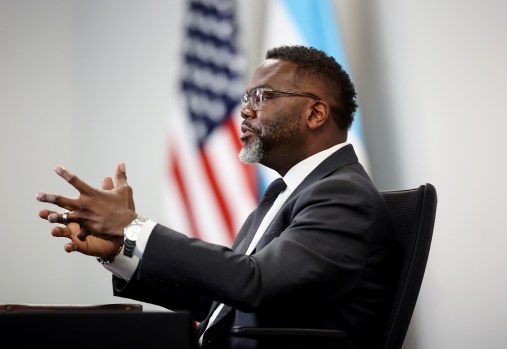
This week, Chicago Mayor Brandon Johnson sought to blow the whistle in a big way by calling for action in a speech to the National Press Club in Washington.
“As a nation, we have to really look at the model that was set during the Civil Rights Movement. We need a well-trained, organized opposition to ultimately expand the resistance that is already afoot in the country,” Johnson told the Press Club on Wednesday. “Saving our democracy is the most patriotic thing we can do in this season.”
But if this was Johnson’s big moment to issue a call, unfortunately, it was a whimper. He recited a litany of past actions but set no plan for what to do next.
Maybe that’s because he sequenced his effort backward: First, the big national speech; next, planning meetings at the U.S. Conference of Mayors; then, at some undefined time — two weeks, maybe, as is the trend in D.C. these days — he’ll unveil a master plan for Chicago that could be a pattern for the country.
There may yet be time for Johnson to offer concrete details and seize the national spotlight again. But to get to where Johnson and his fellow mayors need to go, rhetorically and as leaders, they have work to do.
For starters, they need to reckon with how the power dynamic of the current immigration struggle contrasts with the civil rights era.
In the days of the Rev. Martin Luther King Jr. and others, the federal government imposed its will on the racists running cities and states, in a drive toward racial equity that delivered major progress.
President Dwight Eisenhower federalized the Arkansas National Guard to ensure safe entry of the Little Rock Nine into Central High School, and the federalized Alabama guard pushed Gov. George Wallace out of the schoolhouse door at the University of Alabama. The FBI and Department of Justice ultimately brought justice to the Klansmen who perpetrated the Mississippi Burning murders.
Today, though, the power of the federal government is at times arrayed against constitutional order, the rights of free speech and assembly, and even the power of local authorities to police their own streets. And before Border Patrol Cmdr. Gregory Bovino was demoted, federal agents were using the modern-day equivalent of water hoses and police dogs — and worse — to subdue the public. And they were egged on by cheerleading from Homeland Security Secretary Kristi Noem and the nothing-to-see-here response of Attorney General Pam Bondi’s DOJ.
White House border czar Tom Homan on Thursday promised a more restrained approach by Immigration and Customs Enforcement and other border control forces going forward, after the two killings in Minneapolis this month and the outrage that has followed. He seems aware that most Americans support reasonable enforcement of immigration laws, but not the reckless excesses of federal power we are seeing.
We should know by this spring whether Homan can restrain the forces of chaos that have seized ICE lately. And as a measure of protection, cities such as Chicago still need to prepare for a return to Bovino-style overreach, just in case.
After all, when the DOJ fails to investigate the agents who killed Alex Pretti and Renee Nicole Good, emboldened by Vice President JD Vance’s initial claim that federal shooters could be protected by “absolute immunity,” local authorities are left to investigate and prosecute on their own — with the expectation they will be hamstrung by a lack of federal cooperation and likely resistance.
Johnson is calling for coordinated national efforts led by mayors and state governments, in concert with public pressure groups and local residents, to combat the actions by ICE, the Border Patrol and other federal authorities.
During his D.C. appearance, Johnson promised detailed ideas will be coming soon. As to why this is taking so long — Operation Midway Blitz started in September, after a rhetorical windup by the Donald Trump administration — Johnson did not say.
What can Johnson and other mayors and governors do?
For starters, they can take a page from the Trump administration’s playbook and press their own powers to constitutional limits. Trump goes at least that far, and beyond, evidently under a theory that the courts will have a hard time keeping up with — much less permanently prohibiting — many ICE actions.
There is no reason Chicago can’t consider similar brinkmanship. And Chicago’s track record against court challenges to measures taken so far offer encouragement that there is room for even more ambitious defense of state authority, local police powers and other constitutional rights.
A federal judge has recognized the right of the city and state to require federal agents to wear name tags or other identifying markers, for example. The Trump administration challenged Johnson’s executive order prohibiting agents from wearing masks during enforcement actions, but the city’s public safety and governmental accountability aims are being served for now, even if the courts don’t back the city in the end.
Johnson’s executive order to block use of city property for marshaling immigration agents and equipment remains in effect. And another ordering the Chicago Police Department to protect the free speech rights of protesters will be on hand should federal agents amass again in Chicago this spring.
Johnson has plenty of other tactics available for consideration: requiring federal agents to wear body cameras while working in Chicago, for example; requiring training standards for agents; ensuring that no agents are listed in the DOJ’s National Decertification Index of nearly 60,000 former police officers who have lost the right to work in law enforcement because of misconduct.
The Brookings Institution listed more such ideas this week. No doubt Johnson and his mayoral allies in Los Angeles, Minneapolis and other cities have come up with other ideas during the Mayors Conference this week.
Johnson’s headiest idea — criminally charging Bovino or whoever else might break the law — would be a test of federal versus state power that might be worth taking.
Johnson took a political risk by announcing plans to lay out ambitious steps in the coming days. Now he needs to collect his thoughts, set a plan and blow that whistle.
David Greising is president of the Better Government Association.
Submit a letter, of no more than 400 words, to the editor here or email letters@chicagotribune.com.