

John C. Calhoun, a powerful South Carolinian politician and one of the most outspoken defenders of slavery in the first half of the 19th century, popularized the phrase “peculiar institution” as a euphemism for the brutal practice then thriving throughout the southern United States. In Dominique Morisseau’s 2022 play “Confederates,” now onstage at Redtwist Theatre, one enslaved woman’s experiences of this peculiar institution are juxtaposed with those of a modern-day Black woman navigating another institution, less overtly insidious but still thorny: higher education.
A Haitian American playwright and MacArthur Genius Grant recipient, Morisseau is primarily known for her three-play “Detroit Project,” which highlights key moments in her hometown’s history, and as the Tony-nominated book writer of the jukebox musical “Ain’t Too Proud — The Life and Times of The Temptations.” In “Confederates,” she examines how institutionalized racism and misogyny undermine trust on many fronts, both within and across boundaries of ethnicity, gender and class.
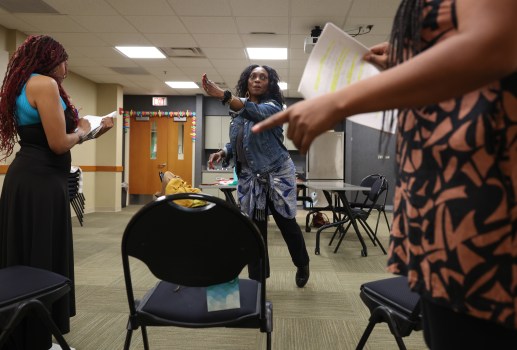
Directed by Aaron Reese Boseman, Redtwist’s cast deftly manages the play’s ambitious structure, hopping between two timelines as several actors play dual roles. Although this format prevents deeper character development for the two protagonists, the connections between past and present — clearly the intended emphasis here — largely come through with clarity.
Monique Marshaun plays Sandra, a tenured political science professor with an elite academic pedigree. In the opening scene, we meet her in a distressed state after discovering a graphic image that was anonymously posted on her office door: her own face edited onto a historic photo of an enslaved woman, who is breastfeeding a white baby. As her present-day timeline progresses, Sandra tries to identify the culprit while also facing interpersonal tensions with two of her students, Malik (Makari Robinson-McNeese) and Candice (Madelyn Loehr), and Jade (Toccara Castleman), the only other Black woman who teaches in her department.
Jumping back some 150 years, Sara (Shenise Danyél) tends to her brother Abner (Robinson-McNeese) as he prepares to flee the plantation and join the Union Army. Longing to join the fight for freedom herself, Sara is susceptible to suggestion when her enslaver’s daughter, Missy Sue (Loehr), returns from the north with a newfound fervor for abolition and asks Sara to spy on her father and his confederates. With an inherent power imbalance also factoring in, Sara agrees to this plan, though she doubts Missy Sue’s motives (which are portrayed as obviously dubious). When Sara transfers from agricultural to domestic labor to better engage in espionage, she clashes with fellow enslaved woman LuAnne (Castleman) over their different approaches to maintaining their own safety and some sense of autonomy.
As they take turns inhabiting a set (designed by Kevin M. Rolfs) that bridges the antebellum and academic environments, Marshaun and Danyél convey both the strength and vulnerability of their characters, separated by generations but sharing certain experiences such as infertility. The majority of the play consists of two-hander scenes between either Sandra or Sara and a succession of supporting characters, with just a few larger ensemble moments toward the end. This structure hampers the development of the individual relationships within their storylines but keeps the focus on the parallels between the two women.
In each one-on-one scenario, Morisseau exposes the limits of solidarity within oppressive systems, especially between people who have much to gain from standing together. When they share their respective scenes with Abner and Malik, who are both Black men, the protagonists bump up against gender-based inequities and mistrust. Missy Sue and Candice are white women whose blundering attempts to connect with Sandra and Sara, woman to woman, are mostly played to comedic effect with a hint of underlying danger. In the cases of LuAnne and Jade, Black women who would seem to have the most potential for kinship with Sandra and Sara, barriers include class differences and their disparate positions within rigid hierarchies.

The play’s inciting incident — an altered photo of a Black woman — seems especially prescient considering that “Confederates” premiered in the year when the floodgates of generative AI opened to the public. With the resultant rise in misinformation threatening any remaining sense of shared reality, Morisseau asks excruciating questions about whether trust is even possible in such circumstances. Her conclusions may be understood as empowering, even hopeful, but there’s enough ambiguity that audience members will likely come away with a range of interpretations. Best to see and decide for yourself.
Emily McClanathan is a freelance critic.
Review: “Confederates” (3 stars)
When: Through March 8
Where: Redtwist Theatre, 1044 W Bryn Mawr Ave
Running time: 1 hour, 45 minutes
Tickets: $10-$60 at redtwisttheatre.org