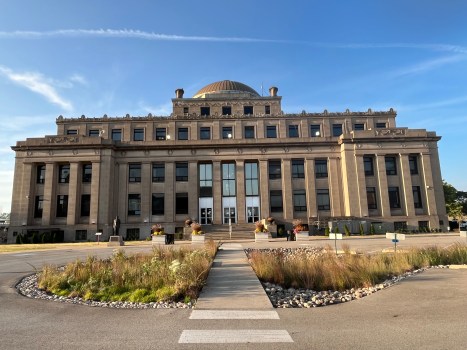

The Gary Common Council was unable to get a majority vote on an ordinance that would allow a wet processing system to come to the city at Tuesday’s meeting.
Four council members voted to approve the resolution, and four were against. Councilwoman Mary Brown, D-3rd, was present at Tuesday’s meeting but left before the ordinance vote.
Council members Dwayne Halliburton, D-2nd; Marian Ivey, D-4th; Lori Latham, D-1st; and Myles Tolliver, D-at large, were the four votes against the ordinance. President Linda Barnes Caldwell, D-5th; Vice President Darren Washington, D-at large; Parliamentarian Kenneth Whisenton, D-at large; and Councilman Dwight Williams, D-6th, voted in support of the wet processing system.
The ordinance would have granted a special use permit to Reconstruct Aggregates, Inc. for the facility on 4900-5200 E. 15th Ave. in Gary. The proposal previously received a favorable recommendation from the Gary Board of Zoning Appeals at a Nov. 13, 2025, public hearing.
According to the ordinance, the wet processing system would use water-based machinery to clean and sort soils, and remove dust and other materials. The recycled soils will be reused for local construction, which can reduce landfill waste, truck traffic and dependence on rural quarries.
The system would be allowed to run from 6 a.m. to 6 p.m. Monday through Saturday, according to Post-Tribune archives. Operators would have to obtain permits from the Indiana Department of Environmental Management and U.S. Environmental Protection Agency.
Site operators would also have to submit a formal drainage and runoff control plan to Gary’s city engineer.
Various Gary residents, including those who are members of Gary Advocates for Responsible Development, have continually opposed the wet processing system, mainly concerned with increased truck traffic in the Aetna community.
Penelope Love, who lives in the Aetna neighborhood, said it seems every resident agrees that they don’t want the development.
“We are not only concerned about our neighbors, but we’re concerned about our future,” she said.
Dorreen Carey, president of GARD, told the council on Tuesday that she would like Reconstruct Aggregates to submit a plan to the city that outlines the company’s expected protocol for the site.
Prior to Tuesday’s meeting, Carey sent a letter to the council, on behalf of GARD, requesting more information about the wet processing system before the city legislative body’s vote. Washington said the council had to vote on the wet processing permit at Tuesday’s meeting.
In her letter, Carey said residents still had not had questions answered about where the soil could come from and if it would contain toxic substances, truck traffic and how much material would accumulate on site.
“Unless we have protections in place, I do not think this company can provide the (necessary) protection and sustainability for the revitalization of the Aetna neighborhood,” Carey said.
Gary resident Glenda Williams said she’s concerned about the environmental effects of the wet processing system, mainly because she and her neighbors don’t know what kind of soil it will bring in.
“We don’t have a desire to have this because it doesn’t sound like it will be beneficial to us,” Williams said. “I’m concerned about the environment and the health of our community.”
Mike Zoeller, senior attorney with the Conservation Law Center, told council members on Tuesday that the community has only heard from Reconstruct Aggregates’ attorney, and he’d like someone from the company to answer questions.
“In any action, if somebody comes before the council, asking you to take action, you deserve to hear from the person who has the direct knowledge and who can answer all of your questions,” Zoeller said.
Darren Eastwood, a representative for Reconstruct Aggregates, was present at Tuesday’s meeting and answered various questions from council members.
“The materials can be used for a lot of beneficial purposes, like making blocks, concrete, floors, pipe drainage…,” Eastwood said. “This is a lot of beneficial reuse that would avoid the need to drive tens or hundreds of miles to a dump site, then to a quarry, and then back again.”
Latham, who represents the Aetna neighborhood, said she believes the property has better uses, including lodging, which she says is in high demand near the Miller neighborhood.
“We don’t have a demand in our neighborhood for washing dirt,” Latham said. “We have a demand for amenities, and I believe that’s why so many people have gathered here today.”
During a Jan. 14 planning and development committee meeting, residents expressed concerns with city truck traffic because of the facility, and Carey asked for a traffic study. Scott Yahne, Reconstruct Aggregates’ attorney, said the facility can process 100 to 250 tons per hour, which he believes equals between five and 10 trucks per hour, according to Post-Tribune archives.
Yahne also said he didn’t expect noise or dust to be an issue for neighbors. Residents were still concerned that the facility would be built near a residential area because of public health and potential soil contaminants.