
A committee of the Aurora City Council is set to consider hiring a company to design a new sound wall for Orchard Road, which is a project that has been in the works for many years.
At a meeting on Monday, the Information and Technology Committee will discuss and vote on a nearly $169,000 contract with Thomas Engineering Group, LLC, of Aurora, for the design of the sound wall, according to the meeting’s agenda. If recommended for approval by the committee, the contract would still need to go to the Committee of the Whole and then before the Aurora City Council for final approval.
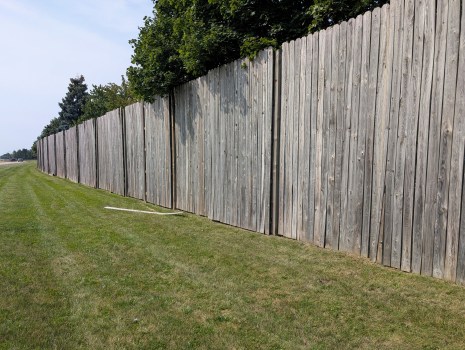
The sound wall would shield residents living near the busy road on the far West Side of Aurora between Prairie Street and Indian Trail from the well-documented vehicle noise. The plan has been to replace the existing wooden fence along the road with a concrete wall that would be something between the current fence and the full Illinois Department of Transportation sound walls used along expressways and interstate roadways.
Once built, the city would be responsible for basic maintenance of the wall while Kane County would do any capital maintenance needed, per an agreement between the two governments that was approved by the Aurora City Council in 2024. The approval of that contract was a major step towards construction, which officials hoped would take place last year but hit delays.
Ald. Carl Franco, 5th Ward, who represents the part of Aurora where the sound wall is set to go and has been involved in the project for many years, said he is happy to see the design contract come forward for approval. But, under Mayor John Laesch, he said he hasn’t been kept in the loop on the project like he was in the past.
“I was in every single phone conversation, every meeting. I knew everything that was going on,” Franco said. “Now, I’m going to have to find out about it through a committee.”
Aurora Chief Operating Officer Brian Caputo said that the proposal set to go before the Infrastructure and Technology Committee on Monday is “just the next step in what has been a methodical process.” Proposals for engineering services were received in October, and since then staff have been confirming funding sources, evaluating the proposals and selecting the most qualified vendor, he said.
The project is expected to now cost $6 million, according to the city’s 2026 budget.
A portion of the new sound wall’s construction cost, around $100,000 of the previously-estimated $4 million price tag, was set to be paid for by residents through a special service area property tax, similar to how many other capital projects within the city have been funded. The property owners in the affected area would have gotten the chance to vote on the 25-year tax, and if a majority agreed, the special service area would have been established.
However, the city found out last year that it would have needed to establish multiple different special service areas to help fund the project. While that situation was being worked out, the city also learned it had lost $500,000 in state funds previously committed to the project, Franco previously said.
Now, the project is expected to get $800,000 in grants from the state, the 2026 city budget shows. Plus, the 2024 intergovernmental agreement between Aurora and Kane County has the county contributing just over $1 million.
Franco is contributing around $600,000 of his own aldermanic ward funds to the project. The rest of the cost, roughly $3.6 million, will be paid from the city’s capital improvement fund, according to the city’s 2026 budget.
While Franco has been in favor of using a special service area to pay some of the sound wall’s cost, Laesch has been against the idea.
In 2024, when the intergovernmental agreement was before City Council for approval, Laesch suggested the city look into using gaming taxes rather than a special service area to cover the gap. As an alderman at-large at the time, he introduced an amendment to the agreement that said the city would look into other ways to fund the wall in the future, but it was voted down.
When talking about the topic with The Beacon-News last year, Laesch mentioned that the city would hopefully be seeing a “sizable” increase to its gaming tax after the opening of the under-construction Hollywood Casino-Aurora resort.
The sound wall project is on track to break ground before the end of 2026, according to Caputo.
rsmith@chicagotribune.com