



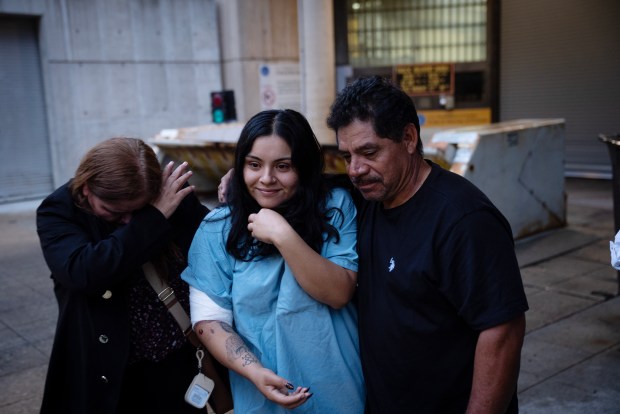


Saying the federal government has shown “zero concern” about ruining the reputation of a Chicago woman shot by a Border Patrol agent, a federal judge on Friday agreed to lift a protective order and allow the release of body-camera footage and text messages from the agent who shot her.
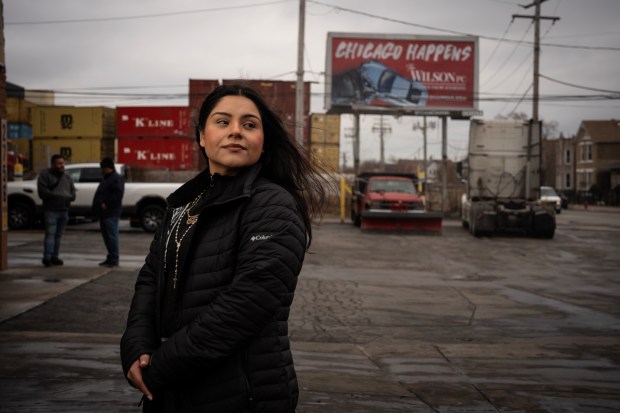
In her ruling, which stems from one of the highest-profile incidents of Operation Midway Blitz, U.S. District Judge Georgia Alexakis said Marimar Martinez has the right to counterbalance the label of “domestic terrorist” put upon her by the Department of Homeland security — a narrative the government has refused to retract even after assault charges against Martinez were dropped.
“Ms. Martinez is a United States citizen. She’s a resident of this district. And under our legal system, she is presumed innocent of any offense of which she has not been convicted,” Alexakis said in a courtroom packed with local and national media.
Alexakis’ ruling means Martinez’s attorneys will be free to release reams of evidence in the case to the public that they say will clear Martinez’s name and show the government has been lying about the facts since the get-go.
Among the evidence: body camera footage that allegedly shows a Border Patrol agent saying “do something, bitch,” before their car collided with Martinez’s vehicle in Brighton Park on Oct. 4, prompting veteran Agent Charles Exum to get out and shoot Martinez five times.
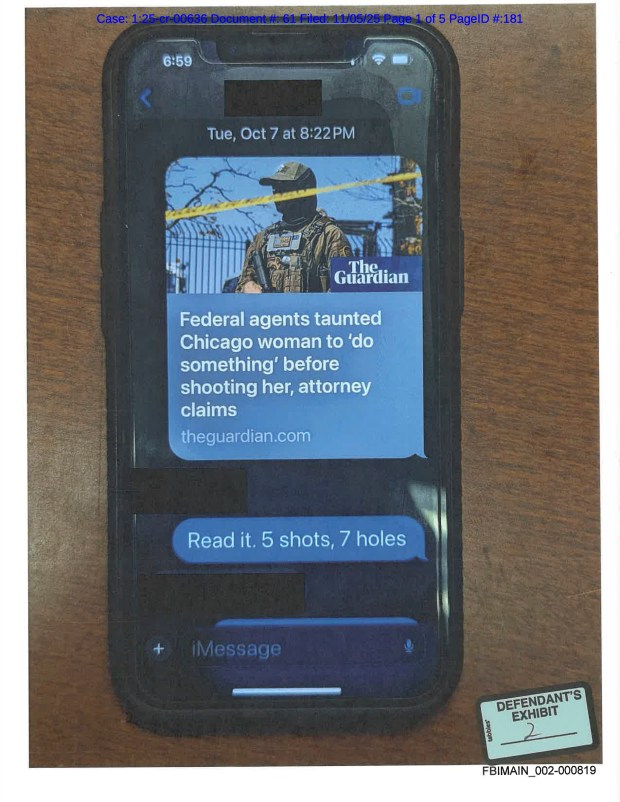
The defense will also be cleared to release dozens of previously sealed texts that Exum sent to co-workers and his wife after the shooting. Previous texts made public in court showed he’d bragged about his marksmanship to fellow agents and said he was ready for “another round of (expletive) around and find out.”
The judge said that while she’s also sympathetic to Exum’s privacy concerns, his own “testimony and demeanor” during a pretrial hearing in November tipped the scales.
“One feeling that comes through in those texts is a feeling of pride,” Alexakis said. “He talked about pride in his shooting skills.”
Alexakis said Exum’s texts are “clearly relevant” and “communicate his impression of the relevant events.”
“They have impeachment value and bear on his credibility,” she said.
Before the judge’s ruling can take effect, Martinez’s attorneys and prosecutors have to agree on any redactions and provide her with a new protective order, which likely would not occur until next week.
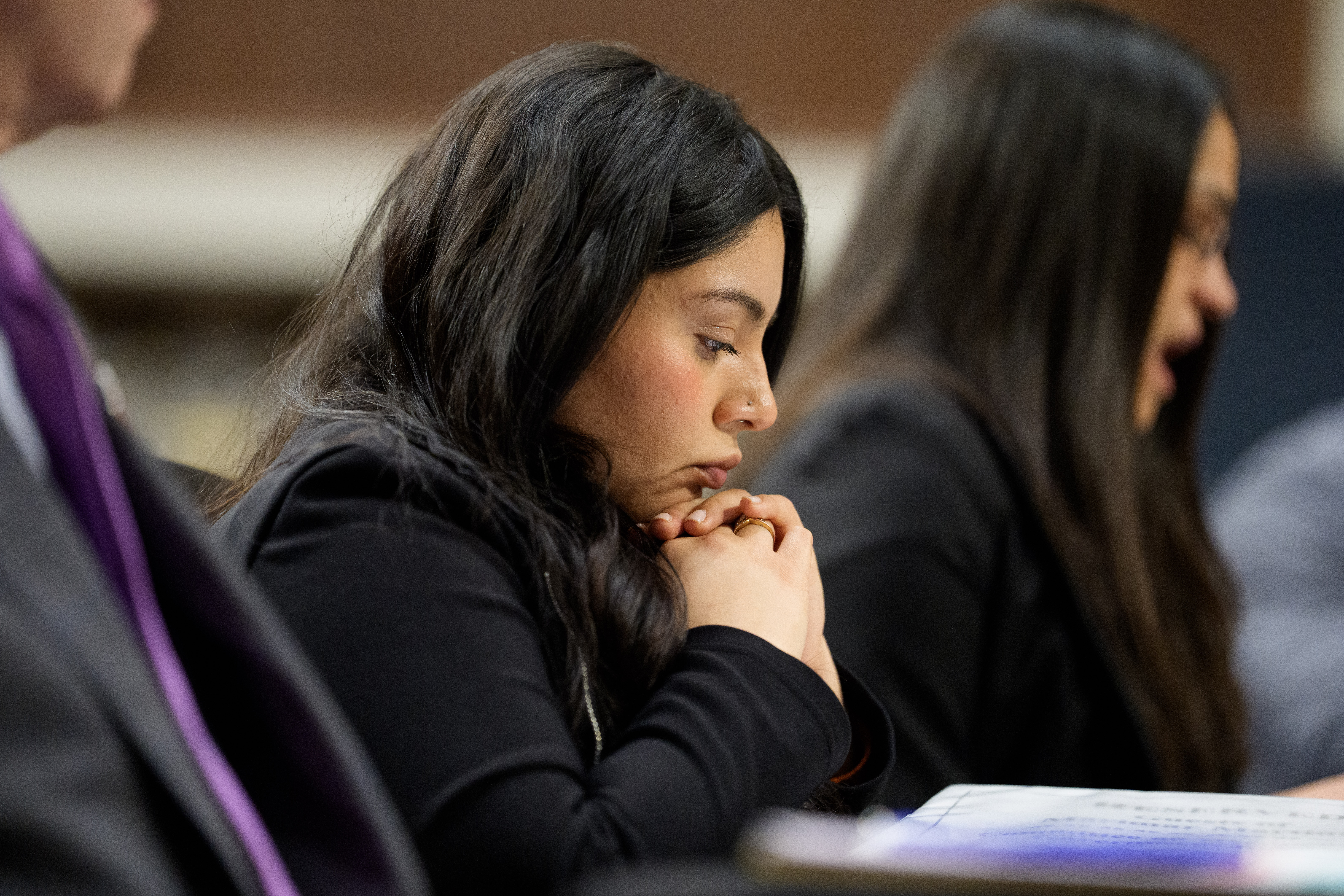
Martinez stood at the lectern quietly as the judge issued her ruling, while her sister and a family friend also listened from the front row of the courtroom gallery.
Martinez’s attorneys took up the battle to get evidence released in early January following the killing of Renee Good by a Border Patrol agent in Minneapolis under circumstances eerily similar to Martinez’s shooting.
Three weeks later, another U.S. citizen, Alex Pretti, was also killed by immigration agents as he tried to record their activities.
As in Martinez’s case, the Trump administration almost immediately tried to brand both Good and Pretti as domestic terrorists who were bent on harming law enforcement.
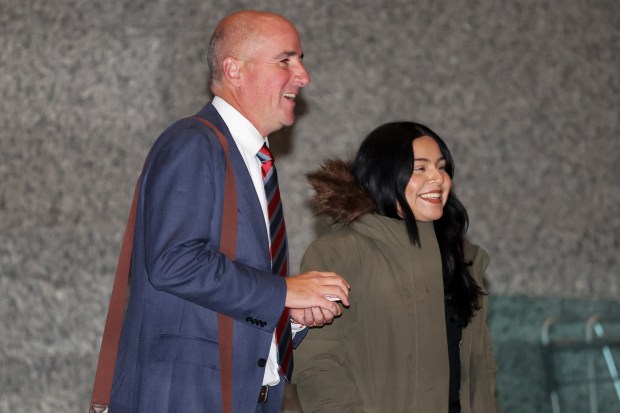
Speaking to reporters after Friday’s hearing, Martinez’s lead attorney, Christopher Parente, said the evidence that will be made public will “pull the curtain back and show everyone how the government responds in the immediate aftermath of one of these shootings.”
“You can’t call a U.S. citizen with no criminal history, who is a Montessori school teacher, a domestic terrorist — which is such a loaded word in this country,” Parente said as Martinez stood with him in the lobby of the Dirksen U.S. Courthouse. “That is absurd and it was rejected by the court.”
Parente also said any concerns about embarrassing Exum went out the window “when he took his phone and used his fingers to write hateful, disgusting language about a woman that he shot while wearing the uniform of Border Patrol.”
“I mean, think about that these are people who are sworn to protect U.S. citizens,” Parente said. “There is a respect for life policy with Border Patrol. And this man, after shooting a woman who did nothing, is going to text his friends and joke about it?”
Prosecutors had alleged Martinez was part of a convoy of civilians who were following agents on Oct. 4 when she rammed Exum’s vehicle near 39th Street and Kedzie Avenue, prompting Exum to jump out of his Chevrolet Tahoe and fire five shots, wounding Martinez seven times.
Martinez’s attorneys argued it was Exum who sideswiped Martinez and that his extreme use of force was completely unjustified. They also alleged evidence tampering, saying Exum was inexplicably allowed to drive the Tahoe more than 1,000 miles back to his home base in Maine, where a Border Patrol mechanic attempted to “wipe off” some of the scuff marks from the crash.
After the charges against Martinez were dropped on Nov. 20, it’s since been revealed in court that Martinez’s car is part of a second, ongoing criminal investigation into the shooting, which is being handled by the U.S. attorney’s office in South Bend, Indiana.
Later this month, Martinez is scheduled to attend President Donald Trump’s State of the Union address to Congress as a guest of U.S. Rep. Jesús “Chuy” Garcia, a Chicago Democrat.
Parente said Friday the Chicago area’s elected leaders have rallied around Martinez and that being at Capitol Hill for the speech will mark a “full-circle moment” for her.
“Who knows? Maybe President Trump will even at that point retract the domestic terrorist label of her, which would be great and she would be there to see it,” Parente said.
Parente has also repeatedly taken the U.S. attorney’s office to task for failing to own up to its mistake in filing the charges against Martinez or get their own bosses to remove the misleading statements about her.
In court Friday, the judge agreed to allow Parente to release surveillance camera footage compiled by investigators in an attempt to prove Martinez was part of a larger coalition of resistors who were attempting to impede immigration agents during Midway Blitz.
Instead, Parente said, the FBI found only that Martinez had been driving around the city and suburbs going to Target, to a hobby store, and other places where “regular people go.” On the day she was shot, Martinez had been heading to her local church to donate clothes, he said.
During a discussion of the camera evidence, Parente told the judge the dispute could go away if prosecutors would give a public statement, along with Homeland Security spokesperson Tricia McLaughlin, “that the United States government conclusively says Ms. Martinez is not a domestic terrorist.”
Assistant U.S. Attorney Ronald DeWald, however, disputed the idea that DHS is a “client” of the U.S. attorney’s office, saying “they can’t tell us what to do. We can’t tell them what to do.”
“It would be improper for me to stand here after we dismissed the case with prejudice to comment on the facts whatsoever,” DeWald said.
For her part, Martinez has said that after the events in Minneapolis, she feels like she is now a “voice” for Good and Pretti and others who did not survive their encounters with federal agents.
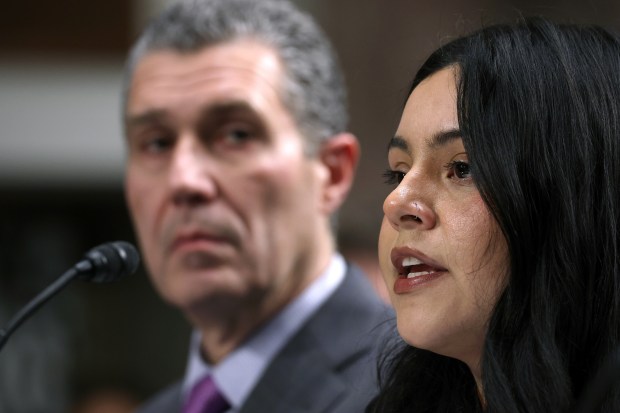
“I am Renee Good, I am Alex Pretti, I am Silverio Villegas González, I am Keith Porter,” she told a Senate forum in Washington earlier this week. “This needs to stop now. How many more lives must be lost before meaningful action is taken?”
Martinez said her main ask of the federal government at this point is for federal officials to take back their words.
“Sorry, you’re not a domestic terrorist, that’s it,” she said. ”That’s all I’m asking for. A simple sorry. That’s it.”
Asked Thursday whether there were any plans by DHS to retract their previous statements, a spokesperson emailed: “DHS stands by our press releases and statements. The facts of what happened did not change.”
jmeisner@chicagotribune.com