The house on Pratt Boulevard goes by many names.
Most neighbors call it Candyland. The Rogers Park kids who once flocked here every day after school for art classes thought of it as the clubhouse of the Battling Butterfly Brigade. Others walk past its pastel stripes and think of it as the Easter House. Once, after that paint began cracking and the old Victorian no longer seemed so eye-popping, a small girl and her grandmother approached owners Joe Bergantino and Ricky Gonzalez and asked, earnestly: “Is this the trash house?”
The reputation of their home had long ago preceded it.
Long before the producers of HGTV’s “Ugliest House in America” ever called.
The good news — in a sense, at least according to the show, which aired its finale Thursday night — is that the house on Pratt was not declared the absolute ugliest in the nation. The bad news is that Bergantino and Gonzalez could have used the $150,000 in renovations that came with that title.
On the other hand, this is a place full of mixed feelings.
When Daniel Hymanson heard last summer that a cable TV makeover series was going to shoot at the house and probably make fun of it — a house for which he had served as the caretaker, a house that he made a documentary about, a house once owned by two beloved artists who regarded their home as an extension of their art works — he bristled at anyone thinking it was “ugly.”
He said, “I knew what would happen on the show, that anything eccentric would get called ‘ugly,’ so it seemed very insulting to the legacy of that house and the great people who once lived there.”
HGTV, after all, is the home of “Help! I Wrecked My House” and “Fix My Frankenhouse” and “Cheap A$$ Beach Houses” and “Scariest House in America.” They considered this one of the ugliest in the nation? After Hymanson was asked to talk about the house on the show, he knew what he had to do: “I’d get confrontational on camera, I’d have like a whole spiel prepared and really give it to them. And then, as soon as I saw no one (on the show) took it all that seriously, despite all of my personal history with this place, I just could not do it with a straight face.”
Candyland, after all, is strange — inspiring, cherished and definitely strange.
Rogers Park has long embraced strange.
There are no shortage of offbeat homes in these largely middle-class streets. There’s the house painted with leopard spots. The house that used its flagpole for monthly art exhibits. The house on Lunt that filled its yard with mirrors and trash sculptures (likely the house that little girl was looking for), not to be confused with the house on Lunt that filled its yard with cowboy dolls and toy horses.
Candyland, though, had been an unofficial landmark for many decades, a neighborhood institution. It’s such a part of Rogers Park that when Bergantino and Gonzalez bought it in 2022, they figured they paid significantly under the asking price because artist Jackie Seiden, the owner, wanted to insure that the home she and her late husband, artist Don Seiden, transformed into an architectural pinwheel would retain its character.
They told Seiden they would make changes, but they would keep Candyland weird.
Still, it is their home now.

So when HGTV contacted them about potentially including the place on “Ugliest House in America,” Bergantino and Gonzalez had a very awkward call. “The woman on the phone from the show took forever to get to the point,” Gonzalez recalls. “We thought it was a scam for a bit,” Bergantino added. “She would ask us, ‘So do you want to be on our show,’” Gonzalez said, “and we’d be like, ‘OK, yes, but wait, what show are you talking about?’ And then she would go on and on: ‘So the idea behind the show is,’ and we’d interrupt: ‘What show?’ We asked this several times. Finally, she goes, ‘Look, do not be offended by this but …’”
“We just laughed,” Bergantino said.
“Yeah, I mean, winners would get a $150,000 renovation,” Gonzalez said, “and for $150,000 you can call my house whatever you feel like — you could call my mom ugly!”
That house on Pratt is not, by any measure, the ugliest in all 50 states. There’s way uglier in Rogers Park alone. There are structures throughout the Chicago area — all of that development around Wrigley Field, I’m thinking of you — far less interesting. The facade of the house on Pratt is yellow and pink and (I think) green. Tie-dyed bunting drapes over the porch. The walkway is cracked and the color of (somewhat) pink Peeps. Is it a sketchy day care? The world headquarters of the Original Rainbow Cone? After Bergantino and Gonzalez bought the house, they heard stories: They’d heard that it had been, indeed, an unofficial neighborhood daycare, but also an unofficial art studio, an unofficial dance studio, an unofficial work of art installation and a social hub.
“We knew we would always play side characters to a place like this,” Bergantino said.
“The house is certainly the star,” Gonzalez said. “We get people who knock on the door and ask for a tour! Seriously. Out of the blue. I’m like, “No! Please be normal!” And that was before HGTV.”
Nevertheless, I got a tour the other day, and here’s some of what you would see: A living room floor covered in plywood the hue of old mayonnaise. An aquarium net hanging in the foyer. Some of the windows are rectangular, but many others are ovals, resembling cruise ship portals. There’s a piano painted pink and green — actually, most of the inside of the house matches the colors of the outside. Except that the inside walls are also covered in glitter. The ceiling is covered in glitter. There are places where a floor was painted one color and places where that same floor is not painted at all. The staircase is pink. The attic bedroom is actually relatively contemporary, with shiny hardwood floors and plumbing cleverly doubling as stair railing. But then there is a working toilet up there that’s not behind any walls or hidden by a door; it’s just plopped there, a few feet from the foot of the bed. In another bedroom, paint is torn off walls to reveal splatters of floral wallpaper beneath.

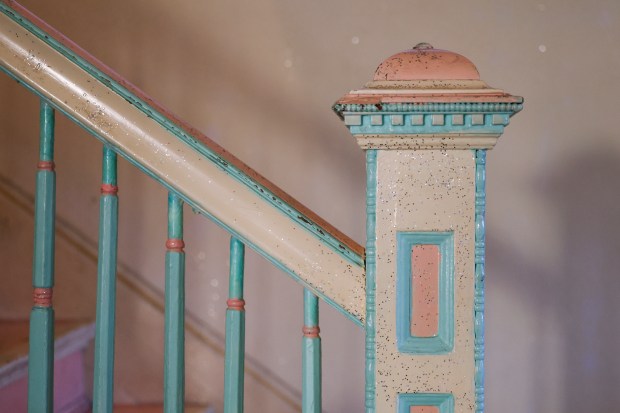


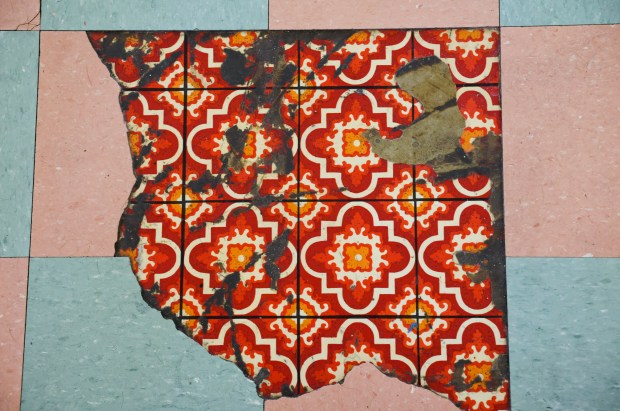


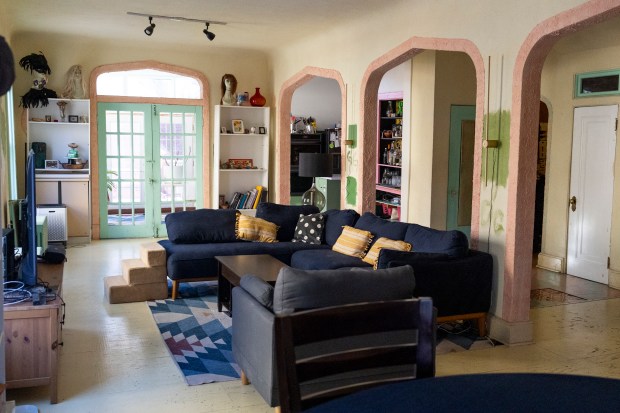

Most of this was the (intentional) work of the Seidens, and their flourishes remain so extensive throughout the four floors of the house that Bergantino and Gonzalez figure, without that HGTV award money, the house will probably take about a decade to restore to something uniquely theirs.
Don Seiden, who died in 2019 at 91, was a pioneer of art therapy and the founder of the art therapy program at the School of the Art Institute of Chicago. But many of the quirks of the house came via Jackie Seiden, who taught art classes for children at SAIC and is now in her late 80s and residing in senior living. For years, she maintained a room that had no practical purpose other than somewhat resembling an ornate bedroom of British royalty. She wallpapered the kitchen with the fortune slips of fortune cookies. “Rooms sort of bled into each other,” Hymanson remembers. Jackie would add layer upon layer of spackle to every surface — archways, radiators — then toss fistfuls of glitter at it before the compound could dry. Don created a life-size rhino out of metal, duct tape and tin foil and installed it in the backyard. Jackie made sure every green was the emerald of hospital walls and every pink echoed the pink Edgewater Beach Apartments building on Lake Shore Drive.
When Bergantino and Gonzalez moved in four years ago, they found a window completely covered in the plastic grass from old Easter baskets. They found a wedding dress hanging from the ceiling. They found a car in the backyard filled with old children’s clothing. They found a pair of men’s underwear stapled to a wall. On an episode of “Ugliest Houses in America,” they pointed out the “clam bisque reds” and “smoker’s yellows” found throughout the house.
The documentary that Hymanson shot here — 2020’s “So Late So Soon,” largely about the Seiden’s marriage, with support from the Sundance Institute — opens with Jackie creating an elaborate weave of strings across the kitchen sink, to support a small plastic cow. In the next scene, she is carefully arranging an art installation of open antique suitcases. “Jackie is a brilliant artist and the house itself was her life’s work,” Hymanson said. “It was a singular vision of a particular person, and constantly evolved. It reflected literally what it means to fully integrate art into everyday life.”
The house was built in 1893; the Seidens arrived in the early 1970s.
“It was once a generic house, painted green, before they got there,” said Dawn Brown, a niece of Jackie. “I remember, at first, they had painted everything white, then lots of pink. They made it look like a fairyland, and it became a gathering place for the family, who really did appreciate it as a work of art itself. Everyone did. As Jackie got older, grown men, members of the Butterfly Brigade who took art classes at the house years ago, they would run up to her on the street and hug her.”

Bergantino and Gonzalez paid $465,000 for the home, about $140,000 below the initial price, partly because it would require upgrades, and partly because Seiden had been assured that they wouldn’t entirely gut the spirit of the place. Gonzalez wrote her a letter explaining as such, that they knew the house was her artwork and vowed to keep it unusual. One married couple was passing their home to another married couple, who see it in the 20th century tradition of “painted ladies,” the name given colorfully retooled Victorians. Hymanson, who had known Jackie since he was her 5-year-old art student, is pleased that she has something of a small relationship with Bergantino and Gonzalez: “It was kind of a relief in the end because I think they really are the perfect owners.”
Bergantino, 36, manages tech coders; Gonzalez, 42, is a software engineer. They say they had never picked up a power tool until they started making changes, remodeling a bathroom here, reinstalling a tiled floor there, showing their progress through an Instagram account called HomosWithHammers. They even added some glitter to the walls of their home offices, as homage.
HGTV found them on Instagram.
Last summer, a director scouted the ugliest rooms to use on the show, only to decide: “OK, everywhere.” Ultimately, the home was on an episode titled “The Midwest Brings the Ugly.” The comedian Retta of “Parks and Recreation,” the host, quipped that the house was where “colors come to die.” She went wide-eyed at the quirks and cringed at the glitter. She said she wondered how a family home could stand out “in a city literally built by architectural legends, but now I see how.”
When I asked Jackie if she was insulted that her home was called one of the ugliest in the nation, she sighed. “I don’t have expectations,” she said. “The word ‘insult,’ it doesn’t fit this at all, because that home was like a soul or another being I got along with — their insults can’t touch me at all.”
Brown, who is close with her aunt, said: “By the time she gave up the house, she had come to terms with it. She doesn’t mourn it, she doesn’t look back — I think, if anything, she mourns being older and everything that comes along with that. She’s now a city artist stuck in the suburbs.”
Bergantino and Gonzalez heard Jackie was not thrilled. But they had made plans in case they won. As part of their contract with HGTV, they designated parts of the house off-limits to any changes.
And yet, they want to be clear: “What Jackie built was so inspiring it helped us throw out the rule book of what this house could become next,” Bergantino said. “We’re not going to restore it to a new version of the same thing. We’re going to make it contemporary, and yet keep the character.
“A home is not a museum, it’s a home.”
cborrelli@chicagotribune.com