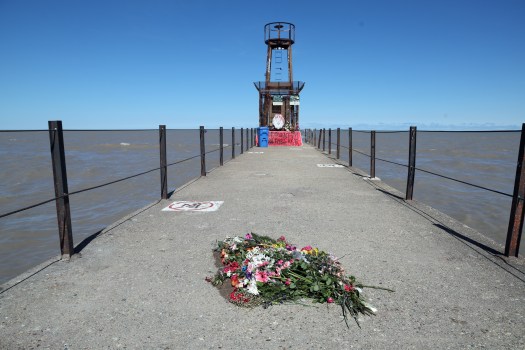
Recent weather extremes in the South and East are examples of what global warming can cause — a warmer Arctic that disrupts the polar vortex and pushes cold weather and snow farther south. It also changes moisture flows around the Earth, causing more rain, flooding and stronger storms in some areas and more heat waves, droughts and wildfires in other regions.
Our use of coal, oil and natural gas, which causes global warming, must be reduced quickly. One approach is to reform outdated and cumbersome permitting processes so clean energy projects, such as for solar and wind power — along with more transmission lines — can be added to our grid more quickly.
Also, permitting reform can put battery storage systems online sooner to hold excess electricity from solar and wind power plants during peak generation periods and release it when needed.
Currently, there are bipartisan efforts in Congress for reform. Email your senators and representative, or call them at 202-224-3121, to encourage them to support sensible permitting reform for clean and cheap renewable energy.
— Gary Jump, volunteer, Citizens’ Climate Lobby
Industry should pay costs
Bravo to state Sen. Graciela Guzmán (“Climate Change Superfund,” Feb. 1) for proposing the Climate Change Superfund Act. Here in California, we are working to do the same. It is unfair for billion-dollar industries that are major contributors to climate change and its disastrous and costly effects to be raking in vast profits and then leaving those costs to cities, states and consumers.
We also should urge our congressional representatives to stop providing billions of dollars in subsidies to these already-profitable industries. Let them instead share some of those profits to help pay for the damage their products are doing.
— Maggie Wineburgh-Freed, Los Angeles
Microplastic pollution
Efforts to keep microplastic pollution out of our drinking water are under way. We hear a lot about individual actions such as not using plastic containers, but drinking water is possibly our biggest source of exposure, and our individual actions are limited.
We drink water every day. It’s impossible to avoid this source of water contamination. I’m grateful that Gov. JB Pritzker joined six other governors to petition the U.S. Environmental Protection Agency to include microplastics in the renewal of its Unregulated Contaminant Monitoring Rule 6. Monitoring microplastics would help us have a better understanding of what is present in drinking water, a necessary step before regulations can be created.
I urge the EPA to include microplastics to help pave the way for regulation that would keep our drinking water safe. And I urge Pritzker to use his power to keep up the pressure.
You, too, can call on Pritzker to ensure the EPA follows through.
— Yhelena Hall, Chicago

Rules for nuclear reactors
President Donald Trump has directed the Department of Energy to review, approve, construct and operate new nuclear test reactors and have at least three operating by July 4. This is clearly not possible considering the importance of safety concerns associated with nuclear reactors, particularly new and novel designs. Careful and objective review against rigorous safety requirements and standards is essential for safe operation of reactors.
Notwithstanding, the DOE initiated the Reactor Pilot Program and is actively proceeding to achieve operation of the new test reactors by July 4. To accomplish this, DOE has worked closely with companies that design and operate test reactors to gut the requirements for reactor design and operation, including nuclear safety, security and environmental protection requirements. Many requirements were removed, and those that remain have been changed from requirements to recommendations and considerations. This was done behind closed doors with no public access to scrutinize and to provide input on DOE actions.
This is unacceptable and must be stopped.
The safety and the public acceptance of nuclear test reactor operation require careful review, approval and inspection by a credible organization against clear and rigorous safety standards by an organization independent of the industry. The DOE has clearly demonstrated that it cannot be depended on to assure the safety of the public and the environment. Public access to and scrutiny of DOE actions is essential.
Stop this cavalier approach to our safety now.
— Jack Grobe, Winfield
We deserve transparency
The U.S. is no longer leading in global efforts to reduce emissions proven to affect public health and climate change. Besides withdrawing from the Paris climate agreement agreed upon by 193 other nations and the European Union, the Donald Trump administration is clearly loosening environmental rules, putting industry interests over the health of our environment and our public.
The Department of Energy’s recent revamping of nuclear safety directives in collusion with the industry allows fast-tracking of construction and operation of experimental nuclear reactors. Changes to environmental protection requirements have been made without public input. These changes relax restrictions on radioactivity releases to groundwater, sewers, surface waters, air, soil and drinking water. Monitoring and documentation requirements of releases are merely recommended, and avoidance and minimization of adverse impacts to animals, plants and the public are left up to the industry. By stripping out detailed rules, compliance with the Clean Water Act and the Clean Air Act is not assured.
The bottom line is the current administration doesn’t want the public or nuclear and environmental experts to be barriers to corporations. The expediency and greed of the fast-moving artificial intelligence industry are the motivators, and health and safety are no longer of paramount concern. Many historical lessons about corporate carelessness and irresponsibility are being disregarded: Superfund radiation cleanup at Kerr McGee in West Chicago and polychlorinated biphenyl contamination of groundwater in private wells in DuPage County and Wayne Township.
I’m someone with two decades of professional experience in environmental protection at a DOE facility. Even with clear and enforceable regulatory requirements, contractors view these regulations as an impediment to their goals. Without clear and enforceable rules, contractors will prioritize profit over protection of the public and the environment.
The public deserves transparency — secrecy does not build trust.
— Deborah Grobe, Winfield
Bad Bunny’s Grammy win
This year’s Grammys were about more than music — they were about who we are as a country.
Bad Bunny made history by winning Album of the Year with a Spanish-language album. That matters. It shows that America is changing and that Latinos are part of the fabric of this nation.
Puerto Rico is part of the United States. Latinos are part of the United States. Our language, culture and stories are no longer on the margins; they are front and center.
I’m not from Puerto Rico, but I am a proud Latino living in the United States, and this moment felt personal. You might like Bad Bunny’s music or you might not; that’s not the point. What matters is what he accomplished without compromising who he is.
This is a powerful message for our youths and our community: Be proud of who you are, where you come from and what you bring to this country.
Last Sunday night was a proud Latino moment and a glimpse of America’s future.
— James di Paulo, president and CEO, Illinois Hispanic Chamber of Commerce
Submit a letter, of no more than 400 words, to the editor here or email letters@chicagotribune.com.