Evanston’s Reparations Committee announced Feb. 5 it will issue reparation payments to 44 additional descendants this summer, while providing an update on its DNA Roots Program and exploring a potential tax on Delta-8 THC products in an effort to expand funding.
The Reparations Program, established in 2019 and later approved by City Council in 2021, is the first government-funded initiative in the United States aimed at providing reparations for Black Evanston residents who experienced housing discrimination between 1919 and 1969 and to direct descendants of those residents.
Each of the 44 descendants will receive $25,000 in reparation payments intended for housing expenses, Cynthia Vargas, Evanston’s Communications and Community Engagement Manager, stated in an email to the Tribune.
“Over the next few weeks, residents assigned numbers 127 through 171 will be contacted to let them know their payment is on the way,” Tasheik Kerr, assistant to the city manager, said during the meeting.
As of Jan. 31, the city has received $276,588 for the Reparations Fund through the real estate transfer tax, with no additional donations reported. The program also receives revenue from Evanston’s 3% Cannabis Retailers Occupation Tax, but state law prohibits disclosure of the total amount.
Since revenue from the city’s cannabis tax has proven limited due to low sales, the committee discussed a potential municipal tax on Delta-8 THC products as a way to boost funding for reparations. Delta-8 THC products are a psychoactive form of cannabis commonly sold in gummies, vapes or other edible forms, with packaging that can resemble candy or snacks.
Alexandra Ruggie, Evanston’s corporation counsel, emphasized that as a ‘home-rule’ community that doesn’t have to wait on federal or state action, the city has the authority to impose a levy on the products.
“Delta-8 products tend to be rather inexpensive, so the tax on them, it likely won’t be a huge revenue stream, but it is revenue,” said Ruggie. “The other thing that we will have to work out with our finance team is how to go about collecting those taxes, whether we tax it when there’s a point of sale at an Evanston business, or whether or not we tax it when those businesses buy it from the supplier.”
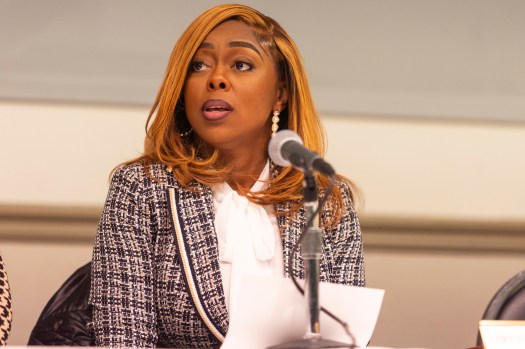
2nd Ward Councilmember Krissie Harris agreed, saying that while she doesn’t believe a tax on Delta-8 THC products will greatly increase revenue, it will “keep moving that number forward.” She also added the committee is not intentionally withholding payment to reparation recipients, noting that distributions are made as revenue becomes available.
To impose the tax, the committee would need to refer the proposal to the City Council, where it requires support from two council members, according to Ruggie.
In addition to discussion on reparation payments, LaKisha David, a professor at the University of Illinois Urbana-Champaign, updated the committee on Evanston’s DNA Roots Pilot Program, which offers free DNA testing for African American descendants of slaves to trace back their ancestry and possibly connect them with living relatives in Africa.
The pilot program, contracted through June 30, has a goal of testing 1,600 participants. So far, 247 participants have received DNA results, with 130 more expected in the next few weeks. David said while the program seeks an extension beyond the contract period, the team is currently working to build a public-facing website and improved database to help manage DNA results.
“I want to say that our research team is working to do this. We are building the website. We report to the state quarterly. We are on time. We will meet our goal of having a more polished result delivery system by June 30, which was the commitment,” she said.