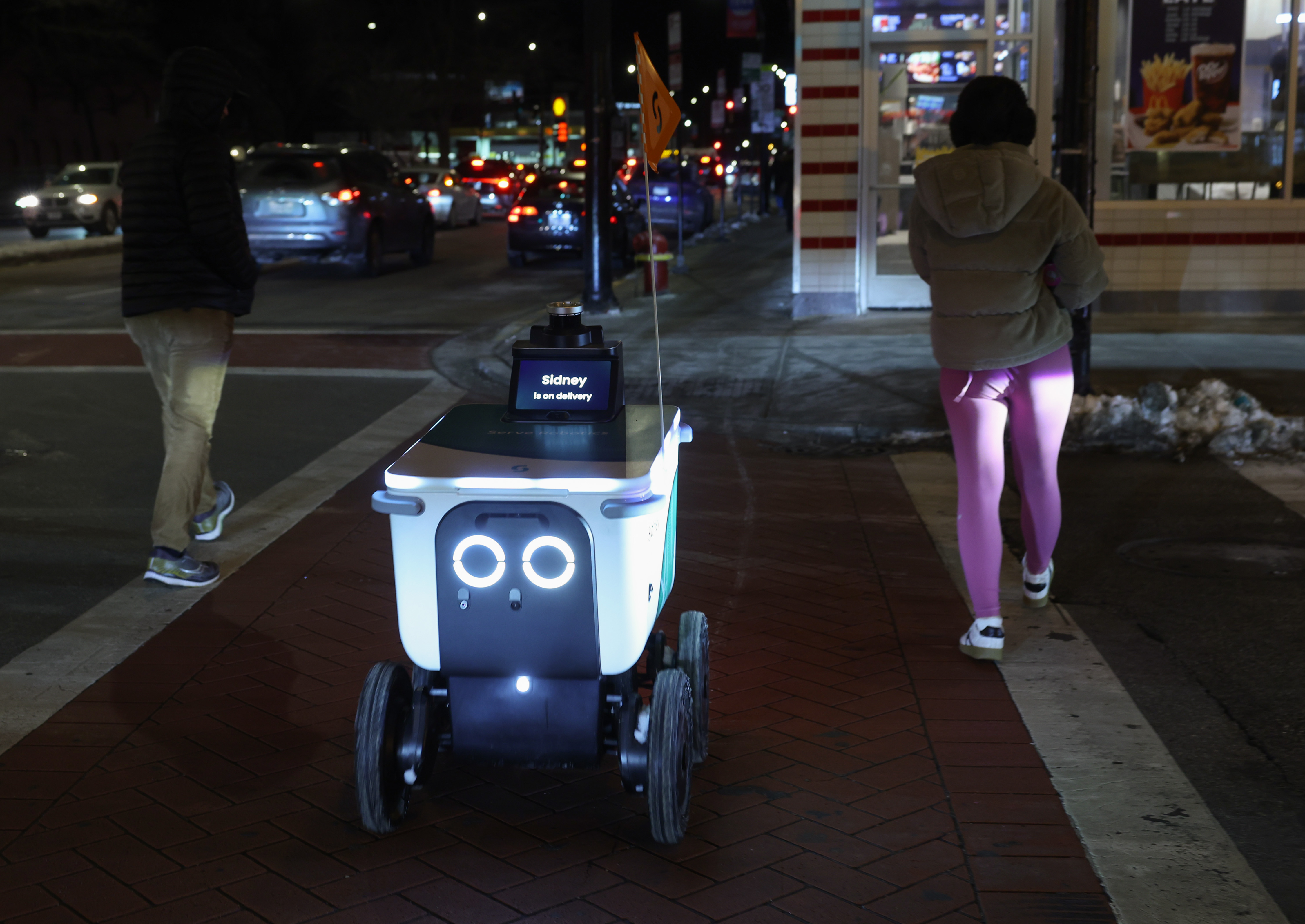





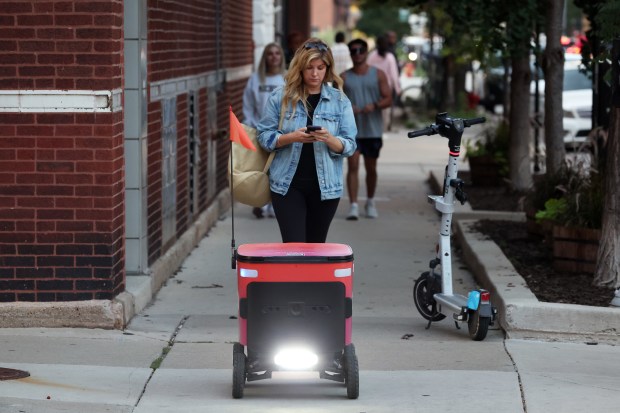
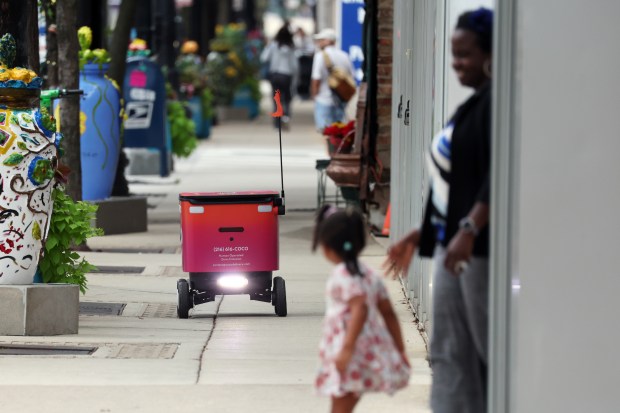
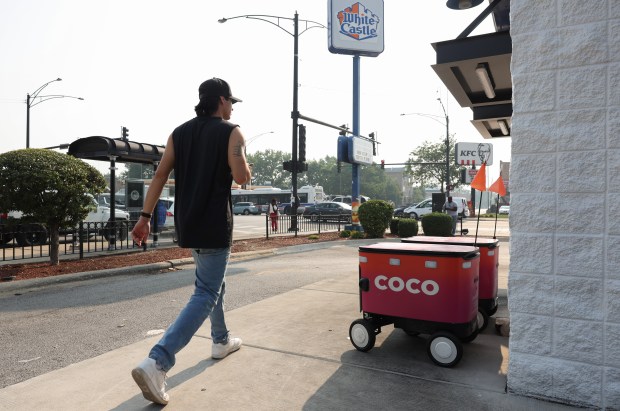


The rise of autonomous food delivery in Chicago has made colorful, flag-bearing robotic carts a familiar sight as they steadily roll along busy sidewalks and crosswalks on a last-mile mission to transport tacos.
But as their robotic ranks swell, there have been an increasing number of incidents pitting man against machine, from sidewalk standoffs and traffic jams to a handful of collisions. Just ask DePaul-area resident Janice Hughes, who claims she was rear-ended by a Coco robot while raking the parkway in front of her home.
“They’re sidewalk hogs,” said Hughes, 66. “They don’t have the education or ability to recognize how to curb themselves.”
The red Coco robots, which have been traversing Chicago since late 2024, were joined last fall by a fleet of green units from Serve Robotics. Together, dozens of self-driving robots have already logged more than 29,000 sidewalk miles and delivered nearly 28,000 food orders, according to city statistics.
While some Chicagoans have taken to the futuristic delivery service, others have not exactly rolled out the welcome wagon for the army of AI-driven meals on wheels. Notably, one Coco robot ended up sleeping with the fishes last summer after it was apparently abducted by unknown assailants and dumped in a canal, according to a company report to the city.
The companies behind the robots say they are safe, and only a few incidents involving the devices have been reported to the city. But amid anecdotal struggles to share the sidewalk, there is a growing movement to slow the robot rollout, including petition drives, residential meetings and rumblings of political pressure to reexamine the pilot program.
Josh Robertson, a Lincoln Park resident who organized NoSidewalkBots.org, has garnered more than 3,300 online petition signatures in an effort to keep the delivery robots from taking over the pedestrian pathways in Chicago.
“Our sidewalks are a precious resource, but it’s so easy to take them for granted,” Robertson said. “We have reason to think that there’s a ripple effect, that the public way itself is less safe, more chaotic with the robots than without.”
Approved in 2022 under then-Mayor Lori Lightfoot, the personal delivery device pilot program enabled companies to partner with restaurants to deliver food orders to customers using small robots traveling on sidewalks and in crosswalks.
The pioneering program started with a fleet of black and white robots from Starship Technologies tooling around the campus at the University of Illinois Chicago.
In November 2024, California-based Coco Robotics launched a broader rollout in Chicago, with plucky food delivery carts blazing new trails across the city.
Founded in 2020, Coco operates about 1,000 units in Los Angeles, Chicago, Miami, Jersey City and Helsinki, Finland. There are about 50 robots currently on the sidewalks of Chicago.
The Coco robot was designed to travel the last mile between restaurants and other retailers to deliver everything from pizzas to groceries, adding such late-night favorites as White Castle sliders last year. Employees put the food inside a locking cooler and the robot sets off on its solo journey to the customer’s door.
Beyond touted environmental benefits, the robots eliminate the need for human delivery drivers — and the prerequisite tip.

Working with partners such as DoorDash and Uber Eats, Coco now operates across 34 square miles of Chicago, covering neighborhoods including River West and Lincoln Park, serving food from 125 restaurants and retailers, according to the company.
In September, Serve Robotics launched delivery service from over 100 restaurants with dozens of robots traversing 14 Chicago neighborhoods on the North and West sides in collaboration with Uber Eats. The California-based Uber spinoff ramped up quickly last year to deploy more than 2,000 robots across markets that also include Los Angeles, Atlanta and Alexandria, Virginia.
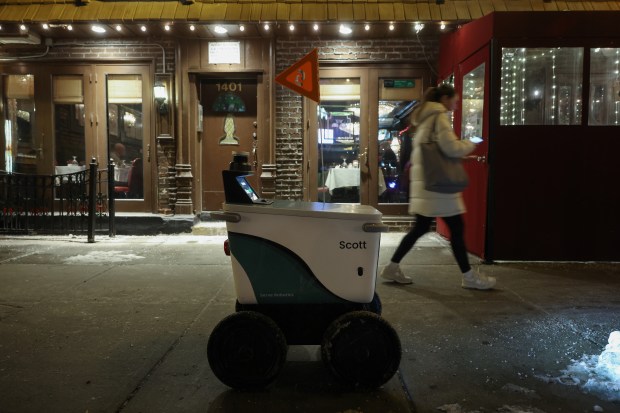
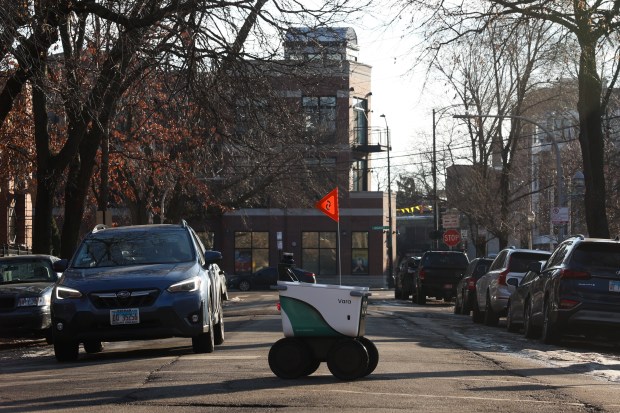
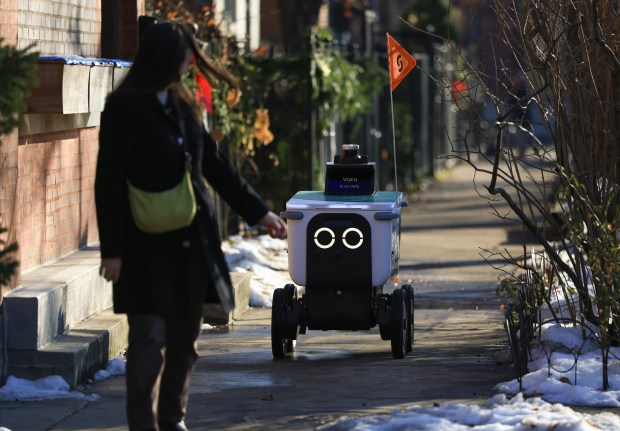
The green and white Serve robots have headlights resembling eyes and each bears a distinctive name. Serve is licensed to operate up to 60 robots in Chicago.

Nationwide, with more than 3,000 robots delivering food between the two leading companies, the robots are gaining traction, visibility and some notoriety. A few prominent mishaps have gone viral.
In January, a surprisingly gleeful witness captured a much-shared video of a Coco food delivery robot that got stuck on the tracks and obliterated by a passing commuter train in Miami.
“The Coco robot experienced a rare hardware failure while crossing railroad tracks,” Carl Hansen, Coco’s head of government relations, said in an email. “We’re reviewing the situation carefully to ensure it doesn’t happen again.”
While some online pundits conjectured it was carrying a smashburger, the Coco robot was not making a delivery at the time, according to Hansen.
In Chicago, the two companies reported five safety incidents to the city last year — three involving Serve robots and two with Coco — despite logging nearly 30,000 sidewalk delivery miles between them.
“We have now driven thousands of miles since we began operating in Chicago, and we have not had any serious injuries,” Hansen said during a virtual meeting last Monday with residents of the 1st Ward on the Northwest Side, a hot zone for robotic delivery.
Some of the incidents have been pretty colorful, however.
In July, a Coco robot was “recovered” from a canal, according to the city’s records. The company offered more details, but few answers as to why.
“This was not an operational incident,” Hansen told the Tribune. “A parked, inactive robot was tampered with and intentionally moved by an unknown third party and placed into a canal. There were no injuries or safety concerns, and the robot was recovered after Coco notified the city.”
Then in November, a pedestrian darted out of a “blind alleyway” on West Diversey Parkway, tripping into a Serve robot and stumbling, according to the company’s report to the city.


Anthony Jonas, 33, said he was trying to catch the bus when he tripped over the robot , making contact with its visibility flag as he fell. The Lincoln Park resident said he needed stitches and a tetanus shot. “My eye was swollen for about two weeks,” he said. He retains a scar near his left eye.
Jonas, a speech language pathologist, said that separately from his own case, he had concerns about the impact robots have on his neighbors who use wheelchairs or strollers. Serve has downplayed the severity of the collision.
“That situation was not listed as a serious incident, because the person simply walked away, and there were no visible marks on that person,” Yariel Diaz, head of government relations for Serve, said during the meeting with 1st Ward residents. “They later did reach out to us, and we did go and process a claim on their behalf.”
The most recent incident happened on the evening of Dec. 20, when an assailant “flipped and attempted to damage” three Serve robots. Two of the robots — Cassius and Sandra — were stationary, but a third named Valerie was making a food delivery. A police officer was on the scene when a Serve field agent arrived to assist the assaulted robots, according to the report.
While the city has received only a handful of safety incidents involving delivery robots, the online campaign started by Robertson has generated hundreds of complaints ranging from sidewalk collisions to idled robots congregating in front of buildings, blocking egress for residents and passersby.
Robertson, a designer by trade, launched the site last year after dodging a robot on a summer walk near Belden Avenue and Halsted Street in Lincoln Park with his wife and their two small children.
“My family and I were out for a stroll and looked ahead, and suddenly a robot was coming toward us,” said Roberston, 40. “We stepped aside and got out of the way. And to me, something about that whole experience felt a bit off. We were in the space designated for pedestrians, yet we were deferring to this vehicle that was using the same lane as us.”
The website gained momentum after the Serve fleet essentially doubled the number of robots in Chicago last fall, Robertson said.
Reports of stumbling, slipping on the ice or just the indignity of having to yield to a robot were among common complaints submitted, Robertson said. Some said the robots, which can weigh more than 200 pounds, ran over their feet during an encounter.
Perhaps the most striking complaint came from Hughes.
Last spring, soon after the launch of the Coco robots in the DePaul area, Hughes was using a small hand rake to tidy up the fenced-in parkway on the sidewalk in front of her Webster Avenue home. Hughes noticed a woman pushing a stroller who seemed to be hesitating as she came closer. Meanwhile, she didn’t see a Coco robot approaching at a steady 5 mph from the opposite direction.
Hoping to make it easier for the woman to pass, Hughes rose up and was promptly rear-ended by the robot, which may have perceived the hunched-over human gardener as part of the landscape as it swung away from the oncoming stroller, she said.
“It clipped my legs and I sat down on it,” Hughes said. “It sort of stung a little bit in the back of my knees there. I didn’t have severe bruising or anything, but it was scary.”

Subsequent altercations included grappling with an ostensibly wounded Coco robot that wailed in distress for hours one night in front of her house. She went out at 2 a.m. in a bathrobe trying in vain to move it, and at one point considered using a baseball bat to commit roboticide, but instead went back to bed. It was gone in the morning.
Hughes said she did not report any of the incidents to the police, and was unable to reach a human at the company when she called the phone number on the robot.
Coco said the company was unaware of the alleged incidents involving Hughes.
“This is the first time we’re hearing about this matter,” Hansen said. “We would have escalated it immediately with a full record in our system, since safety is a top priority for Coco and we remain committed to safe operations. After conducting a full retrospective review, however, we found no records or evidence of an incident matching the description provided or involving Coco during that time or in that ward.”
Hughes brought up her concerns during a visit to Ald. Timmy Knudsen’s office in the 43rd Ward when she stopped in to buy some parking stickers, and said the alderman’s staff was neither helpful nor particularly concerned.
Knudsen did not return a request for comment.
Meanwhile, Ald. Daniel La Spata, 1st, fielded an hour of questions and concerns from residents during the meeting last Monday, which included representatives from Coco and Serve.
Coco operates in his ward, La Spata said. But the alderman said he was surprised last fall when Serve started deploying robots there, too. La Spata said he reached out to the city’s Department of Business Affairs and Consumer Protection (BACP) and found that his ward had been included in the Serve pilot without his knowledge. Soon after, La Spata said he had the 1st Ward taken out of Serve’s operating area.
In an interview, La Spata said he felt that the delivery robots meant “trading one version of congestion for another.” They may take vehicles off the road, he acknowledged. “But the robots are operating on a much more limited public way, which is the sidewalk,” he said.
Almost 79% of 1st Ward residents who responded to a survey his office put out opposed to the robots, he said.
Ali Kashani, Serve’s co-founder and CEO, told the Tribune Friday that he hopes to have permission to get his robots up and running in the 1st Ward soon.
“As we earn that trust, my hope is that we will continue to expand,” Kashani said.
Elisa Sledzinska, a spokesperson for BACP, said the pilot program is assessing “both the benefits and risks” of the robots. In December, the city added a personal delivery device category to its 311 service to encourage public feedback and has received 63 reports on the robots this year, she said.
BACP has issued “emerging business” permits to both Coco and Serve, Sledzinska said. Those permits allow new types of businesses to operate “while the city determines what new policies and or even legislation (is) needed to support them long-term,” she said in an emailed statement.
The robot delivery pilot program, which BACP administers jointly with the Chicago Department of Transportation, will end in May 2027 without further action from the City Council.
That gives restaurants and customers more than a year to try out robotic delivery service. Meanwhile, Coco and Serve, whose robots ostensibly grow smarter and more street savvy with each passing day, may learn to better adapt to navigating the city.
Bobby Brooks, 33, an accountant for a Loop financial firm, has been getting groceries delivered by a Coco robot for months. The novelty of it has given way to a new normal for Brooks.
The robot brings the groceries to the front door of his apartment building in Old Town without fail, he said. Brooks said he’s amazed the robot even finds the front door, which is on the side of the building — something that repeatedly stumped human delivery drivers.
“It’s been a great experience every time so far,” Brooks said. “It’s usually quick and I like how when they deliver it, you know it’s secured.”
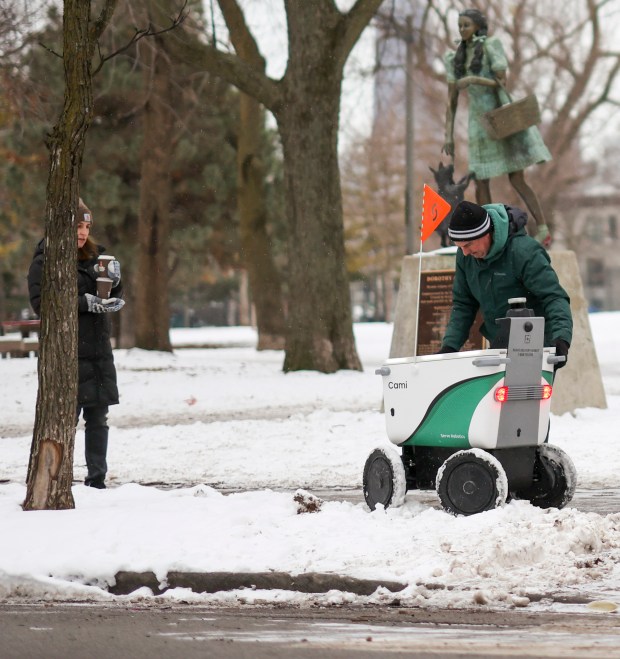
The robots have already proved hearty enough to deliver the goods on most days this winter, despite heavy snow and a prolonged cold snap, although a few have gotten stuck in snowbanks and other weather-related sidewalk hazards.
“If a bot becomes stuck, a remote Coco operator will alert the Coco Chicago Field Operations team, who would be immediately deployed to recover the bot,” Hansen said. “And in the event of exceptionally heavy snowfall, Coco may temporarily pause deployment until sidewalks are safe and navigable.”
For opponents of the pilot program, rescuing food delivery robots from snowbanks should never become a priority.
“Sidewalks are for people, not for robots,” said Kyle Lucas of the group Better Streets Chicago, which advocates for pedestrians and bicyclists.