


Reginald “Reggie” Morrow was homeless in Chicago for 15 years, sleeping in parks, hallways and abandoned buildings while struggling with addiction. He said he thought he would be homeless for the rest of his life.
Today, Morrow has been clean for four years after making his recovery a priority. He now works on rail maintenance for the CTA and credits local organizations like the Ignatian Spirituality Project, Back on My Feet and the Salvation Army for helping him along the way.
Morrow shared his story in front of hundreds of community members, nonprofit workers and formerly homeless people Sunday morning as they walked through Humboldt Park to raise awareness and money for homelessness.
“We all understand (people experiencing homelessness) need help, and I think the majority of them all really do want help,” Morrow said. “But I think we have to push harder to help.”
Walkers registered with local organizations that provide services to homeless people, including the groups that assisted Morrow. The ongoing Winter Walk Chicago campaign has raised over $36,000 between the organizations.
In 2024, over 58,000 people experienced homelessness in Chicago, according to the Chicago Coalition to End Homelessness.
Doug Fraser, executive director of the Chicago Help Initiative, who worked with the national organization Winter Walk to organize the drive, referenced recent hardships for nonprofits in his speech and said it’s important to support their missions.
“What has essentially happened at a federal level is that they have tried to shift the funding out of proven, effective solutions that are evaluated on merit into a giant fund that would be evaluated on a different set of criteria,” Fraser told the Tribune.
The Trump administration and the U.S. Department of Housing and Urban Development support funding transitional housing with work or service requirements over permanent housing programs. Advocates say the latter provides a more impactful solution, and the administration’s aversion to permanent housing shows a stark break from recent tactics to end homelessness.
Winter Walk’s executive director, nonprofit leaders, 26th Ward Ald. Jessie Fuentes and Sendy Soto, the city’s chief homelessness officer, addressed the crowd.


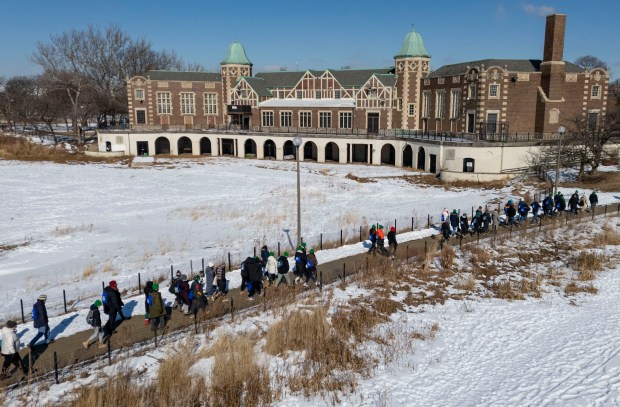
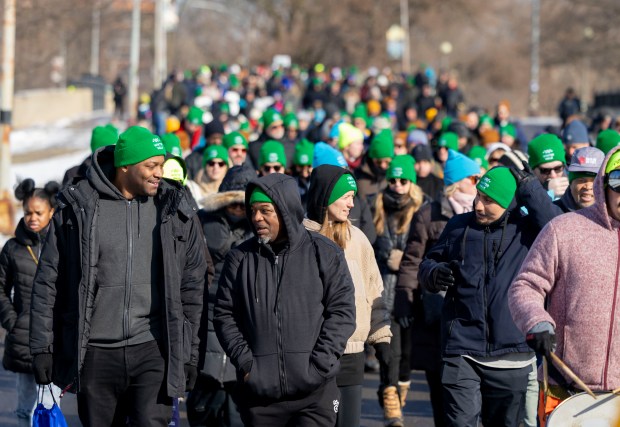


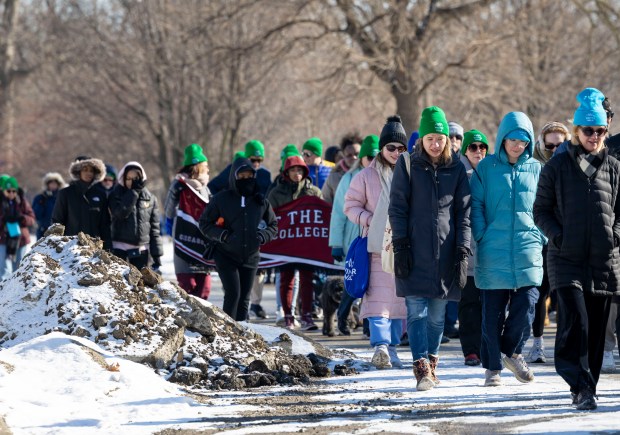
After the speeches, attendees walked a 2-mile loop through Humboldt Park, accompanied by banners and a marching band. Some walkers wore blue signs across their chests that displayed their motivations for participating.
Morrow, who now lives in West Humboldt Park, walked alongside Pamela Pickett, a recovery home manager at the Salvation Army. Pickett worked with Morrow as his counselor four years ago when he came to the Salvation Army for addiction treatment and housing programs, he said.
Pickett said she became a counselor because she knows what the people she serves are going through — she was homeless herself for nearly 20 years. She remembered crying tears of joy and gratitude the first time she bought towels, when she finally got a place of her own.
“Who would ever have thought somebody like me would be taking a walk for homelessness?” Pickett said. “I still am amazed. I thought I was going to die like that. I thought there was no hope.”
Like Morrow, Pickett said she benefited from treatment and support programs. She added that in her work today, she’s seen the homelessness crisis worsen, making the need for these programs and affordable housing all the more important.
Morrow told the Tribune that support programs are vital for giving people a new start. He hopes the Winter Walk Chicago crowds will continue to grow as the years go on, and he plans to remain an active voice in the fight to end homelessness.
“In order to keep something, we have to give it back,” Morrow said. “So my main goal is to help somebody else. It’s not to just keep it to myself.”



