
Democracy does not sustain itself. It survives only when each generation is intentionally welcomed into civic life and given a real opportunity to participate. That responsibility feels especially urgent today, as young people remain deeply engaged on the issues shaping our future but are still the least likely age group to be registered and voting.
This disconnect is not apathy. It is structural. Registration deadlines, confusing rules and inconsistent access make participation harder at the very moment young people become eligible to vote. When that first opportunity is missed, civic engagement too often never fully takes hold.
That is why I introduced HB4339, the Rev. Jesse Jackson, Sr. Young Voter Empowerment Law.
Nearly 61 years ago, Americans watched in horror as peaceful marchers in Selma, Alabama, were attacked for demanding the right to vote. That violence helped lead to the Voting Rights Act of 1965 and reinforced a truth that still matters today: Access to the ballot must be actively protected.
Jackson emerged from that movement with a lifelong commitment to expanding democratic participation. He understood that progress is not permanent. Naming this legislation in his honor is not symbolic. It is a commitment to carry that work forward.
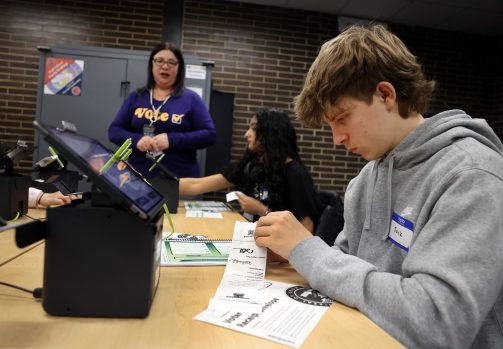
HB4339 requires Illinois high schools to offer students a voluntary, nonpartisan opportunity to register to vote. It does not tell students who to vote for or what to believe. It explicitly prohibits partisan activity in schools and ensures the process is educational, neutral and student-centered.
Schools are where civic identity begins to form. By meeting students where they already are, we normalize participation and help ensure young people are not excluded from democracy before they ever have the chance to engage.
Throughout our history, expanding democracy has meant removing barriers, such as ending literacy tests, poll taxes and intimidation. Today, the barriers look different, but they are no less real. Expanding access now means recognizing that lifelong civic participation begins early. Young people who register and vote in their first eligible election are far more likely to remain engaged for decades.
At a time when voting rights protections are being rolled back across the country, investing in youth voter engagement is not radical. It is responsible governance.
— State Rep. Kimberly Du Buclet, D-Chicago
Athletes’ fall from grace
Mark Mitchell wrote a lengthy op-ed on the common thread among college athletes who have been accused of fixing games (“Here is the common thread among college athletes accused of fixing games,” Feb. 5). The common thread? “Weak schools, poor neighborhoods and families with limited structure,” as well as living in “low-mobility counties.” But while Mitchell lists these issues, he admits he does not have a “clean policy fix.”
In addition, even in identifying this common thread, Mitchell perhaps leaves out more than he includes. First, while these young athletes may be the ones more likely to get involved with gamblers, Mitchell omits the fact that the vast majority of young athletes with this common thread do not get involved with gamblers. They know that it is wrong, and they don’t do it.
Also, Mitchell leaves out the fact that these young athletes have something most young people in their situation do not have: a chance to get a college degree at little or no cost to themselves and their family. They were blessed with an athletic ability, and the advantages that come with it, an ability most of their compatriots do not have.
Which is, perhaps, the real story here: We need to do our best and play by the rules, and if it seems unfair that there are some for whom things are easier, remember that nothing can be perfectly fair and, in any case, there are probably others for whom it is harder.
— Patrick J. Allen, River Forest
Support needed for all
Regarding Mark Mitchell’s op-ed: The bigger issue is how to make support available for all of the young people in such circumstances — not just a chosen few. And, of course, how to ensure that providing such resources produces a better overall societal outcome.
The recent news stories about fixing games have gotten a lot of attention, but the real question is about the actions of people in general, not just elite athletes.
— Jay Kosta, Endicott, New York
Bears’ negotiation tactics
Many understand that building a new football stadium can be a daunting task for any developer or management team. We also understand that the effort can be just as frustrating for city and state officials. Chicago, Arlington Heights and northwest Indiana are experiencing anticipation, expectation and frustration as they negotiate and wait for a decision.
To what extent are the Bears using each of these locations as bargaining chips when the decision overwhelmingly favors Arlington Heights?
The Bears knew they would encounter resistance downstate for Chicago and Arlington Heights. Enter Indiana. The Bears understood that Indiana would have to offer a package that was attractive and very difficult to turn down. They also anticipated that it could be the catalyst that would force Illinois to inflate their offer. It worked! Now, Illinois is talking about a $895 million infrastructure support package for the Arlington Heights site.
I believe the public understands the merits of certain negotiation tactics. However, I also believe Chicago and Indiana understand the difference between sincere and disingenuous.
The Indiana legislature has moved with breakneck speed to complete a package that would be difficult for the Bears to turn down. Three sites have been proposed with all kinds of impressive incentives. Many believe the Indiana package will be hard to turn down.
However, the big question remains: Why would Bears ownership spend $197 million on a piece of land in Arlington Heights and then build a stadium in Indiana? Also, we must not forget the Bears are worth over $8 billion. They are not worried about going broke. They just want to make sure the squeeze has been a successful tush push!
— George Comer, Crown Point, Indiana
Home to a new team?
I am no sports fan and especially am not in favor of any taxpayer money in any city or state going to sports franchises (or private schools, businesses or casinos — don’t get me started!).
But if the Chicago Bears go to Indiana, don’t they have to forfeit their name? Let the Bears go, and Soldier Field can become the home of a new Chicago team. Who will take it on and build a great new team from scratch?
Maybe they can even steal some of the existing Bears players.
— Leslye Winslow, Riverwoods
Maple Tree Inn memories
Thank you for the wonderful story by Cam’ron Hardy about Maple Tree Inn (“Milestone,” Feb. 4). I was lucky enough to work there from 1975 to 1978, when it was in an old two-flat on Western Avenue in Chicago with a wine cellar in the basement and a beer garden. I remember when Katie was born. Her dad, Charlie, was quite a character but sure knew how to cook.
When the restaurant first opened, it served delicious American fare. The sauerkraut soup with a dollop of sour cream and the ginger cake with hot lemon sauce were my favorite menu items. Sure wish I had asked Charlie for those recipes!
— Sheila Hansen, Western Springs
Submit a letter, of no more than 400 words, to the editor here or email letters@chicagotribune.com.