
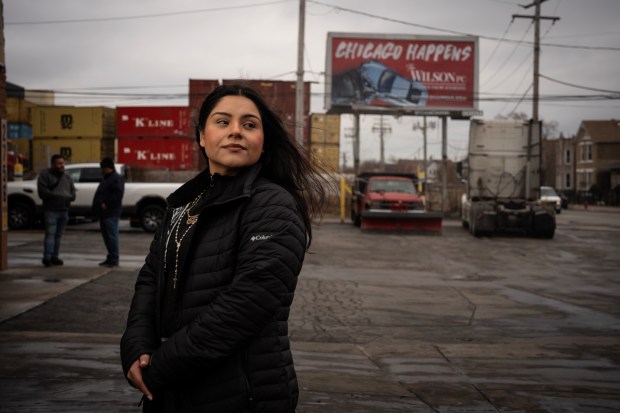




Lawyers for Marimar Martínez, the Chicago woman shot by a Border Patrol agent in October, said Wednesday newly released evidence in the case demonstrates how Trump administration officials “have created a culture of violence among their agents” where the shootings of U.S. citizens are “embraced, celebrated and promoted.”
Investigative materials made public Tuesday showed that after shooting Martínez five times on Oct. 4, Border Patrol Agent Charles Exum joked about it in a text chat with colleagues, was called a “legend” by one of his fellow agents, and even received praise directly from his boss, Border Patrol Cmdr. Gregory Bovino, as Martínez lay badly wounded in a hospital.
“As Marimar was fighting for her life, Greg Bovino was promoting the agent without any investigation being done into the shooting,” Martínez’s lead attorney, Christopher Parente, said in a statement Wednesday ahead of a news conference at a downtown law office.
Parente said the evidence shed light on the actions of Bovino’s agents in later operations in Minneapolis, where residents Renee Good and Alex Pretti were killed in incidents eerily similar to Martínez’s.
“This is why after agents shot Renee Good in cold blood on the streets of Minneapolis they did not attempt to perform CPR,” Parente said. “They were all checking their phones to see what reward commander Bovino was going to give them for successfully killing another protestor.”
Martínez’s attorneys called the news conference to review what they say were a series of lies perpetrated by Homeland Security officials about Martinez’s shooting, beginning within hours of the incident with the branding of Martínez, a Montessori school teacher with no criminal record, as an armed “domestic terrorist” who was part of a convoy attempting to box agents in that day.
With Martínez seated at a conference table with them, Parente and his co-counsel, Damon Cheronis and Michael Gallagher, also said they would be filing a federal tort claim Wednesday against the Department of Justice, which is a precursor to a federal lawsuit.
Unless the Justice Department takes action, in six months Martínez’s attorneys will file a federal civil rights lawsuit in U.S. District Court alleging excessive force by Exum as well as a pattern of misstatements by his superiors intended to smear Martínez’s character and cover up the truth, Gallagher said.
Gallagher said they would be asking for “tens of millions of dollars” in damages in the suit, and that they’d press for a quick bench trial later this year.
The Tribune asked to speak with a Department of Homeland Security spokesperson regarding the allegations, but was sent a written statement from U.S. Customs and Border Protection instead.
The agency confirmed for the first time since the shooting that “consistent with policy, Agent Exum was placed on administrative leave” while an internal investigation was conducted, but it did not say whether he was back on duty.
“CBP is committed to the highest standards of conduct, transparency, and accountability,” the statement read. “All significant use-of-force incidents are thoroughly investigated, reviewed, and presented to the National Use of Force Review Board, an independent body comprised of senior CBP officials and representatives from DHS and DOJ, including the DOJ Civil Rights Division.”
The evidence released by the U.S. attorney’s office — after Martínez’s lawyers pushed for a protective order to be lifted — offered a rare, behind-the-scenes look at one of the highest-profile investigations of Operation Midway Blitz.
It also shed light on the Trump administration playbook that has now become familiar in other cities like Minneapolis, where DHS Secretary Kristi Noem and others have quickly cemented narratives about the victims of the shootings and then refused to retract or correct their statements even amid evidence showing the contrary.
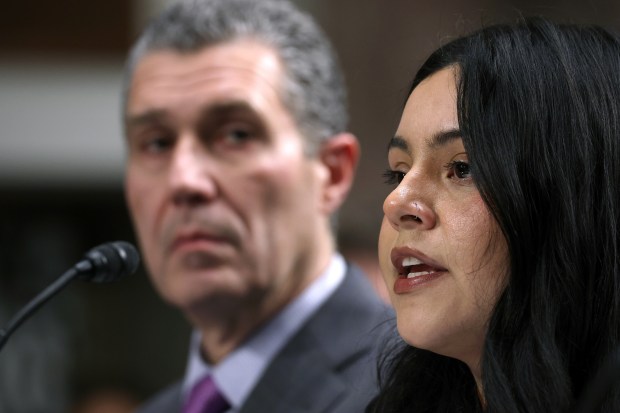
At the news conference Wednesday, Parente said “it is scary” to see the machinery unveiled, and that Martínez herself pushed for the evidence in her case to be made public because she sees herself as a voice for others who have been hurt or killed by immigration agents.
“We live in a strange time right now, where we cannot trust our government,” Parente told reporters.
Among the trove of evidence in Martínez’s case was body-camera footage from one of the agents in the car with Exum that day showing the tense moments just before their unmarked Chevrolet Tahoe, which was outfitted with an Uber sign, collided with her SUV.
“It’s time to get aggressive and get the (expletive) out,” one agent said as horns blared. Seconds later, Exum, who was driving with his Glock pistol in his right hand, appeared to jerk the steering wheel to the left, in the direction of Martínez’s vehicle alongside them.
“Be advised we have been struck!” one of the agents in the vehicle yells to a dispatcher. Exum then gets out of the vehicle and moves off-camera and five rapid-succession gunshots are heard. Martínez was struck by gunfire in the legs, arm and chest, but managed to drive off before calling 911.
A few hours after the shooting, Bovino sent an email directly to Exum and others in Border Patrol commending him for his work, the evidence released Tuesday showed. “I would like to extend an offer to you to extend your retirement beyond age 57…. In light of your excellent service in Chicago, you have much left to do!!” it read.
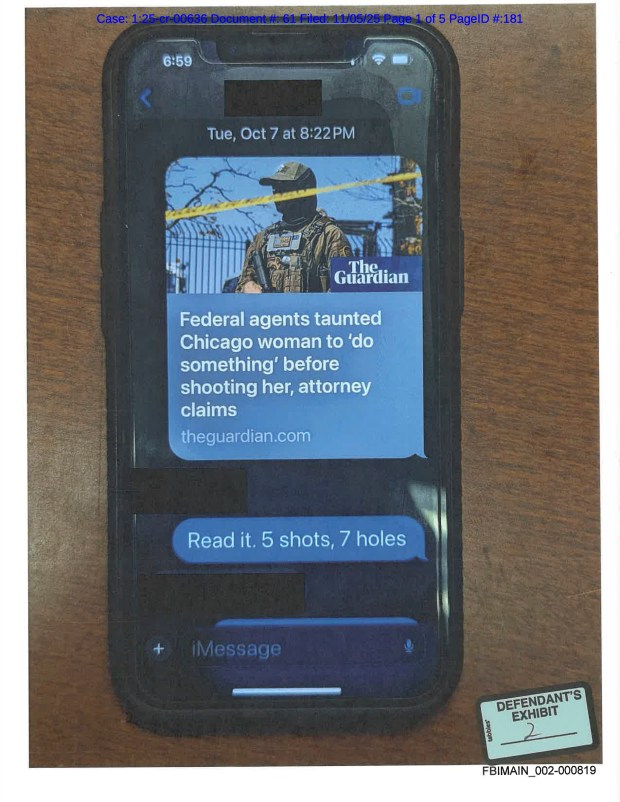
Exum, meanwhile, exchanged a series of texts with his wife as well as a group of fellow agents under the name “Posse Chat.” In one of them, someone Exum identified as “the guy from Vermont” wrote, “Good job brother, glad you are unharmed and get to live to tell the story.”
“You are a legend among agents you better (expletive) know that. Beers on me when I see you at training,” the agent texted Exum, the records show.
On Wednesday, Parente had several of Exum’s text messages displayed on large posters, and played portions of the bodycam footage and other surveillance video to point out how the shooting unfolded — and how he says the government tried to lie about it.
“If you watch these videos, you can see these agents are going down Kedzie Avenue Saturday morning, (and) these are automatic weapons. Their fingers are on the triggers,” Parente said. “One pothole, one kind of swerve by this agent and anyone on the sidewalk is getting sprayed with bullets. Why they are doing this on a beautiful Saturday morning on the South Side of Chicago is beyond me, but they are certainly not making our communities safer, in fact they’re making it worse.”
After the shooting, Parente said, government officials immediately attacked Martínez, saying she had a history of doxing federal agents and had posted threats on social media, including one specifically that said in Spanish: “Hey to all my gang let’s (expletive) these mother(expletive) up, don’t let them take anyone.”
But investigative reports released by Parente on Wednesday showed that threat had been posted by someone else unrelated to Martínez.
Parente also said ballistics evidence in the case showed Exum lied about firing all five shots through the front windshield of Martínez’s car. While three of the shots went through the passenger side of the windshield, another broke out the rear passenger window and the fifth went from back to front through the passenger side seat, indicating Exum fired as she was driving away from him, Parente said.
The other agents in the car continued to lie when describing the circumstances of the shooting to the FBI, including in a diagram that purported to show three cars in front of the agents’ Tahoe blocking them from moving forward.
Surveillance footage from a nearby tire shop that was secured by Parente and his investigators showed those cars were not there and that Exum could have kept driving forward.
“They drew those cars to justify a bad shooting,” Parente said. “You can’t argue that this is a gray area. This is simply black and white. They drew a picture saying they were trapped when they weren’t.”
But Parente saved his harshest criticism for the praise heaped on Exum by his colleagues and superiors after the shooting, which he said shows the “upsetting” culture within Homeland Security that celebrates violence against citizens who protest their actions.
“I’d like to go to their next training and see how many beers Agent Exum gets,” Parente, a former federal prosecutor, said about the text from a colleague offering to buy him drinks. “It’s pathetic that they celebrate this. I’ve worked with federal agents my entire career and I have never seen any of them celebrate having to shoot someone.”
As for Bovino’s email to Exum offering to extend his mandatory retirement, Parente said the message could not have been clearer that his superiors approved of what they were doing on the streets and “want you to keep going.”
“You’re proven yourself. You’ve proven that you are a shooter, that you’re willing to shoot a U.S. citizen, a protester. … It’s unbelievable,” Parente said.
Later this month, Martínez is scheduled to attend President Donald Trump’s State of the Union address to Congress as a guest of U.S. Rep. Jesús “Chuy” García, a Chicago Democrat.
Parente said it’s important to her to go to Washington “and show that she is a fighter … that they haven’t killed her, and that they haven’t prevented her from standing up for herself.”
“If she doesn’t do it, I don’t know who is,” Parente said. “Not many people have survived these shootings.”
jmeisner@chicagotribune.com