
Gwendolyn Whiteside, the star of “Come Back Little Sheba” at American Blues Theater, is one of the great Chicago actors.
You might not know that because over the last 15 years or so, Whiteside has moved into directing and administrative roles, including building a new theater for American Blues in a former drugstore on Lincoln Avenue. But I’ve been around long enough to remember her on-stage work from 20 years ago. It was exceptional then, and it is yet more remarkable now as she returns to the American Blues stage.
Whiteside is playing one of the mid-century canon’s trickiest roles in Lola, the woman at the center of William Inge’s “Come Back, Little Sheba,” a piece of domestic realism that once was so frequently produced as to be a virtual cliché, its raw honesty mistaken for sentimentality, but now has fallen into relative obscurity.
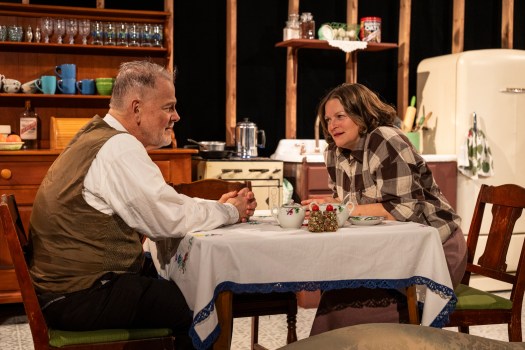
Played on film in 1952 by Shirley Booth (who was reprising her Broadway role), Lola is a frumpy, middle-aged housewife with the misfortune to be married to Doc Delaney, a recovering alcoholic played in director Elyse Dolan’s black-box production by Philip Earl Johnson. Their marriage was seeded in bitterness: Doc was a promising medical student but Lola became pregnant with his child and was thrown out on her ear by her father. Doc did the right thing, as they used to say at the time, but also dropped out of college. Worse, their child then died, and others became impossible, a situation that arrived long before the play begins. The Sheba of the title is a missing dog, but its symbolic referent is obvious.
Inge, a Midwestern writer who specialized in depicting ordinary lives of quiet desperation, throws into the mix a young college student named Marie, who has rented a room from this sad couple. Marie, played by Maya Lou Hlava, has an active sex life with both Turk (Ethan Serpan) and Bruce (Justin Banks) and Lola and Doc struggle with how to react to her, juggling genuine affection and worry for her well-being with the envy and bitterness that flows from the punitive reaction to their own situation and its long-term consequences for their lives.
Dolan’s production is staged in American Blues’ smaller studio with the audience arranged around the periphery of the space, allowing the actors to range freely as Lola begins to lose control of her world. Designer Shayna Patel has built one of those Chicago-style sets that didn’t cost a fortune but still evoke the fragility of these characters without symbolic pretension; it’s a fine environment for this particular play.

Not everything about the production works. I think the play works better with an intermission, as it was written, rather than going straight through, and although Johnson is excellent later in the play, his sober version of Doc is so low energy in the early scenes as to slow the pace of the writing; the show has to move a little more than it does here at times. And this symphony of sexual desire doesn’t always smolder as it can.
But this is Lola’s play, and Whiteside’s deeply moving performance is so multi-layered and, frankly, courageous as to more than compensate. I’d certainly stack its vulnerability, and also its optimism, against any other Inge interpretation I’ve seen over the years and it will linger long after you head back out onto Lincoln Avenue.
Chris Jones is a Tribune critic
cjones5@chicagotribune.com
Review: “Come Back, Little Sheba” (3.5 stars)
When: Through March 22
Where: American Blues Theater, 5627 N. Lincoln Ave.
Running time: 1 hour, 35 minutes
Tickets: $34.50-64.50 at 773-654-3103 and americanbluestheater.com