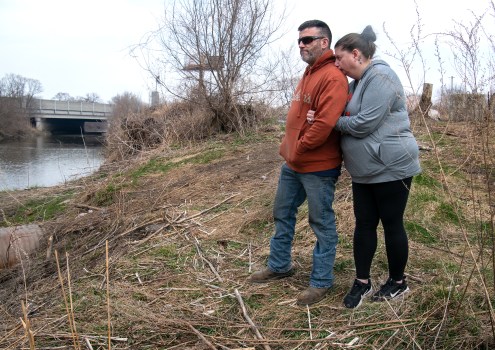

One year after icy floodwater poured into her Skokie neighborhood block on Lyons Street, Kathleen Schmidt is still paying the price for the extensive Valentine’s Day damage.
“I lost over $100,000 worth of stuff and the (village) was only going to give me $500,” for the Feb. 14, 2025, disaster, Schmidt told the Pioneer Press.
A large water main broke and triggered the fiasco, which caused financial losses, the shutdown of a major mall and other businesses, a lack of sanitary tap water for everyone in the north suburb of 65,000 and a lot of hassle.
As a single mother with school-age triplets, Schmidt said she didn’t have the time or resources to navigate a lengthy claims process. Her insurance provider agreed to cover the damages to her home only after she paid the full deductible. They didn’t cover the damage to her car.

“I had to buy a whole new car,” Schmidt said. “My payments went up $500 a month.” Two vehicles owned by Schmidt’s 82-year-old father, with whom she shares a residence, were also lost to water damage.
“It’s just really frustrating, and I had to go to therapy and my daughters had therapy because our anxiety was making it hard to function,” she said.
Schmidt is just one of the many residents and businesses still grappling with the fallout from the 36-inch water main break that left parts of Skokie flooded with freezing cold water last year.
The incident lasted nearly three days, triggered a boil water order for the village and ultimately a state of emergency, forcing many businesses to close on one of the most profitable holidays of the year: Valentine’s Day.

Village officials say they have taken significant steps in the past year to repair the damaged infrastructure and prevent future issues from occurring. But residents and local business owners say a year out from the flooding, they are still grappling with financial losses and unanswered questions.
The calamity occurred about six weeks before Skokie Mayor Ann Tennes was elected, but she has had to deal with the fallout.
“I remember that weekend clearly — the confusion, the disruption, and neighbors stepping up to help one another,” she wrote in an email to Pioneer Press. “Although I was not yet in office, I heard from many residents and businesses about the strain it caused, and those impacts lingered when I took office two months later.
“Since then, the Village has repaired vulnerable infrastructure and strengthened emergency communications. We are pursuing funding, working with state partners, and focusing on long-term improvements to our aging systems. If a similar situation occurs during my tenure, we will be better prepared.”
Infrastructure updates
At a November village board meeting, former Public Works Director Max Slankard assured residents that the department initiated an analysis immediately following the incident to determine the cause of the water main break and to prevent future infrastructure failures.
“We talked in the immediate aftermath of the water main break about next steps on our Feb. 18, 2025, presentation, and we’ve completed the majority of those steps,” Slankard said. “One of the things was to determine mitigation measures necessary to prevent this from occurring in the future and based upon what we’ve thought we’ve understood about the nature of this failure, we’ve taken care of the two biggest points of vulnerability through this investigation process.”
Exponent, an engineering and scientific consulting firm hired to investigate the infrastructure failure, later shared its findings at the meeting.
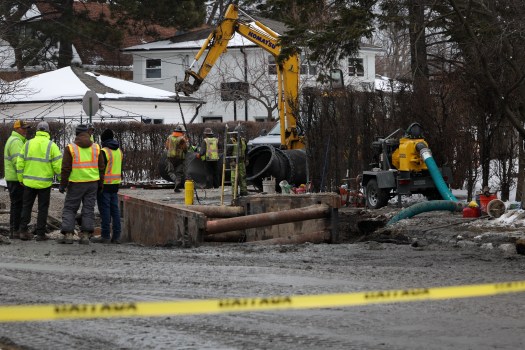
According to the investigation, the source of the failure occurred around 5 a.m. at the water main at East Prairie Road and Emerson Street. The break was caused by a failed fitting cap manufactured in 1956. The cap had an expected lifespan of between 80 and 100 years.

A later review of water records indicated that two additional locations were found to have “wye” pipe fittings similar to the fitting that failed last February, and crews excavated and replaced both fittings to add new infrastructure and concrete restraints.
Patrick Deignan, Skokie’s communications and community engagement director, said in an email that the village was also in the process of selecting a contractor “to conduct a broader assessment of large-diameter pipes,” specifically pipes that are 20 inches in diameter or larger in the transmission system, “to guide future risk and rehabilitation planning.”
Deignan added that village staff conducted “extensive door-to-door, phone and email outreach to households in the affected area,” and worked “closely with households impacted by flooding to document property damage and review insurance coverage.”
After receiving surveys from 11 residential property owners who reported damage to living spaces and 16 who reported vehicle damage, the village provided financial support ranging from “several hundred dollars for minor vehicle damage, to $10,000 for households with basement damage,” Deignan said. The financial support was distributed to households over the past summer.
Schmidt, the resident whose home suffered the extensive damage, said that village officials informed residents that they were “self-insured,” meaning the village had opted against third-party insurance policies and would pay any claims out of their own funds (up to $2,000, according to a Skokie financial report).
Schmidt said the village gave residents who filed claims with them an amount equal to their deductible, but advised residents to contact their own insurance providers.
Schmidt said she was told by officials that the village would not get assistance from the Federal Emergency Management Agency (FEMA) because fewer than 25 houses were affected by the flooding and that disaster relief did not include vehicles. Officials later told her they would only refund her insurance deductible.
Because Schmidt had been in contact with the city prior to their policy announcement, and had “written communication” with the village’s risk manager at the time, Schmidt said the village was able to give her the full amount promised in their communications, “which was only about $2,000.”
Deignan, the communications director, noted, “While the Village was not legally responsible for the damages resulting from this unprecedented event, we recognized the significant impact it had on households in the immediate area and made every effort to support their recovery.
“Because the aggregate damage did not meet the established emergency thresholds for state or federal disaster assistance, the Village chose to work directly with affected residents to provide financial support. The Village’s self insurance strategy provided a funding source to make this assistance possible.”
Slankard said at the board meeting that the biggest reflections from the water main break were “communication lessons” for the department. He confirmed the department received a lot of feedback from residents in the area regarding its messaging and outreach, and that it would prioritize future “timely coordination and communication of messaging” to the community.
“We did consider at the time deployment of the mobile police command station, but we had some concern, as I recall at the time, that we didn’t want to draw people out of their homes, out in the water environment when the situation was first going on,” he said.
Slankard acknowledged that the department’s telephone system did not function as effectively as intended during the break, and that it was “overwhelmed” by calls. He later stated that this spring, public works will be migrating to a new phone system with “virtually limitless capacity,” so that residents should never experience a busy signal.
While the department works to upgrade its communication system and emergency response messaging, village leaders said the incident underscored the broader challenges that arise with aging infrastructure across the city.
“I think just on a regional basis, the Chicagoland region has aging infrastructure,” said incoming Skokie Public Works Director Patrick Hastings, who has not started on the job yet. “It opened up a lot of eyes and made a lot of other municipalities say, ‘Hey, we need to start reviewing not only our capital needs, but also our procedures for handling situations like this.’”
Hastings, who currently serves as the director of public works for Schiller Park, said the event propelled that village to take a “different look” at the infrastructure in place. This included undertaking two new projects to re-line the water main and upgrade the piping in an incoming transmission meter pit from Chicago.
“I think what (the water main break) did was definitely, in my eyes, made us look at what are the critical points in our water system and start prioritizing those,” Hastings said.
Financial reimbursements
Despite the flooding being mostly contained in a residential area of northeastern Skokie and the northwestern portion of Evanston, the burst resulted in major financial losses for several local businesses and restaurants, including the closure of Westfield Old Orchard Shopping Center. It also forced the transfer of several Skokie Hospital patients due to a lack of clean running water in the area.
Marcos Rivera, owner of Libertad, a fine dining restaurant on Lincoln Avenue in downtown Skokie, said his damages totaled over $70,000 that weekend.
After more than a year of haggling over costs with his insurance provider, Rivera said he just couldn’t take it anymore and settled for the $4,000 they gave him.
‘It was a difficult and long process, and ultimately I pretty much got nothing,” Rivera said. “It was rough, especially considering that (it happened) on one of our best days of the year. (Valentine’s Day) is what gets us through the hump of winter.”
Rivera said the village offered local business owners the opportunity to apply for financial assistance after they received approval for emergency disaster relief from the U.S. Small Business Administration (SBA) in May 2025. But Rivera, along with many other small-business owners, opted not to file a claim with the village because the assistance was provided in the form of a low-interest loan that came with additional drawbacks.
“To take out a loan to cover a loss of something that the village did, and it wasn’t interest free … it didn’t feel very nice,” said Madeleine England, owner of Kneads & Wants bakery in downtown Skokie.
England also opted against the loan, but said her bakery lost a total of over $8,000 in waste, labor, accommodations and business over the weekend. Many customers came from across the city to buy pastries on Valentine’s Day and left angry when they couldn’t purchase anything. England said the event likely cost her future business as well.
“The communication was not good enough that some of the restaurants just operated normally, so they were serving in unsanitary conditions,” England said.
As the leader of the Downtown Skokie Merchants Collaborative, England said she wrote to village leaders on behalf of all merchants, requesting future communication on how to operate in water emergencies. Officials agreed to send this information, but England said she hasn’t received anything yet.
“That feels like the missing piece to me,” she said.
Fostering collective support
Carrie Cole, owner of Take Flight Spirits, a craft distillery in downtown Skokie on Lincoln Avenue, said she estimates her business lost between $3,000 to $4,000 in sales between Friday and Saturday.
“People come out for Valentine’s Day, regardless of the weather or anything. And since it was on a Friday, we were expecting it to be even better than usual. So it just, it hurt,” Cole said.
Cole said she didn’t file an insurance claim or apply for the village’s loan. “We’re already dealing with our small-business loan, and I didn’t want to add another loan payment onto that. We just toughed it out. And I do think it hurt for a couple of months.”
Despite the widespread disruption on what was supposed to be one of the biggest profit-generating days of the year, Cole reflected on the crisis optimistically, acknowledging that it worked to foster a sense of solidarity among local business owners and residents.
Later that month, a collection of local establishments partnered to launch a website where customers could donate or purchase gift items, with the proceeds shared across the participating businesses to help offset losses from the major holiday. Cole said the proceeds raised over $2,000.
“It’s such a great community,” Cole added. “Between all of the business owners, but also all of the residents. Some of our favorite residents live within walking distance of our tasting rooms. They came out to support us as soon as we were back open again.”
Tennes added, “I remain committed to supporting our small businesses, encouraging residents to shop locally and ensuring those still experiencing lingering impacts know the Village is here to help.”