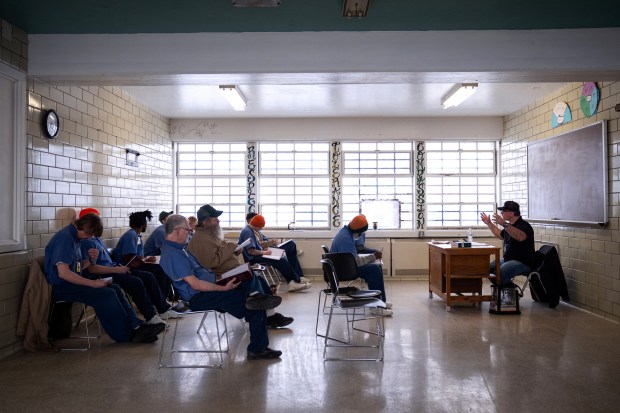







Wayne Antusas sits behind a wooden desk in a classroom in the A3 unit at Westville Correctional Facility, wearing a black T-shirt and a black baseball cap emblazoned with the Builder of Men Ministries logo.
The blackboard behind him reads “Fundamentals of Faith.”
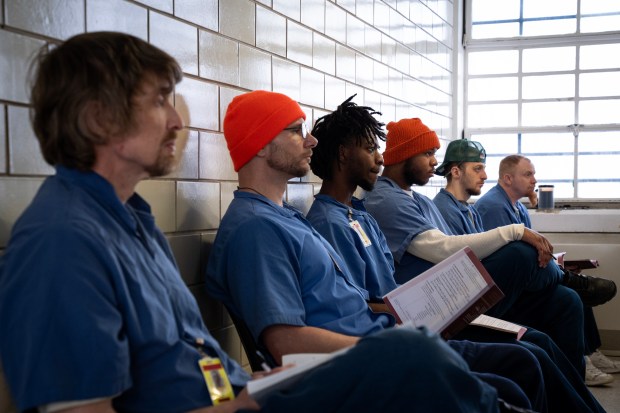
The 13 or so inmates who trickle into the room spread out over a few rows facing Antusas, clad in blue prison garb. Some wear long-sleeve shirts under the short-sleeved tops, a recognition of the chill in the room. Some hold clear plastic travel mugs full of coffee. A couple of them wear green baseball caps, but more are wearing orange knit stocking caps.
The sky outside the classroom in the prison wing, considered an honors dorm of sorts by prison officials because it’s reserved for inmates in the PLUS program, is cloudy on this January morning.
Windows line opposite walls in the classroom. On the panes between one set of windows, in loopy green script written vertically, are the words ‘Respect,” “Tolerance” and “Compassion.” Across the room, in the same script, are ‘Honesty,” “Integrity” and “Responsibility.’
The words represent the six core values of PLUS, the Purposeful Living Units Serve program, which is available in prisons across the state. According to the Indiana Department of Correction website, the program is a faith- and character-based reentry initiative.

“It’s our plush unit. It’s where we have a lot of our faith-based inmates who are engaged in religion,” Westville Warden Jason Smiley said about A3. “For the most part, these are the good inmates, trying to do their time and better their circumstances when they get out.”
When two of the inmates admit to Antusas that they didn’t finish their coursework after the last class, they drop to the floor at the front of the room and do 10 pushups, the same disciplinary tactic used if anyone in the class — including Antusas — is late.
Antusas’ class begins and ends with heads bowed for a brief prayer.
Sometimes, Antusas and the inmates read a selection from a maroon workbook in unison. Other times, inmates take turns reading passages aloud, and Antusas asks questions about the material they’re going over.
The 90-minute class is punctuated by “Amens” as Antusas goes over the points in the workbook for that day’s lesson about God and God’s actions.
“We take the word of God to be the word of God. There aren’t any contradictions,” Wayne tells the class.
‘Save the man, save the family’
Five years ago, after spending his entire adult life incarcerated, Wayne Antusas was a free man.
On Feb. 11, 2021, Illinois appellate judges tossed out his sentence for the 1995 killings of two teen girls in Chicago after Antusas and his attorneys from Northwestern University’s Center on Wrongful Convictions spent years arguing that Antusas, who was 17 at the time of the slayings and 18 when he was arrested and charged, had not been involved in the crimes.

These days, Antusas is back in prison sharing his faith with inmates at Westville five days a week. Builder of Men Ministries, which was incorporated and received nonprofit status last year, runs programs for inmates to help them turn their lives around and make them better husbands, fathers and community members when they someday leave prison behind.
“We believe that through a relationship with Jesus Christ, these men will overcome gangs and drugs and become better fathers and help the community,” Antusas said. The men, he said, can be examples instead of pariahs.
“Save the man, save the family,” he said.
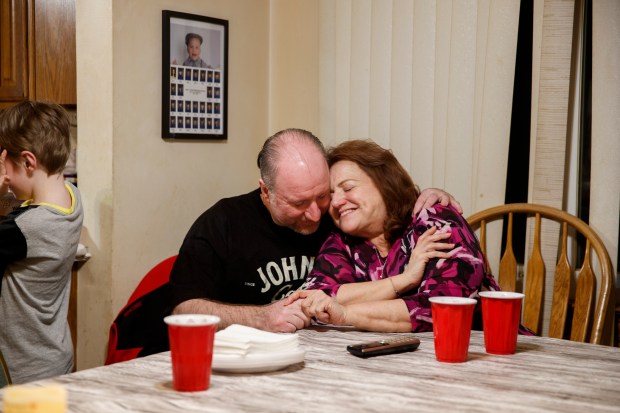
Sitting at the dining room table in his Portage home with his wife, Lena Marie Antusas, by his side, Antusas said he found God not long after he was arrested.
The two, who met through mutual family friends when Antusas was out on bond after his initial arrest, hold hands periodically. The longtime friends married just weeks after he was released from prison; at that point, Lena Marie was living in Portage with one of her sons from a previous marriage, and Antusas joined her here after his release. At times, they are overcome with emotion when they share Antusas’ story about how far he’s come.
Lena Marie, like the inmates in Antusas’ classroom, sometimes murmurs “Amen” as her husband speaks.
In November 1996, two months after his arrest, when he was still a teen at Cook County Jail, Antusas said two Black Christian men started spiritually challenging him. Antusas was raised in the Catholic Church on Chicago’s Southwest Side.
“This is the beginning of the change in my life,” he said.
He put a blanket down on his cell floor and got down on his knees. Tears streaming down his face, he said, Antusas asked God to forgive him for the sins he had committed, including smoking and drinking.
He got off his knees. “I felt like 1,000 pounds came off my shoulders.”
Throughout his incarceration, as he moved from facility to facility within the Illinois Department of Corrections, Antusas found his calling ministering to his fellow inmates. Antusas served throughout his time in prison, leading Bible study, devotionals and Christian services.
“I had the honor of baptizing 30 men in Menard (Correctional Center in Chester, Illinois), and that was one of the honors of my life still today,” he said.
He said he turned his cell at Menard, full of resources and biblical reference books, into a sanctuary. His mom told him he wasn’t in prison; he went to Bible college for 23 years.
Now, he’s at Westville five days a week, working with 150 men each week. He’s granted more than 800 certificates for completing his classes, provided more than 120 salvations and baptized more than 100 men there.

“I know Wayne wants to reach anybody he can reach and get his message to,” said Smiley, the warden at Westville.
Westville is a medium-security facility, with an average sentence of six to 12 years. Some inmates have “leveled down” from the maximum security Indiana State Prison in Michigan City and are closer to getting out.
Westville was built in the 1950s as a state mental hospital and in 1979 was converted into a prison to handle the booming prison population at the time, Smiley said. A new facility slated to open next year will have the capacity for 4,200 inmates, he said, and it will be state of the art.

The prison had 2,699 male inmates on Jan. 21.
“If they’re talking about Jesus and building their lives, they’re not doing drugs for the most part and walking around like zombies,” Smiley said. “Everybody here will get out.”
‘This is almost impossible’
Antusas has Level 1 access at Westville, a blue badge that’s a backstage pass of sorts for the facility, a change for a man who used to have an inmate badge with the Illinois DOC.
“This is almost impossible that I’m doing this today,” he said, holding up the badge. “This is insane. This is like a miracle.”
It’s also a marker of how far Antusas has come since he was released from prison in Illinois five years ago.
Initially sentenced to natural life without parole, Antusas was resentenced in May 2015 to 54 years in prison. After his conviction was overturned, a judge filed a certificate of innocence on his behalf on Nov. 29, 2021. He also received $256,000 from Cook County for his wrongful conviction.
Antusas has filed a civil suit in U.S. District Court for the Northern District of Illinois against the detectives, investigators and all who conspired to charge him with and convict him of a crime he didn’t commit.
Attorney Judy Royal, who retired from Northwestern University’s Center on Wrongful Convictions, still does pro bono work for the center and is in frequent contact with former clients, including Antusas. She was with the center from 2001 until she retired in 2018.
The center, she said, receives hundreds of letters every year from people seeking help with their cases. It’s difficult sometimes not to help everyone, she said, but the center has to make choices.
Lena Marie contacted the center on Antusas’ behalf when the two were just friends. Royal was not initially involved in the case, but the center was reluctant to take it on because there was no new evidence.
“It was basically a recantation case, and judges hate recantation cases,” Royal said of one of the other defendants in the case, who recanted his testimony about Antusas’ involvement in the slayings.
The case wasn’t easy to win, she said, and relied on the shifting stories of others, and proving that Antusas didn’t suggest changing the plans for the shooting that took the lives of two teen girls, because he wasn’t involved in the crime.
“I think that Wayne is a remarkable human being and I am so proud of him and how he has thrown his whole heart and soul into helping others,” Royal said.
She added his work also isn’t a surprise, given how much energy he put into ministering to other inmates while he was still in prison.
“Things coming from him have so much more impact than coming from others who don’t have that experience,” she said, adding Antusas radiates faith, positivity and hope. “People get a little tired of wrongful convictions, and his case is really unique.”
‘I saw hope’
Now, his goal is to tackle the state’s prison recidivism rate with Builder of Men Ministries.
According to an IDOC recidivism report, released in 2024 after tracking inmates who were released in 2021, state prisons have a 36.52% recidivism rate.
Antusas thinks his program can help with the recidivism rate, which he estimates is more like 40% or 50%, if it took into account former inmates who’ve left the state.
“I think we could get this thing under 10% recidivism,” he said.
If Phase 1 of Builder of Men Ministries is working with men on the inside, Phase 2 is a transition center that Wayne and Lena Marie hope to establish in Wheatfield at the former Wheatfield Academy, a now-closed Christian therapeutic boarding school for teen boys.
The 101-acre parcel at 12501 Rt. Indiana 49 has two dorms, a gym, a church, a pond, an educational center and a host of other resources. They are trying to raise around $2 million to purchase the property.
The two programs together — men would have to complete the program in prison to be eligible for the transition center — have the potential to change Indiana, Antusas said.
“What we do will change our communities,” he said.
Michael Petrovic has seen that change firsthand. Now 51 and living in Portage, Petrovic first met Antusas when he was an inmate at Westville a few years ago. Antusas hadn’t yet started his own ministry work but was doing similar work for another organization.
Petrovic said he circled in and out of jails and prisons, starting when he was a juvenile, for violent crimes including murder and struggled with addiction.
“There was never a transition unit,” he said by phone, adding that anyone who serves more than five years in prison needs assistance “before they step into society.”
The last time he landed at Westville, Petrovic said he was hopeless and had completely given up. He said he was badly injured when other inmates jumped him and he wound up in a coma for five days, suffering brain damage.
He was moved to a program for inmates struggling to overcome addiction, a program Petrovic admits he wasn’t qualified for, and met Antusas.
“He started with tears in his eyes, and I saw my reflection. Men don’t cry in prison. When Wayne started crying, those tears coming down his face were so many of the tears men couldn’t cry in prison,” Petrovic said. “I saw hope. That’s when I seen restoration.”
Petrovic was released on parole in 2024, and, as he promised Antusas, showed up at his church the first Sunday he was out. Petrovic was formally released from parole on Dec. 7. He hopes now that, with Antusas’ help, he has broken the cycle of prison.
“I was led by a man who has been through it, with Jesus Christ at the center. That was so key. That’s what Wayne is trying to do,” Petrovic said.
He is now married and serving the community, helping provide meals and other assistance.
“I’m passionate now. I have a purpose. Before, I didn’t care,” Petrovic said. “There’s just a huge difference.”