
I find myself, rewardingly, in a Reader state of mind.
It’s the result of spending time savoring the 300 pages of a book that some thought might never be created. “Free Chicago: 50 Years of the Reader” is a big, beautiful book, delivered to some 1,600 of us who helped fund its publication through a Kickstarter campaign launched in 2024. It is also available for purchase at chicagoreader.com.
This book coincides, serendipitously, with the “rebirth” of the Reader itself. A few weeks ago, under the headline “Chicago Reader, the city’s struggling alt-weekly, is going monthly under new owners,” my colleague Robert Channick interviewed its new editor, Sarah Conway, a 39-year-old Pulitzer Prize-winning investigative reporter, who said, “I think the Reader is going to retain its legacy, and then also, I really want to bring some of my approaches to doing investigative and feature work that centers on people, and is generative and expansive to the paper.”
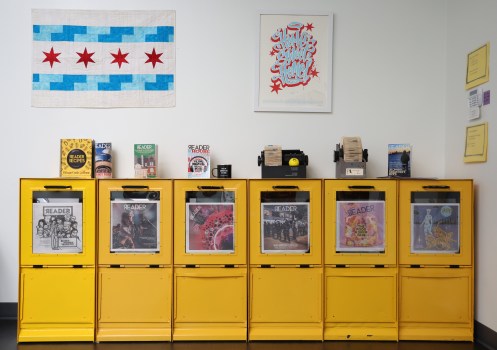
On Feb. 4, some 63,000 copies arrived at outlets and newspaper boxes across the city and suburbs, the paper’s Instagram page announcing, “The Chicago Reader is back in print beginning today. … We put an egg on the cover to symbolize rebirth as we enter a new era.”
The new issue has a yellow tabloid-sized cover with a large white egg with a small crack and the words “Free and freaky since 1971.”
And that is where the book takes us, back to a time when four young Carleton College alums — Bob Roth, Robert E. McCamant, Thomas J. Rehwaldt and Thomas K. Yoder — gave Chicago the first issues of the Reader, all 16 pages of it, on Oct. 1, 1971. As Roth says in the book, “At the very beginning, I think it was almost entirely motivated out of a crazy notion that we had that this was going to be fun.”

And that it was, great fun. And also important, innovative, entertaining, informative and useful, especially if you were into its voluminous classified listings for finding a place to live, a job, a used car, or a person to love. It has become one of the country’s longest surviving free city papers, with emphasis on free. As independent press expert Richard Karpel wrote in 2007, “the most significant historical event in the history of the modern alt-weekly (was)… when the Chicago Reader pioneered the practice of free circulation.” It was so coveted that copies were stolen from the printing plant before they were to be distributed and sold for $1.
Piecing together interviews from various sources with dozens, maybe hundreds, of writers, editors and other principals, the editor and designer Christopher Hass has been able to capture it all. The main historical text is written by my former Tribune colleague, Mark Jacob, who compiled a history of the Reader for its anniversary issue published on Oct. 13, 2021, at the behest of then editor/publisher Tracy Baim.
Last year, Hass asked him to update it.
“I was happy to do it but wasn’t sure when, or if, the book would come out,” says Jacob, who now writes books and the Substack weekly newsletter “Stop the Presses.” “It is a gorgeous coffee table book, the reproduction of the covers, the pages and the artwork is spectacular.”
He was able to get an interview with publicity-shy Fred Eychaner, now a big-money Democratic donor and philanthropist, who printed the Reader from its birth at his Newsweb facility. He told Jacob, “The Reader owed Newsweb far more than whatever our meager net worth was then.”
Jacob tells me, “If he had called for them to pay the bill, the Reader would have had to close immediately.”
Such stories enrich the book, and Jacob artfully captures the chaos at the Reader since it was sold to an outfit called Creative Loafing in 2007. There have been other owners since, an unsuccessful switch to nonprofit status, staff upheavals, and changes in format and frequency of publishing.
The latest? It was, as Channick put it, taken over “in a complex ownership transfer” in August by Noisy Creek, a Seattle-based media company.

Albert Williams joined the Reader in 1985 and was a writer, editor and theater critic until 2007. Over the weekend, he told me, “I am so happy this book has happened. It’s often said that journalism is the first draft of history, and the Reader was so tied to that, not just our cultural history, but politics and gay life, and more.”
He praises Hass (who also has an essay in the book, “Epilogue: What Was the Alt-Weekly”): “I appreciate the passion (he) brought to the project.” A recent former editor, Salem Collo-Julin, contributed an afterword, in which she writes affectionately of the paper and shares her hope for its future.
The foreword is by Chris Hayes, known for MS NOW’s “All In with Chris Hayes” and somewhat lesser known as a Reader contributor and son-in-law of former WLS-TV political reporter Andy Shaw. It’s a celebratory piece: “The Reader was more than a publication, more than a platform for journalism. It was a running conversation about the city. … Thank god it’s still alive.”
It’s been a struggle to remain so, and I have observed it closely since the beginning, wherever I picked up that first issue, likely some tavern on Lincoln Avenue. I have known and been friends with a number of its writers and editors. I wrote its Hot Type media column for a short time when I was between other newspaper jobs, played tennis on Saturdays with Bob Roth and, most recently and sadly, wrote the obituary for writer/editor Mike Miner, a friend who had a story in the Reader’s first issue and worked there for nearly 50 years.
Thanks to this book, I remembered John Conroy’s brave work detailing the horrors of police torture; the coverage of Harold Washington that help propel him to the fifth floor at City Hall; the distinctive work of such writers as Neil Tesser, David Moberg, Pat Colander, Grant Pick, Mike Lenehan, Lee Sandlin, Ben Joravsky and many others; the photos of Paul Natkin, Marc PoKempner and many others.Now, 50 years is a long time, and 54 and counting is even longer. I do not want to gather the names of newspapers and magazines that have vanished in that time, though it’s impossible for me not to think of the Chicago Daily News, because I worked there on March 4, 1978, when it folded after 102 years.
The Reader lives!
rkogan@chicagotribune.com