
As the United States marks the 250th anniversary of the signing of the Declaration of Independence this year, the Embassy of Ireland and Ireland’s consulates in the U.S. are reflecting on the role played by Irish communities in the making of America. Three of the signatories to the 1776 Declaration of Independence were born on the island of Ireland, and many others were of Irish descent, while the first person to print the Declaration of Independence was John Dunlap from County Tyrone. The declaration’s powerful assertions of rights and liberties reverberated across the globe and are clearly echoed in the 1916 Proclamation of the Irish Republic, which is the foundational document of the modern Irish state.
Although Chicago was not incorporated as a city until 1837, the city’s Irish community is also marking a significant milestone this year as the Irish Fellowship Club of Chicago — one of Chicago’s oldest and most influential Irish organizations — celebrates its 125th anniversary.
In addition to playing a central role in Irish community life in Chicago, the Fellowship Club has long been important to Ireland’s international engagement. As early as 1919, Irish Fellowship Club founder Edward Fitzsimmons Dunne — who served as Chicago’s 38th mayor and the 24th governor of Illinois — was one of three Americans who traveled to France to make the case for Irish independence at the postwar Paris Peace Conference. This group ensured that neither America nor Britain could altogether ignore the Irish question, while also influencing public opinion on Ireland in the U.S.
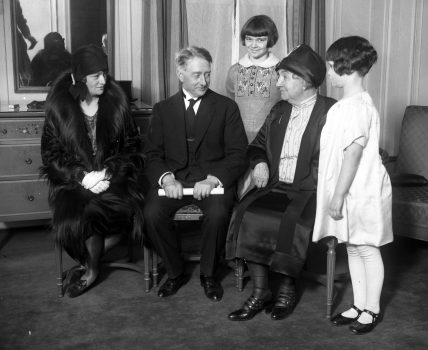
The Fellowship Club was an important partner after Ireland secured independence in 1922. An invitation from Chicago brought about the first official visit to the U.S. of the leader of an independent Ireland: William T. Cosgrave, the first president of the Executive Council of the Irish Free State, forerunner to the taoiseach, visited in 1928. It proved to be highly significant for Ireland’s subsequent diplomacy in the U.S., setting the template for decades to come.
After the establishment of the Irish Free State in 1922 and the conclusion of the Irish Civil War in 1923, many in the government focused on enhancing bilateral ties with the U.S. and cultivating the support of Irish American communities. In 1924, Ambassador Timothy A. Smiddy became Ireland’s first-ever diplomatic representative to the U.S. He encouraged Cosgrave’s 1928 visit, which Fellowship Club members Michael J. Faherty and Kevin Kelly prompted by asking the president to address the club. Smiddy assured his colleagues in Dublin that the Fellowship Club was “one of the most respected clubs in Chicago” and that the organization had hosted such distinguished guests as President William Howard Taft and President Theodore Roosevelt.
Cosgrave and his delegation arrived at the train station at LaSalle Street on Jan. 21, where they were greeted by Mayor William “Big Bill” Hale Thompson and a large group of aldermen, as well as Chicago police Capt. Patrick Collins, a brother of Irish revolutionary leader Michael Collins.

Big Bill brought Cosgrave for a ride in his open-top car, before the mayor hosted a luncheon for the Irish delegation at the Drake Hotel. This was followed by a visit to Tribune Tower, where Cosgrave met with publisher Robert R. McCormick and viewed the city from the tower’s rooftop.
That evening, Cosgrave addressed a crowd of 4,500 at a dinner organized by the Fellowship Club at the Stevens Hotel (now the Hilton). In his remarks, broadcast on the radio across the nation, Cosgrave expressed thanks for the United States’ support and spoke of the Free State’s achievements, emphasizing in particular its economic development.
Cosgrave made a call for Chicagoans to experience Irish independence for themselves, encouraging tourism and investment from his American audience. “We want all of you to … judge for yourself what use we are making of our freedom,” Cosgrave proclaimed.
The visit marked an arrival of sorts for Ireland on the world stage, with the Fellowship Club giving Cosgrave a remarkable platform to connect with Irish America.
Cosgrave attended Mass at Old St. Pat’s on Sunday morning before traveling to Washington, D.C., where he met with President Calvin Coolidge, senior members of the Coolidge administration and members of Congress. These engagements served as powerful symbols of the Free State’s legitimacy. Cosgrave’s itinerary also included stops in New York and Philadelphia, as well as Ottawa and Montreal in Canada. Everywhere he went, Cosgrave called on everyone who would listen to support Ireland, visit Ireland and buy Irish.
The Ireland-U.S. relationship has deepened immeasurably since Cosgrave’s visit. Today, Ireland is a modern European country with a global outlook, connected to the world in ways that Cosgrave and his contemporaries could only have imagined. Ireland has transformed into a high-tech, globalized economy. It is now the fifth-largest source of foreign direct investment in the United States, with Irish companies employing some 200,000 people around the country. In Illinois alone, around 12,000 people work for Irish companies.
More than 30 million Americans claim Irish heritage today, including over 1.3 million in Illinois and over 200,000 in Chicago. Over 1.7 million American tourists traveled to Ireland in 2023, and half a million Irish visitors traveled to the U.S. that same year, including the thousands of young students and graduates who work in Chicago on J-1 visas each year.

As Ireland-U.S. ties have grown, so, too, has Ireland’s footprint across the United States. Along with the embassy in Washington and the consulate in Chicago, Ireland is now also represented at consulates in Atlanta, Boston, Miami, New York, Los Angeles, San Francisco and Austin, Texas.
Last year, the Irish government opened Ireland House Chicago on Michigan Avenue, which brings Ireland’s diplomatic and economic teams together under one roof to create a hub for diplomacy and trade promotion.
Despite the evolution of the U.S.-Ireland relationship over the years, many of the early themes and partner organizations involved in Cosgrave’s 1928 visit to Chicago are as important as ever.
Illinois remains a key location for the promotion of Ireland’s trade and foreign policy priorities. Countless Irish dignitaries have visited Chicago over the years to engage with the city’s business, civic and political leaders, as well as to experience the iconic turning of the Chicago River green each March.
The Irish Fellowship Club of Chicago is also still a close partner of the consulate. The club has been a valuable source of advice and friendship for successive Irish diplomats in Chicago and has hosted senior Irish government representatives for decades, including the taoiseach in 2010, 2012 and 2019.
Mary Robinson and Mary McAleese, former presidents of Ireland, have also addressed gatherings of the Irish Fellowship Club; in 2024, the club supported the transfer of Robinson’s literary collection to DePaul University.
As the Fellowship Club prepares to mark its 125th anniversary, and as communities throughout the United States reflect on the 250th anniversary of the signing of the Declaration of Independence, Ireland is proud to celebrate our deep ties to Chicago and the contributions that our people have made — and continue to make — in this great city.
Brian Cahalane is the consul general of Ireland in Chicago. Pádraig Manning is the vice consul.
Submit a letter, of no more than 400 words, to the editor here or email letters@chicagotribune.com.