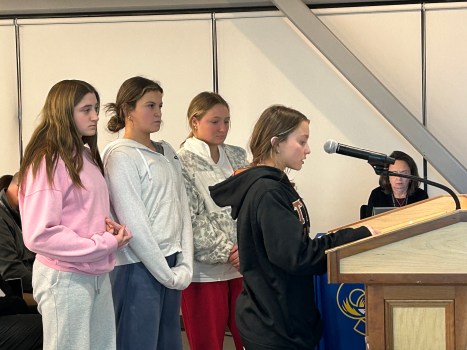

Addison Hartman, a sophomore on a cooperative gymnastics team made up of athletes from three Orland Park area high schools, said the team enabled her to continue the sport when the commute for club practices got to far, at least 20 minutes after school every day.
She said the team, created because the sport did not have enough participation for independent teams at each school, allows her to practice with teammates who live close to her. She said she has already learned a lot of new skills and made friends in her first year.
But Hartman said she was recently unsure what to tell other club athletes interested in joining the team because of an Illinois High School Association policy approved in December.
The policy prohibits cooperative teams from competing for team awards and in the IHSA state series if combined enrollment at the high schools in the co-op exceeds 3,500 students.
This rule applies to all six cooperative teams across Carl Sandburg, Amos Alonzo Stagg and Victor J. Andrew high schools beginning July 1, said District 230 Superintendent Robert Nolting. The teams are girls gymnastics, girls wrestling, girls and boys lacrosse and girls water polo.
Nolting said there are financial issues continuing the co-ops programs without IHSA support.
If the district split programs into independent programs, that could potentially double the cost to the district, to the tune of about $40,000, with the cost of increased coaching stipends, transportation, official costs, supplies and uniforms, he said in a statement.
He said some student athletes may lose opportunities because their school cannot continue supporting their team.
“We’d like to see if we can, pardon the expression, minimize the damage to some of the student athletes because, as we’ve heard from our parents and students, whatever the sport is, if it doesn’t matter to us, it matters to them dearly,” Nolting said.
Matt Troha, IHSA associate executive director, said Friday he was unaware of funding concerns throughout the process of approving the policy. He said the policy will affect 107 cooperative teams across 19 sports in the state.
Troha said a school representative, not an IHSA official, wrote the policy aiming to address large cooperative teams, or “super teams,” that may have a high rate of success due to team size. He said cooperative teams are meant to eventually split into individual school teams, but some school officials fear these teams may choose to stay together due to success.

Troha said the policy went through several town hall meetings and was ultimately added to the December ballot by the IHSA legislative commission, based on town hall feedback.
The policy passed with 488 school representatives voting in favor, 172 representatives voting against it and 66 representatives voting no opinion, meaning the policy passed with about 67% support.
“I will be frank, I do understand some of the intentionality of the bylaw because you don’t want to create super teams and that’s what some districts might be accused of doing,” Nolting said. “But cooperatives are really about developing sports so that you could down the road break up into, or in our case schools having their own program.
Several District 230 co-op teams have achieved state success in recent years, with the District 230 wrestling team winning the state championship last year. The girls gymnastics team won its regional competition with a team record Feb. 6.

Nolting asked the district board Jan. 29 for guidance on responding to the policy, clarifying it might not affect all sports the same.
He said gymnastics and wrestling programs qualify as individual sports and could still compete individually. He said these sports could possibly keep their program, and athletes could qualify individually for state championships, but the teams would not qualify for a team trophy or team recognition.
The other four co-op programs, he said, are team sports and are barred from competing in state tournaments. He said they can compete against other schools during their season but not at the IHSA tournament level.
He said four other superintendents told him informally that if they decided to keep their co-ops, they would be interested in participating in an alternative state series tournament, apart from IHSA.
But board member Tim Danlow said he was concerned some schools may not want to compete with the co-op teams because these teams would no longer count toward ranking for the state tournament.
“IHSA could look back at this and go, we really screwed this up here, we’re taking away opportunities from student athletes, which is not what we’re about, and reverse course,” Danlow said. “I don’t see any reason we need to jump the gun and even think about taking away opportunities from our students just because of a really bull-headed decision that could get turned around again.”
Nolting and Danlow also expressed concern that if sports with already low participation at the state level lose the co-op teams, the sport could be discontinued for low participation.
“There’s always concerns about some of these sports that maybe don’t have quite as much participation and maybe their long-term viability when things come up with things that could potentially limit participation,” Troha said.
The IHSA discontinued the boys gymnastics state tournament after the 2023 season due to low participation, marking the first sport dropped since the early 1980s. Participation had dropped to 40 teams, far below the threshold, with many schools relying on co-ops to maintain programs.
Nolting said he is particularly worried about state participation numbers for girls lacrosse, girls water polo and girls gymnastics teams.
The board informally agreed Jan. 29 to offer the co-op teams the option to compete individually, or for team sports against other teams outside of state tournaments, but not achieve a trophy, leaving the decision to the athletes.
Nolting said district athletic directors, principals and financial staff are working together to develop more formal proposals.
He also said district officials are interested in writing a reverse bylaw, but said under IHSA policy that cannot be written within the first year of the policy’s implementation.
District 230 sent two letters to the IHSA board opposing the policy and that were both denied, Nolting said. One letter requested IHSA delay implementing the bylaw by pushing it back to the legislative commission until schools, like those in the District 230, could have more time to adjust and make decisions, but was denied.
The policy was reviewed and discussed at the education committee on Feb. 4, Waterman said.
Waterman said administrators plan to review the policy with each school’s athletic directors, who she said will then speak with coaches, parents, and athletes.
“District 230 is finalizing its options, hopes to better define opportunities for teams vs. individuals, and is trying to determine thresholds needed to combine or sustain sports,” Waterman said.
awright@chicagotribune.com