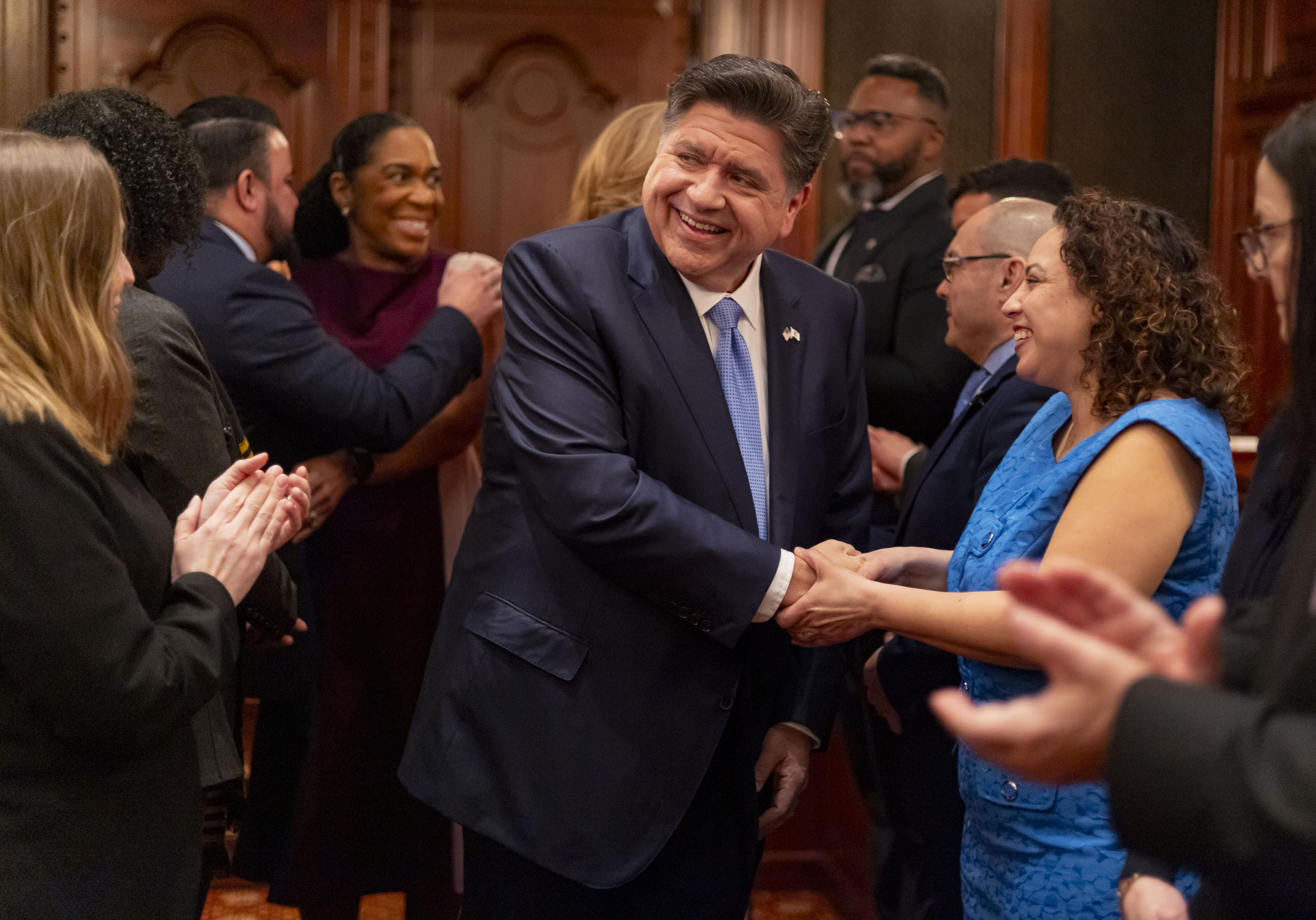
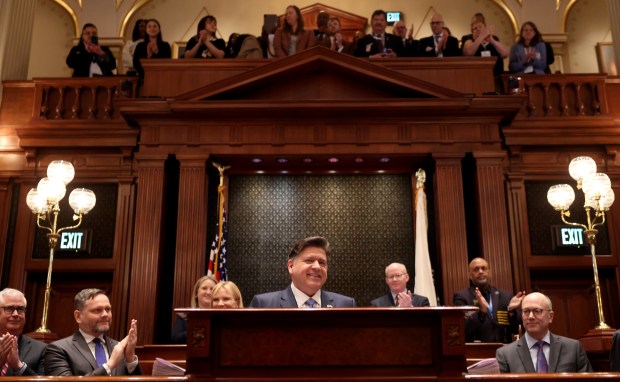


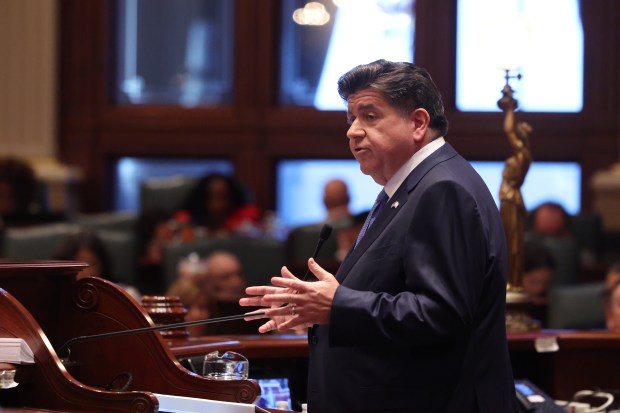
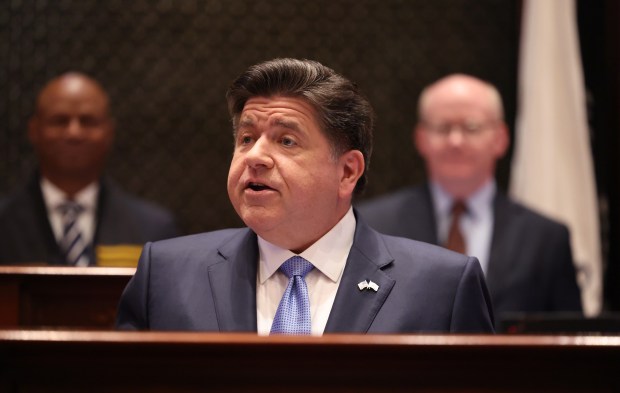



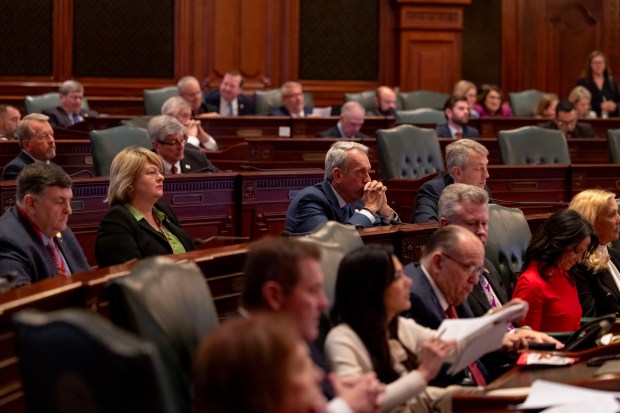


SPRINGFIELD — With an eye toward this election year and potentially the next, Democratic Gov. JB Pritzker used his State of the State and budget address Wednesday to cast Illinois as a bulwark against Republican President Donald Trump and to argue for an affordability-focused response to the White House’s often retributive economic moves.
The two-term governor, who is seeking reelection and considering a potential 2028 presidential bid, told a joint session of the Illinois General Assembly that the Trump administration’s actions and federal funding cuts — which he mocked, invoking “The Wizard of Oz,” as “proclamations from the Lollipop Guild” — have cost the people of Illinois $8.4 billion.
“When Donald Trump is taking resources away that are rightfully ours, none of us — Democrats or Republicans — should be OK with that,” Pritzker said.
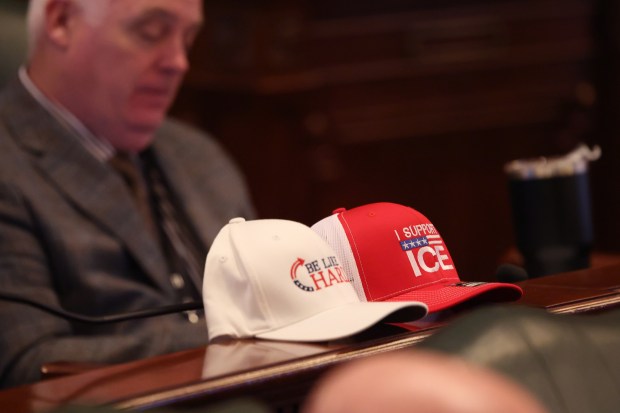
He then issued a stark warning aimed at Republicans, causing some of the most conservative lawmakers to walk out of the House chamber: “If you want to talk about our fiscal year 2027 budget, you must first demand the return of the money and resources this president has taken from the people of Illinois.”
The governor’s annual address kicked off budget negotiations with lawmakers that will carry on until the Democratic-controlled legislature’s scheduled adjournment at the end of May. Pritzker’s opening bid proposed a $56 billion spending plan balanced with the help of $649 million in tax increases and tweaks.
Most notably, the governor’s plan relies on $200 million in revenue from a new “platform fee” for large social media companies, coming as many tech executives have capitulated to Trump in his second presidency. Although both the Illinois House and Senate have Democratic supermajorities, Pritzker is still expected to face pressure in budget talks, as some progressive Democrats and others in the party’s base will urge the state to go further in taxing Illinois’ wealthiest residents and corporations.
In a roughly 47-minute speech that oscillated between state finances and national politics, Pritzker noted Trump’s aggressive enforcement of immigration laws by federal agents in the Chicago area during Operation Midway Blitz. He called Illinois the “canary in the coal mine” for the agents’ actions in Minneapolis, where two U.S. citizens were shot and killed.
“It’s a playbook as old as the game — overwhelm communities, provoke fear, suggest that those tasked with enforcing the law are also above it — and drip authoritarianism bit by bit into our veins in the hopes that we won’t notice we are being poisoned by it,” Pritzker said. “The problem for Donald Trump and (Trump senior homeland security adviser) Stephen Miller was that Illinoisans did notice.”
Nevertheless, the speech was more subdued in delivery and reception than last year’s address, which garnered national attention for drawing parallels between the second Trump administration and the rise of Nazism in 1930s Germany.
Adopting the refrain of “affordability,” a bipartisan political talking point ahead of November’s midterm elections, Pritzker used his eighth budget speech to say the state’s “narrative and our economy is changing and improving, and we’re setting ourselves up for even better results in the years ahead.”
“We won’t let headwinds from Washington stop us from addressing the fact that Illinoisans, like Americans everywhere, are still paying too much for groceries, too much for housing, too much for electricity, too much to live,” Pritzker said. “Everything is just too damned expensive.”
For the budget year that begins July 1, Pritzker proposed a mostly hold-the-line spending plan, contending the state needs to play financial defense against future Trump moves to slash federal funding in states the president views as his political opposition. The Trump administration has repeatedly slashed funding earmarked for states whose voters didn’t support his 2024 election, including Illinois. The White House has moved to cut or freeze funding for child care, transportation, education, energy projects, nutrition assistance and health care coverage, among other programs.
Among his proposals was a two-year pause of a state incentive program for large data centers amid concerns over the effect of their massive electricity use on residential ratepayers. He also issued an executive order directing his staff to identify sites for new nuclear power plants after a state moratorium was lifted.
Both those moves mark reversals for Pritzker.
In 2019, the rookie governor agreed to the data center tax credit to win Republican support for his first budget, and in 2023, he vetoed an initial proposal that would have lifted the nuclear moratorium, citing concerns it would “open the door to proliferation of large-scale nuclear reactors that are so costly to build that they will cause exorbitant ratepayer-funded bailouts.”

To encourage more housing, Pritzker proposed limiting local governments’ authority on residential zoning in order to allow duplexes, four flats and other multi-unit buildings, as well as so-called accessory dwelling units or granny flats, on more properties statewide.
He also sought to resurrect plans lawmakers failed to endorse from last year’s speech to ban students’ use of cellphones in schools, allow community colleges to offer specialized bachelor’s degrees, and force insurance companies to justify premium increases for homeowners.
On the revenue side, the new social media company tax would be based on the number of users those companies have in Illinois, with the projected $200 million being earmarked for K-12 education. Social media companies with 1 million or more Illinois users would pay $165,000 per month, plus an additional 50 cents per month for each Illinois user above 1 million.
Pritzker, who relinquished control of his personal investments upon taking office, as of last year was a shareholder in both Facebook parent Meta and Google parent Alphabet, according to state economic interest disclosures.
At the state’s 15 casinos outside of Chicago, Pritzker is proposing raising taxes on post-payout revenues from table games such as blackjack, craps and roulette to match the rates charged for slot machines. The additional $120 million in estimated revenue would help fund education.
Pritzker’s plan would generate another $269 million by extending a cap on how much corporations can deduct from their state taxes for operating losses, and an additional $60 million by reducing the percentage of state income tax dollars that are passed on to local governments.
But as the March primary and November general election loom, Pritzker made no call for a general tax increase, as he also called on lawmakers to curb their spending habits to create new programs.

The billionaire Hyatt Hotels heir may face pressure this spring from the progressive wing of his own party to ease the state’s budget pressures by raising taxes on the wealthy. Pritzker has resisted those calls since his failed attempt in 2020 to amend the state constitution and allow a graduated-rate income tax.
“I’ve always believed that the key to Illinois’ long-term fiscal stability is making our tax system more fair, so that the very wealthiest folks pay their fair share, and then we don’t have to dig into the pockets of working people to fund our budget,” said state Rep. Will Guzzardi, a Chicago Democrat who serves as a budget negotiator in the House.
“What that looks like, and the timing and actual language and implementation of it, I think, is still being discussed,” Guzzardi added, noting that he was “intrigued” by Pritzker’s proposed social media tax.
The Illinois Federation of Teachers, which recently tapped uber-progressive Chicago Teachers Union President Stacy Davis Gates to lead the statewide organization, was more outspoken, saying Pritzker and lawmakers face “a choice in his ‘maintenance budget’ to maintain inequality and giveaways to billionaires or to help Illinois’ working families who are struggling to maintain under higher costs and fewer supports.”
And Pritzker’s proposal to allow more multi-unit residences received immediate pushback from the Illinois Municipal League, as its members could lose some zoning authority.
“This is another example of where one-size-fits-all statewide mandates are unworkable,” Chief Executive Officer Brad Cole said.
Pritzker’s plan would raise spending on day-to-day state operations by only about 1% over the current year, among the smallest increases he has proposed since taking office. The plan “in some cases reduces programs that are important to me, some of which were proposals of my own,” Pritzker said during his speech.
That includes leaving on hold Pritzker’s plan to add 20,000 seats to state-funded preschool programs over four years. Intended as a signature initiative of the governor’s second term, the expansion was paused in this year’s budget after adding 11,000 seats over its first two years.
Spending on many major state programs would remain flat under Pritzker’s proposal, while elementary and secondary education would see a $305 million increase over the current year, helping bring overall funding to $10.7 billion.
For the second straight year, the proposed increase is below the $350 million minimum increase set by a school funding overhaul signed into law by Pritzker’s Republican predecessor. But the governor is proposing to continue a pause approved last year on the portion of the funding increase that goes to a property tax relief grant program.
For operations at public universities and community colleges, Pritzker is proposing an additional $16 million in state funding, a 1% increase from the current year, with $13 million going to universities. Funding for the Monetary Award Program, a program Pritzker frequently touts that provides grants to low-income students, would remain flat at $721.6 million. Overall, funding for higher education operations would remain essentially flat at $2.6 billion.
With Republicans once again campaigning on public safety issues despite falling crime rates, Pritzker’s plan highlights funding to hire and train 100 state troopers and add 100 more correctional officers at state prisons. The governor also proposed continuing the $111 million in spending for his Reimagine Public Safety anti-violence initiatives, which were originally launched with federal pandemic relief funds.

The governor’s plan calls for making the state’s full required pension payment of $10.7 billion, though fiscal watchdogs have long said those payments are inadequate to address the state’s gaping unfunded pension liabilities of about $144 billion.
Funding for a program that provides Medicaid-style health insurance to noncitizen immigrants 65 and older would be maintained under Pritzker’s plan, with $110 million coming from the state’s general fund. Last year, the governor cut a similar program for middle-aged adults to save hundreds of millions of dollars and close a budget gap.
The programs have been a source of intraparty tension among Democrats in recent years as costs ballooned well beyond estimates.
After Pritzker’s address, members of the legislature’s Latino Caucus said they’d push for additional funding for the program for older noncitizen immigrants as well as the health care system overall.
“This moment calls for more than simply holding the line. At a time of federal instability, Illinois must double down on protecting health care access and expand investments in the programs that serve people when no one else will,” Democratic state Sen. Graciela Guzmán of Chicago said.
Further reflecting the spending pressures that will come from within Pritzker’s own party, members of the legislature’s Black Caucus called for more support for the communities they represent, including in violence prevention, pretrial services and public universities.
“We hear about the new BUILD housing plan, nuclear expansion and clean energy projects,” Democratic Rep. Sonya Harper of Chicago said, referring to some of Pritzker’s proposals, “yet too many Black neighborhoods still don’t have a full-service grocery store, still don’t have stable living wage jobs, and still don’t see serious investments on their blocks.”
Looming over Pritzker’s spending plan are ongoing disputes with the Trump administration over federal funding for a wide range of programs. The governor’s plan assumes money from Washington, including $1 billion for child care programs, will continue to flow to the state.
But if those federal funds are cut off, the state will either have to find new ways to pay for those programs or drastically reduce services, state budget officials said.
Pritzker reserved much of the final minutes of his address to deliver a form of a love letter to Illinois and the country, urging citizens to use that emotion to embolden their hopes despite “the turbulence of Donald Trump.”
“I am begging my fellow politicians, my fellow Illinoisans, my fellow Americans to realize that right now in this country, we are not fighting over policy or political party. We are fighting over whether we are going to be a civilization rooted in empathy and kindness — or one rooted in cruelty and rage,” Pritzker said.
“I love my country. I refuse to stop. The hope I have found in a very difficult year is that love is the light that gets you through a long night,” he said.
Republican lawmakers, meanwhile, felt Pritzker used his speech to blame Trump too much for Illinois’ economic shortcomings and outlined too little to address affordability issues in the state, while furthering his potential 2028 presidential aspirations.
“Let’s be clear about what affordability really means. It means families can pay their mortgage and their utility bill in the same month. Means seniors can stay in their homes. It means small businesses can actually keep their doors open, and it means tax relief, not gimmicks, or new revenue schemes,” House GOP leader Tony McCombie of Savanna told reporters Wednesday. “You don’t lower the cost by growing government. We do it by growing our state.”

Candidates in the March 17 Republican primary for governor in many ways echoed the party’s legislative leadership, saying Pritzker’s efforts to blame Trump over affordability issues were misplaced and failed to reflect the Democratic governor’s enactment of tax hikes and costly programs during his tenure.
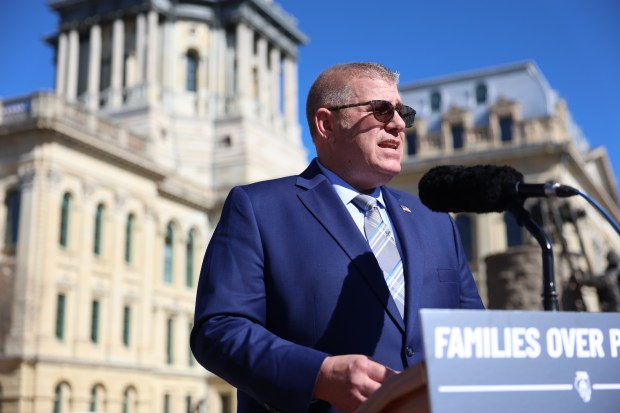
“Illinois doesn’t have a revenue problem. Illinois has a spending problem, and Illinois has a priorities problem,” said Darren Bailey, who is again seeking the GOP nomination for governor after losing to Pritzker four years ago.
“What families didn’t hear was an honest acknowledgement of what life actually feels like here in Illinois. Families aren’t living inside of (gross domestic product) statistics,” Bailey added. “They’re living inside of grocery stores where prices are too high. They’re opening property tax bills that feel impossible and they’re staring at utility bills that continue to climb.”
Ted Dabrowski, another candidate for the GOP nomination to face Pritzker in November, said the last seven years under Pritzker have been “dismal.”
“Bottom line is we’ve seen seven years of decline, seven years of quality of life, fail. And I think you could ask lots of people in Illinois, ‘How is your quality of life?’ And they can’t give you a positive answer,” Dabrowski said.
Pearson reported from Chicago.