A Lake Superior Court Civil Division judge has denied a request from four Hobart homeowners challenging the city of Hobart’s designation of 725 acres as an Economic Revitalization Area (ERA) with property tax abatements.
The property, presently farmland, is located at 61st Avenue and Colorado Street, and the designations are connected to the proposed Amazon data center development.
Judge Kristina Kantar, in her ruling made on Wednesday, said “the actions of the Hobart City Council in designating an ERA and approving a tax abatement, by means of written resolutions approved at public meetings, is hereby confirmed.”
“This is a final appealable order and no cause for delay exists,” Kantar said in her written decision.
Hobart City Attorney Heather McCarthy issued the following statement in regard to the decision made by Kantar:
“The city of Hobart is pleased to announce that the Lake Superior Court has ruled in its favor, confirming that all statutory provisions were followed, including procedural requirements and due process. The court further ruled that the record reflects the Hobart City Council made its decision in an appropriate manner, supported by substantial evidence. This ruling validates the city’s position and affirms the council’s commitment to acting lawfully and responsibly on behalf of its residents. Mayor Josh Huddlestun remains steadfastly committed to advancing initiatives that benefit the city and its residents, a priority that continues to guide every decision of his administration.”
Kantar on Tuesday took all evidence under advisement following a Gary court hearing that lasted more than two hours.
The four homeowners, including Angelita Soriano, Albina Venegas-Roman, Barbara Koteles and Joseph Conn, were seeking to vacate two city council resolutions awarding real property tax abatements and a council resolution approving an enterprise information technology exemption for entities that have said they intend to develop data centers on property within the ERA.
The plaintiffs, in their complaint, said the Hobart City Council’s grant of a personal property tax exemption to Amazon Data Services was “arbitrary, capricious, not in accordance with law and not supported by substantial evidence because the council did not validly declare the subject property an ERA.”
The plaintiffs were seeking a declaratory judgment that the tax exemptions granted to Amazon Data Services be declared null and void and that the resolutions passed by the Hobart City Council be declared null and void.
Soriano, a spokesperson for the Hobart homeowners, said on the No Data Center group’s Facebook site: “The court’s verdict unfortunately did not go in our favor for the Feb. 17 ERA hearing, but let’s not get discouraged.”
“The scope of this hearing was extremely limited. We were only allowed to argue if this land was blighted or not. The first argument determined if we had legal standing to make this argument and the judge determined that we did have legal standing,” Soriano said.
“However, throughout the proceedings, the other attorneys repeatedly argued the burden was on the residents (appellees) to prove the land was not an Economic Revitalization Area. While we strongly disagree with that premise and believe that the city council should have been required to demonstrate and prove to its residents as to why this land qualified as an ERA in the first place, it basically became a Catch 22,” Soriano said.
“Unfortunately, under current Indiana law, the statute does not require the city council to carry that burden the same way it did for us when we were appealing it. Apparently per a more recent 2022 General Assembly language amendment, vacant farmland qualifies for an ERA. Thus the law is structured to give enormous discretion to the city, even when the public raises serious concerns,” Soriano said.
Several people testified at the hearing held in Gary on Tuesday including Hobart Realtor Sophia Mason; Hobart City Councilman Matt Claussen; and Brandy Schaeffer, an economic land development principal for Amazon.
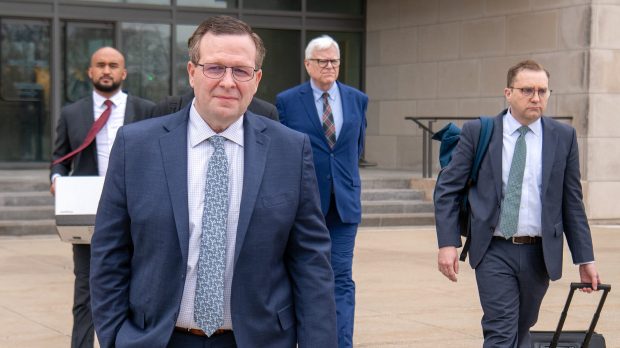
The four Hobart residents were represented by attorney David E. Dearing of Dearing Law Firm.
Deborah Laverty is a freelance reporter for the Post-Tribune.