
This week, the United States hosted two sets of peace talks in Geneva: indirect talks with Iran and trilateral talks with Ukraine and Russia. Neither achieved much, which was unsurprising since the men leading the U.S. delegation for both have more experience in real estate deals than conflict resolution.
Oman mediated the talks with Iran, which occurred under the shadow of President Donald Trump’s military threats and calls for regime change. The rapid military buildup in the region echoes the buildup near Venezuela just before the U.S. abduction of Venezuelan President Nicolás Maduro but with preparations for something far more complex even than the 12-day Iran-Israel war that the United States joined in last June.
Trump’s initial threats concerned the Iranian government’s violent crackdown on anti-government protests last month. He encouraged the protests and claimed on his Truth Social account, “HELP IS ON ITS WAY.” But the Iranian government successfully crushed the unrest, and arrests and abuse of dissidents continue. The plight of Iran’s people didn’t appear to be on the agenda at the talks this week.
The Iranians responded with threats of their own. As talks were underway, Iran’s Revolutionary Guards also closed the Strait of Hormuz, a critical oil export route, in a clear effort to remind the world of the havoc it could wreak on global energy prices if it chose to do so.
Despite the seemingly high stakes, the talks ended with nothing more than some agreement to “general guiding principles” for future discussions on the nuclear program. While the Iranians seem convinced that they bought themselves time, the threat of imminent war remains as U.S. military preparations continue.
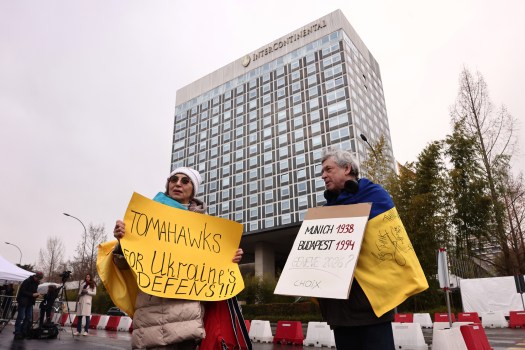
Almost immediately after the Iran talks concluded, the U.S. team turned to Russia and Ukraine, which seemed even more futile. Ahead of the talks, Trump again publicly pressured Ukrainian President Volodymyr Zelenskyy to make concessions instead of making demands on Russian President Vladimir Putin, the instigator of the war whose military continued to carry out airstrikes on electricity infrastructure across Ukraine as the talks continued.
Zelenskyy responded that he was ready to secure a “worthy agreement to end the war” but did not believe Russia was serious about peace as Moscow continued to demand the surrender of even more Ukrainian territory as a condition for a deal. Ukraine sensibly sees firm security guarantees as the necessary starting point to ensure that any territorial concessions don’t become a foothold from which Russia can simply resume its attack. The tense talks continued into a second day but concluded without progress, in a diplomatic effort that seemed little more than another stalling game for Putin.
The U.S. team in both negotiations consisted of Steve Witkoff and Jared Kushner. Witkoff is a real estate developer, investor and golf buddy of Trump who had no diplomatic experience prior to his appointment as a special envoy last year. Kushner is Trump’s son-in-law who was appointed as a senior White House adviser during Trump’s first administration but holds no official role with the U.S. government now.
What the two have in common is close ties to Trump and huge financial interests in and investment from many of the countries that they have been dealing with on behalf of the U.S. government. Alongside peace talks conducted over the past year, the head of Russia’s state fund has frequently met with Witkoff to discuss massive economic deals including the acquisition of Russian energy assets and rare-earth mines, in exchange for bringing Russia sanctions relief.
Kushner’s investment firm has secured billions of dollars in investments from investment funds controlled by the governments of Saudi Arabia, Qatar and the United Arab Emirates. World Liberty Financial, a crypto company founded by the Trump and Witkoff families, secured a $2 billion investment from a UAE-backed government firm around the same time that Witkoff successfully advocated for the export of advanced artificial intelligence chips to the UAE, a deal that had been prohibited previously due to national security concerns with the UAE sharing the technology with China. All of this raises questions about their motivations, competence and conflicts of interests, which should be squarely prohibited under the Constitution’s Emoluments Clause.
Kushner first reemerged on the scene in October to help Witkoff broker the Gaza-Israel peace deal, which was lauded but has made little progress yet toward resolving the underlying obstacles to peace. Most notably, all living and dead Israeli hostages have been returned, but Hamas has not yet disarmed, Israeli strikes continue to kill Palestinians and incoming aid remains seriously inadequate to meet dire humanitarian needs. Meanwhile, Kushner has been touting the “amazing investment opportunities” that a peaceful Gaza could offer.
Implementing peace deals is notoriously difficult, so slow progress can be expected. But the question remains whether this unconventional diplomatic duo has what it takes to turn dealmaking into real peace that serves U.S. national interests rather than their own. As Trump’s new Board of Peace meets in Washington this week to discuss complex next steps in Gaza, the world may soon find out.
Elizabeth Shackelford is a senior adviser with the Institute for Global Affairs at Eurasia Group and a foreign affairs columnist for the Chicago Tribune. She is also a distinguished lecturer with the Dickey Center at Dartmouth College. She was previously a U.S. diplomat and is the author of “The Dissent Channel: American Diplomacy in a Dishonest Age.”
Submit a letter, of no more than 400 words, to the editor here or email letters@chicagotribune.com.