
The Rev. Jesse Jackson was a civil rights icon. A presidential candidate. A global leader. But for the people living on tree-lined South Constance Avenue in South Shore’s Jackson Park Highlands, Jackson was a neighbor.
Although he worked alongside the Rev. Martin Luther King Jr., captured political and media attention and founded the Kenwood-based Rainbow PUSH Coalition, to his neighbors, he was a friendly face who made others feel seen.
They shared fond memories of Jackson, who died Tuesday morning at age 84 after years of declining health and for decades lived at 6845 S. Constance Ave. with his family.
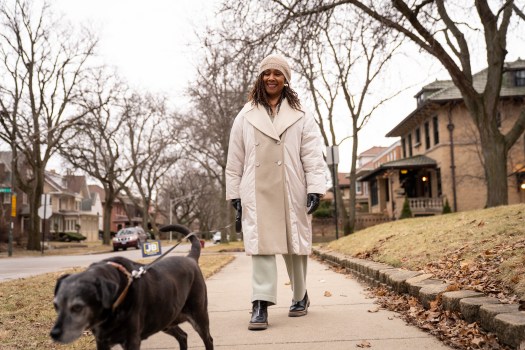
“Just seeing him in the neighborhood was kind of like a quiet reminder that greatness can live right next to you,” said Joy West, 63, who has lived three doors down for the past 30 years.
Jackson was the type of neighbor to compliment your baby as you push her in a stroller and then stop by your house to celebrate her law school graduation decades later, West said.
West said she credits Jackson with playing a major role in keeping the doors open at Roseland Community Hospital, where she still works as a doctor. Around 10 years ago, financial struggles put the hospital in jeopardy, West said. She confided in Jackson about the situation, and he invited her to speak at PUSH and visited the hospital to gain the attention of lawmakers.
West said Jackson committed to seeing those who weren’t often seen.
“He would take your issue and advance it forward so that others would understand the need to help,” West said.
Jackson was no stranger to bringing important issues to light in Chicago. He came to the city to lead the Southern Christian Leadership Conference’s initiatives to promote Black employment and businesses. Through PUSH, Jackson led boycotts, like those against WBBM-TV over minority employment and promotion and the beauty company Revlon for its comments alleging Black hair-care companies made inferior products in the 1980s.
Neighbors said he left the home recently as his health declined further, but even still, he left a large impact on the block. The house’s white walls with black trim and cobblestone porch saw a lot of history, including an investigated arson attempt in 1973. Two of his children also remained close by in their own homes as adults.

Junelle Speller, 51, has lived next door to the Jacksons for nearly 10 years. Speller said she and her family hosted him for a barbecue and would talk in their driveways. She added that she appreciated how Jackson would always ask after her three daughters. He was an extension of her family, Speller said.
Speller recalled how Jackson shared stories about the Civil Rights Movement and his presidential campaigns. He also talked about the “strides that we need to make going forward,” Speller said.
“He was absolutely wonderful,” Speller said. “Very personable, genuine, generous with his time.”

Dominique Ross, a soon-to-be-retired judge who lives across the street, said she also appreciated Jackson’s kindness to her child. Ross recalled that when her son visited a few years ago, Jackson offered to take him to a baseball game after their first introduction.
“I think that he and I both were surprised, but I think that’s just in line with the kind of man that Rev. Jackson was and how neighborly he was,” Ross said.
West said what stuck with her about Jackson was how forward-thinking he was. He wouldn’t spend much time talking about his past unless asked, West said. Instead, she said he talked frequently about local issues and what needed to be done in the present to support the most vulnerable.

Jackson continued protesting and speaking publicly into the current decade, even after being diagnosed with Parkinson’s disease in 2017. He spoke at demonstrations after George Floyd’s murder and was arrested several times in 2021 at protests for voting rights legislation. Jackson was demonstrating as late as June, protesting a Loop Target with Rainbow PUSH to call for a boycott of the retailer due to the rollback of its diversity, equity and inclusion initiatives.
After Jackson got sick, his son, U.S. Rep. Jonathan Jackson, stepped into his shoes, West said. The congressman is also her neighbor, West said, and spoke recently at a funeral for her aunt, who was a Bronzeville activist and PUSH supporter.
Jonathan Jackson is “maintaining that Jackson commitment not just to the larger community and the nation, but to the neighborhood,” West said.
Esther Schechter, 87, has lived in her house for over 60 years. Schechter said she and her husband bought the place for $30,000 in 1965. They even toured the home that Jackson would move into a block away, which Schechter remembered as having five bedrooms and an elevator.
Schechter said that before she moved in, the Jackson Park Highlands was a wealthy, white area. Home values in the Jackson Park Highlands dropped when the Blackstone Rangers gang, which became the Black P. Stone Nation, formed nearby, she added. Schechter moved in as most other white people moved out. Today, the area is around 88% Black, per census tract data, and the average home value is around $570,000, according to Zillow property value estimates.
Schechter and her husband liked to go for walks, she said, and the two would see Jackson on his. Schechter said she got to know him as they passed by each other.
“Every time I would go by and he was there, he would always give me a hug,” Schetcher said.
After Jackson’s death, visitors — both those who knew Jackson personally and those who did not — came to the house to leave flowers, balloons and cards on the porch and in the yard. They spoke of a man who changed the country and paved the way for other Black leaders.
But West said that to her, Jackson’s legacy is not only the change he made at the national level or what’s in the history books. It’s also the impact he had on his block.
“Rev. Jackson wasn’t just this global civil rights leader,” West said. “He was my neighbor.”