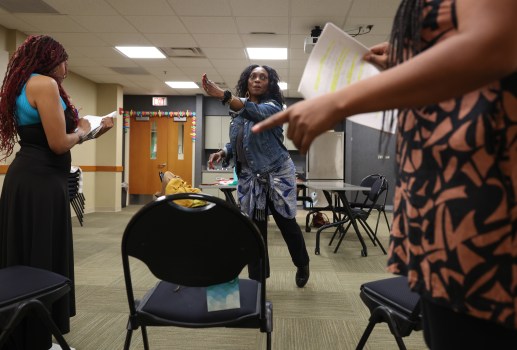


Caryl Churchill’s 1982 drama “Top Girls” is widely considered one of the best British plays of the 20th century, but until this week, it was one of those modern classics that I’d never had the opportunity to see live. After attending Raven Theatre Company’s new production, directed by Lucky Stiff, I’m glad to report that it was worth the wait. With a top-notch cast and slick production design, Churchill’s clever concoction of speculative fiction, corporate satire and family drama remains sharp and timely.
Claire Kaplan stars as Marlene, an ambitious professional woman who’s just been promoted to managing director of the Top Girls Employment Agency, hopscotching over an older man who feels he deserved the job. To celebrate her achievement, Marlene invites to dinner a group of notable women from history and legend. The guests include Pope Joan (Morgan Lavenstein), a ninth century woman who rose to power disguised as a man; Lady Nijo (Hannah Kato), a 13th century Japanese courtesan turned Buddhist nun; Patient Griselda (Luke Halpern), the obedient wife from Chaucer’s “Canterbury Tales”; Dull Gret (Yourtana Sulaiman), who was depicted leading an army of women into hell in a Flemish renaissance painting, and Isabella Bird (Susaan Jamshidi), a globe-trotting, Victorian-era Scotswoman.
The infamous dinner party scene lasts nearly an hour, but there’s never a dull moment as the women crack dirty jokes and swap stories of what they did to survive, or even get ahead, in patriarchal societies. The cast rises to the challenge of Churchill’s rapid-fire, often overlapping dialogue, with comedic highlights including Pope Joan’s coarse frankness and Dull Gret’s unexpected interjections. Amid the boozy chaos, it becomes clear that these women share sobering similarities, despite coming from different eras and cultures.
After the first of two intermissions (a choice that logistically makes sense but somewhat slows the pace), the action jumps to Marlene’s present day, in the early years of conservative politician Margaret Thatcher’s tenure as the UK’s prime minister. Back in Marlene’s working-class hometown, we meet her teenaged niece, Angie (Sulaiman); older sister, Joyce (Jamshidi), and Angie’s young friend, Kit (Collin Quinn Rice). Next, Marlene’s workplace comes into focus, featuring lively banter among the women of the office (Kato and Halpern), a tense confrontation with her male colleague’s wife (Jamshidi) and a humorous sequence of interviews with clients seeking work (Halpern, Rice and Lavenstein).
Just about any woman who’s navigated a professional environment will relate to at least one of the Top Girls clients. Although these vignettes are largely comedic in tone, they raise serious issues such as ageism, sexism and classism. It’s easy to draw parallels between these working women from 1980s Britain and our own moment in the post-Dobbs U.S., considering the disproportionate drainage of women from the workplace during the pandemic, the rising influence of trad wives and their apologists, and the weakening of an already threadbare social safety net for working parents.
Joonhee Park’s grayscale set design, complemented by Ben Carne’s fluorescent lighting, particularly suits Marlene’s harsh corporate world, but the chilly look also nods to Thatcherite austerity throughout the play. At several points, Carne and Park use opaque scrims to create striking silhouettes of the women. Sound designer and composer Dee Etti-Williams provides cool transitional music that blends electric bass and the sound of a typewriter into a driving rhythm; during other scene changes, ’80s-style pop music plays while Rice (in whichever character they’re playing at the moment) dances to a Walkman. On the whole, the production design is period-appropriate yet neutral enough to give it a modern feel.

Without spoiling plot details of the last scene, which flashes back to Marlene’s long-overdue visit to her sister and niece, it’s safe to say that the hidden costs of her successful career are revealed in this family-focused finale. Kaplan and Jamshidi are riveting here, as Marlene’s coolly confident mask slips away and Joyce’s maternal persona belies a steely inner core. Viewers don’t need to be overly aware of the era’s politics to recognize the differences in worldview, circumstances and loyalties that painfully divide these sisters. It’s a dilemma common to families across time and place: who stays, who leaves, and what’s the fallout of these decisions for each party? These questions continue to haunt modern women, even — or perhaps, especially — those who make it to the top.
Emily McClanathan is a freelance critic.
Review: “Top Girls” (3.5 stars)
When: Through March 22
Where: Raven Theatre, 6157 N. Clark St.
Running time: 2 hours, 40 minutes
Tickets: $45 at raventheatre.com