
Sometimes, I like to choose a book based upon a truly minimal amount of information, to just see a title, a cover, a single line of description and dive in.
I recognize the irony of this position as someone who talks about books and tells other people what they should read for part of his living, but one of the side effects of our interconnected media and social media ecosystem is that we often have access to too much information, information which can cloud our individual experiences.
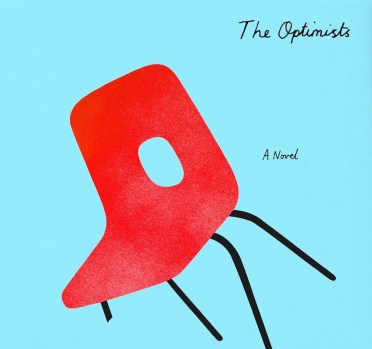
So, I dove into Brian Platzer’s “The Optimists” based on the title, the cover image (one of those molded plastic school chairs with one leg snapped off), and a single sentence, “Mr. Keating is an extraordinary teacher.”
It was a good choice. “The Optimists” is an interesting, oddball book that had me well-invested in the fates of its characters.
“The Optimists” opens with a classroom scene in 1997, narrated by Mr. Keating. We are in the midst of a ritual, the blinds drawn, a candlelit lantern the only illumination. A student, Clara, is being dubbed an “Archon,” the highest level of something called the “Ember Exam.”
Mr. Keating addresses the reader, acknowledging our possible confusion, telling us that this is OK: “It was for them, not you. They were children. And it made sense to them. Especially to Clara. Even if she didn’t want to admit it at the time.”
What unfolds from there is an unpacking of these things as Mr. Keating tells his story entirely retrospectively. We learn that he is confined to a specialized chair following a stroke-like event, and can only communicate by moving his eyes across a screen. He is using his time to write his life story as a teacher and the particularly special relationships he had with Clara, and another student, Jacob.
Jacob is the son of Enid, a former girlfriend of Mr. Keating’s who has enlisted him for occasional quasi-parental work, though Jacob is not his son. Clara lives upstairs from Jacob with her troubled parents. Jacob attends the exclusive St. George’s Episcopal School because Enid teaches art there. Clara is on scholarship and she is brilliant, the only student to pass all levels of Mr. Keating’s exam on the finer points of grammar and rhetoric. She is also preternaturally charismatic and capable, and as we move between past (where Mr. Keating narrates the events) and present (where Keating reflects on them), a narrative builds of the way these lives intertwine.

We know we are heading to some kind of climax, but it is clear that the journey is the point, and this fact had me grateful I entered the experience with such ignorance.
The journey is episodic, as there are years when Clara and Jacob are not in Mr. Keating’s life. The present-day scenes fill in some of the blanks. Mr. Keating has had a full life, a great love (Caroline), friendships, decades of teaching, thousands of students. Clara and Jacob are at the center of the narrative, but the story is deeper than this. It is about what it means to invest your time in steering and aiding the fates of others.
My only quibble is describing Mr. Keating as an “extraordinary teacher.” For sure, he is, by all evidence, an excellent teacher, but in my experience, this is true of many, many teachers. What is extraordinary is not the teacher (or student), per se, but the underlying experience of teaching and learning as a communion of unique intelligences.
Perhaps we can come away with the notion that if we pay enough attention, the ordinary is extraordinary.
Book recommendations from the Biblioracle
John Warner tells you what to read based on the last five books you’ve read.
1. “The Underground Railroad” by Colson Whitehead
2. “James” by Percival Everett
3. “The Trees” by Percival Everett
4. “What We Can Know” by Ian McEwan
5. “Theo of Golden” by Allen Levi
— Bill T., Chicago
Hopefully, Bill will forgive the recommendation of a wee novella, but this feels like the right pick, Alan Bennett’s “The Uncommon Reader.”
1. “Bewilderment” by Richard Powers
2. “The Wedding People” by Alison Espach
3. “Beautiful Ruins” by Jess Walter
4. “So Far Gone” by Jess Walter
5. “The Age of Acrimony: How Americans Fought to Fix Their Democracy 1865-1915” by Jon Grinspan
— Jonathan B., Elmhurst
I think Jonathan will take to the sly humor of Emily Adrian’s “Seduction Theory.”
1. “My Friends” by Fredrik Backman
2. “The Housemaid” by Freida McFadden
3. “The Wedding People” by Alison Espach
4. “The Women” by Kristin Hannah
5. “The Book of George” by Kate Greathead
— Liz P., Chicago
Richard Russo’s “Empire Falls” should have the kind of human drama that Liz gravitates to.
Get a reading from the Biblioracle
Send a list of the last five books you’ve read and your hometown to biblioracle@gmail.com.
John Warner is the author of books including “More Than Words: How to Think About Writing in the Age of AI.” You can find him at biblioracle.com.