
Most American cities are organized on an unrelenting grid, an artifact of early European settlers’ simple and unimaginative approach to land surveying and real estate speculation. While most of Chicago’s well-noted architecture has been built on this grid, our major diagonal streets create numerous “flat iron” sites across many neighborhoods.
The North Side abounds in these anomalies, including Clark Street, Broadway and Lincoln, Milwaukee, Elston and Clybourn avenues. There are fewer on the South and West sides, most prominently Ogden, Blue Island and Archer avenues. And while not all of these diagonal streets reach the Loop, it’s unusual for them not to point in that direction (Ogden being the most obvious example that originally terminated at the old Chicago Academy of Sciences building in Lincoln Park).

The term flat iron building can be applied to any triangular-shaped structure with an acute angle, so named for a resemblance to the old-fashioned cast-iron home appliance for pressing clothes. The most famous example is Chicago’s by provenance, the Daniel Burnham-designed building in New York at the corner of Fifth Avenue, Broadway and 23rd Street. Completed in 1902, that 22-story-high structure quickly became iconic through the 1903 photograph by Alfred Stieglitz and a 1904 photograph by Edward Steichen. New York’s Broadway creates similar sites along its path, but only the old New York Times building (1904, Cyrus L. W. Eidlitz) between 42nd and 43rd streets has much architectural presence — it gave Times Square its name and provides the base for the annual New Year’s Eve ball drop.
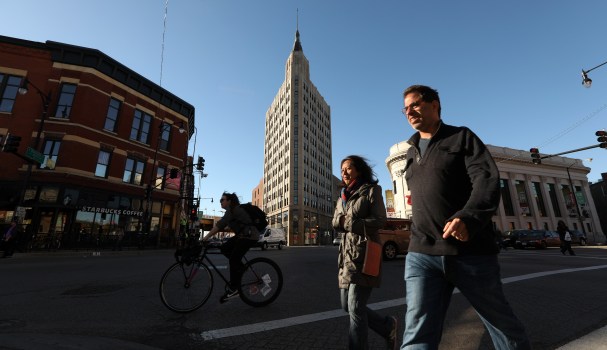
Chicago has a lot more versions, although we don’t really celebrate them enough. The straightforward terra cotta-clad, three-story-high Flat Iron Arts building (1913, Holabird & Roche) at the intersection of North, Milwaukee and Damen avenues is our sole entry that names the building for its urban type. But that same intersection in Wicker Park demonstrates the versatility of the form with the stately art deco Northwest Tower (1929, Perkins, Chatten & Hammond), now The Robey, and the classically ornamented jewel box Noel State Bank (1919, Weary & Alford), newly minted as the Barnes & Noble in Wicker Park.
In Lincoln Park, the intersection of Fullerton Parkway, Halsted Street and Lincoln sports a pair of modest but handsome terra cotta-clad, two-story flat iron buildings that frame Lincoln. And the solidly classical 12-story-high Sheridan Trust & Savings Bank building (1926, Marshall and Fox) at Lawrence Avenue and Broadway in Uptown is another variation on the theme with a less acute angle and no distinctive prow. A more contemporary take was designed by Ralph Johnson of Perkins & Will in 2004 at the corner of Archer Avenue and State Street in the South Loop. The Perspectives Charter School is a sleek, metal-skinned structure that celebrates its library with an exposed steel frame at its two-story-high point.
When well considered, the flat iron is a building that fits in and stands out. It’s this multivaried quality that allows many of them to be less obvious than other buildings. These are good neighbor buildings that can attract attention in a quiet way — which is why so many of our local examples don’t get much attention — and why we should value them as essential elements of densely developed and thriving urban communities.
The latest plans for Foundry Park, previously the north portion of Lincoln Yards, include two enticing opportunities for new flat iron structures — at the corners of Cortland and Kingsbury streets and Sheffield avenue. The planned development approved earlier this week by the City Council is being developed by a joint venture of Chicago-based JDL Development and Boca Raton, Florida-based Kayne Anderson Real Estate. The locally based firm of Hartshorne Plunkard Architecture is responsible for the urban planning across the entire 28-acre project as well as the schematic building designs produced to date.
The Lincoln Yards scheme had tenuous connections to Chicago’s grid. Foundry Park scores better, maintaining Cortland, Kingsbury and Southport Avenue with the proposed new neighborhood’s center within the large triangular block created by these streets. It’s not spectacular urban design, but it is better than the previous version. At the north end of the block is a 156-foot, 11-story-high hotel with cast stone and masonry cladding. Its feel is residential with a comfortable sensibility that wouldn’t be out of place in the Gold Coast.
Its immediate neighbors are two midrise apartment buildings that adopt an appealing, if safe, industrial vibe similar to many new buildings in the West Loop and Fulton Market. It’s the southeast corner of the block that promises to be the signature structure, an enormous flat iron building with offices, apartments and condominiums. At 520 feet and 38 stories, this glass, stone and metal-clad tower will be — by far — the tallest flat iron building in Chicago. And almost twice as tall as Burnham’s New York Flatiron building.
The still schematic design shows a large-scale grid across its facades grasping at some form of architectural decorum while demonstrating the building’s unwieldly proportions. This is the right place for the tallest building within the development, and creating a flat iron with its prow facing the Loop is a good start. But it needs some serious design development as well as a reconsideration of its size.
Standing at the corner of Kingsbury and Cortland, it’s easy to dream big. This is the logical place for Foundry Park’s signature structure — which isn’t to say that it needs to be anywhere near as tall as proposed. And after years of false starts, Foundry Park is a definite improvement over Lincoln Yards. But the architecture of this building needs to be better — much better. The architects and developers need to go back to school on the flat iron building type — and they don’t even need to leave Chicago.
And a reminder that bigness only guarantees quantity, not quality.
Edward Keegan writes, broadcasts and teaches on architectural subjects. Keegan’s biweekly architecture column is supported by a grant from former Tribune critic Blair Kamin, as administered by the not-for-profit Journalism Funding Partners. The Tribune maintains editorial control over assignments and content.
Submit a letter, of no more than 400 words, to the editor here or email letters@chicagotribune.com.