SPRINGFIELD — With enrollment plunging at many of Illinois’ regional universities, state leaders are again pressing a sweeping overhaul of higher education funding — one that would steer more money to smaller campuses despite firm opposition from the state’s flagship system, the University of Illinois.
The proposal, years in the making, stalled in the General Assembly last year. Now lawmakers hope a revised version could gain traction this spring and direct more support to universities that serve larger shares of low- and moderate-income students, even as Gov. JB Pritzker cautioned last week that a final agreement remains far from certain.
The debate comes as more Illinois high school graduates — particularly those who once filled the classrooms of directional schools such as Western and Eastern Illinois as well as Chicago State University — are looking beyond the state’s borders for college. With state funding lagging, schools have raised tuition to stay afloat, a cycle the legislation’s sponsors say their plan could break.
“When you underfund schools, you’re pushing universities to raise the tuition at the same time,” said Democratic state Sen. Kimberly Lightford of Maywood, the main Senate sponsor. “They’re unable to help students stay in school, so they are pricing them out. They’re leaving the state of Illinois and they’re going to other states.”
The concept has won support from every public university system in the state except the University of Illinois, whose leaders have argued the proposed formula fails to account for fiscal nuances among universities, especially large institutions like U. of I.
“Our concern with the current proposed model is not its intent, but its design,” a U. of I. spokesperson said in a recent statement to the Tribune. “As drafted, it applies a uniform formula that does not fully account for differences in institutional missions, scale, or statewide responsibilities.”
U. of I. officials have previously pointed to its system’s size as proof that the proposed formula needs additional tinkering, since more than half of Illinois’ public university students attend its three campuses in Urbana-Champaign, Chicago and Springfield, including nearly half of the state’s Pell Grant recipients. The system employs about 31,000 people statewide, including workers at UI Health.
Democratic state Rep. Carol Ammons of Urbana, whose district includes the University of Illinois’ largest campus but who supports the overall higher education funding plan, said University of Illinois officials have had ample opportunity to recommend specific ways to better refine the data underpinning the model.

“They have suggested that those numbers are not quite accurate, and we have asked the University of Illinois repeatedly to provide us better data,” said Ammons, the main House sponsor. “We’re still waiting on that.”
After delivering a State of the State address focused heavily on the politically popular theme of “affordability,” Pritzker said Wednesday that any overhaul must prioritize students’ costs, not just institutional funding.
“The way the bill is designed, at least last session, the way it was designed was much more about the schools and funding the schools than it was about making sure that more students or that students who attend can afford it,” Pritzker said. “Those are tweaks that need to happen.”
New version of old plan
The legislation would establish a new funding formula modeled loosely on Illinois’ landmark 2017 overhaul of K-12 education. Universities would receive sustained, long-term increases in state support based on how far they fall short of a calculated “adequate” funding target — the level the state determines is needed to operate effectively.
Western Illinois University, for example, currently receives about 46% of its calculated adequacy target, the largest gap among public universities. The University of Illinois Urbana-Champaign stands closest to its target by percentage, at 88.6%. Under the proposal, schools furthest from adequacy would receive priority for new dollars.
Advocates argue that the approach would stabilize campuses serving rural communities and working-class students and help stem the outflow of Illinois high school graduates.
In real dollars, estimates suggest the state could invest as much as $1.7 billion in new funding over 10 to 15 years, with recommended but not mandated annual increases of about $135 million to move universities toward their funding targets. A “hold harmless” provision would ensure that no university receives less state funding than it does at the time the law would take effect.
Lawmakers backing the measure have made one significant revision since last year, hoping it will lead to its passage this spring. While the previous legislation called for factoring universities’ endowments into funding assessments, the revised bill removes that section, a move supported by the U. of I. as well as the regional schools. Universities feared that including endowments in the formula could discourage donations to the schools.
Still, in an election year marked by budget pressure, committing to long-term spending increases poses political challenges, something Pritzker tacitly acknowledged last week even as the bill has been backed by some of the state’s top Democratic lawmakers, including House Speaker Emanuel “Chris” Welch.
“There’s also the question of where is the funding going to come from in order for us to get where we need to go. I 100% agree that we need a bill that equitably distributes money to the schools and that we need more to go to our universities,” he said. “Again, the principles are all there. We just, you know, I think there are some tweaks and questions that need to get answered before we can get to a final result.”
Unlike the K-12 overhaul, which was partly driven by court mandates, the push to remake higher education funding emerged from a shared belief that Illinois has historically underinvested in its universities and that more equitable funding was needed, Lightford said.
An Illinois Board of Higher Education commission spent roughly three years developing the model before releasing its report in 2024. Lightford and Ammons, who co-chaired the group, introduced legislation closely mirroring its recommendations.


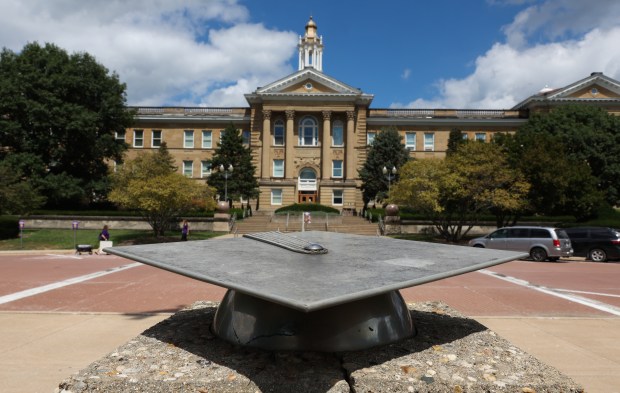
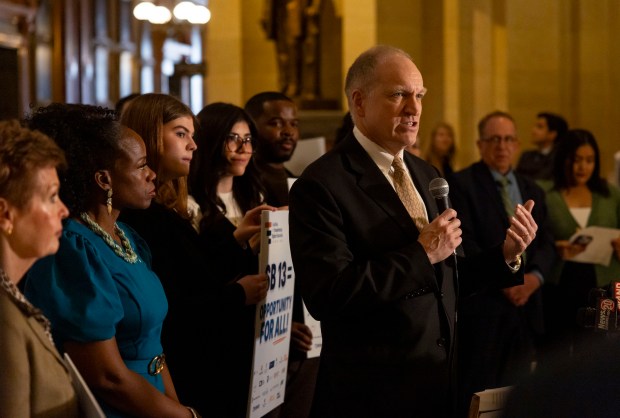

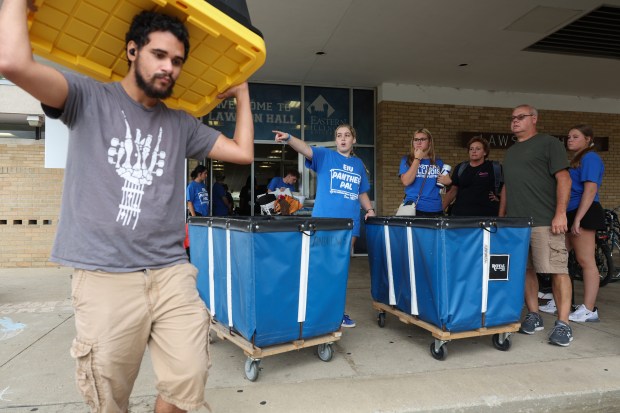
The new funding model would account for school size, research activity, academic programs, maintenance needs and student demographics to calculate each university’s adequacy gap — the difference between how much money a school receives and how much it needs. Athletics, housing and health insurance would not factor in. The target would adjust annually for inflation.
U. of I. officials contend the formula would leave the system with a smaller share of new funding while exposing it to a disproportionate share of potential future cuts. Because reductions would be structured to shield the least adequately-funded campuses, the University of Illinois could absorb up to 74% of any reductions under current projections.
Ammons said that even in lean fiscal years, the state needs to support those who are struggling, while Lightford said U. of I. is choosing to ignore the positives in favor of maintaining the status quo.
“I believe that they’re not looking out for their entire system overall,” Lightford said of U. of I administrators. “To see them say ‘Hey, we’d rather everyone go down so that we continue to monopolize the system’ is really disheartening.”
Murphysboro Republican state Sen. Terri Bryant, who serves on the Senate’s higher education committee and was on the commission that created the model, agreed that Illinois is not fairly distributing money to its universities. But she said that while the proposed formula factors in students from underserved communities, it doesn’t specify who counts as underserved. She said lawmakers must define the term and figure out where the money will come from to implement the model before she will vote for the bill.
“Even though I am supportive of a funding formula,” Bryant said, “I think that there’s still a lot of work that has to be done before we’re actually voting on the formula itself.”
If passed, the bill would instruct the Board of Higher Education to determine who qualifies as underserved every three years by identifying demographic, geographic and income gaps in “enrollment, retention, or completion” compared to the average.
Pricing out students
Illinois’ public universities were already grappling with declining state support before former Republican Gov. Bruce Rauner took office in 2015 following his election pledge to take a chainsaw to wasteful government spending.
But Rauner’s plans were interrupted by a protracted budget impasse with the Democratic-controlled legislature, leaving the state without a full budget for more than two years. Universities went nearly 10 months without state funding.
The budget standoff cost an estimated 7,500 higher education-related jobs and nearly $1 billion annually in economic activity, according to a study from the Illinois Economic Policy Institute and the Project for Middle Class Renewal at the University of Illinois Urbana-Champaign. During the impasse, Western Illinois University eliminated at least 50 faculty positions. Chicago State University sent potential layoff notices to all 900 employees.
With less money, higher education institutions have leaned on tuition increases to make up the difference.
In 2021, Illinois’ $14,993 average in-state tuition cost for public four-year universities was the third most expensive in the nation — only behind Vermont and New Hampshire — and over $5,000 more expensive than the nationwide average, according to federal data from the National Center for Education Statistics.
“When (universities) don’t get enough money from state sources, that means they’ve got to pass costs on in the form of tuition increases,” said Robin Steans, a commission member who is also executive director of the education policy and advocacy organization Advance Illinois. “The result is we are pricing out far too many Illinois students.”
Enrollment trends underscore the strain. While total public university enrollment reached a 10-year high of nearly 190,000 last year, it remains below levels seen through much of the 2000s, with most recent gains concentrated at the University of Illinois system.
Regional campuses have borne the brunt of declines.

WIU had more than 13,500 enrolled students in fall 2004, but at the beginning of last school year enrollment hovered around 6,300, according to Board of Higher Education figures. At SIU in Carbondale, enrollment dropped by about 45% in the last two decades, from roughly 21,600 to around 11,800 in fall 2024, the data show. For EIU in Charleston, fall 2004 enrollment stood around 11,650 before dropping to a little more than 8,500 last year.
In DeKalb, Northern Illinois had about 24,800 students in fall 2004 but lost more than 9,000 by last year. On Chicago’s Far South Side, Chicago State University’s enrollment declined from more than 6,800 to 2,200 over the past 20 years, while enrollment at Northeastern Illinois University on the city’s Northwest Side dipped from more than 12,100 20 years ago to 5,700 last year, the figures show.
Only Illinois State and the University of Illinois systems have grown since 2000, according to Board of Higher Education data.
College-bound Illinois high school students who would normally crowd the halls and fill the dorms in these regional schools are driving enrollment declines. Nearly 48% of these students said they were choosing a college outside Illinois, according to a 2021 Board of Higher Education survey.
Steans said undoing decades of long-term enrollment declines, underinvestment and tuition spikes will require Illinois to significantly change how it approaches funding its nine public university systems. She said the funding model and the major investments it calls for are the best way for Illinois to save its struggling universities.
“I believe it is badly needed,” Steans said. “It puts the money where it needs to go, gets us to an adequate funding level that reduces costs for students, even while it improves their experience, and it keeps more students in state, and it strengthens communities.”