

As David Miranda huddled in his Airbnb in Puerto Vallarta, Mexico, the smell of smoke wafted through the window. He watched as the smoke from burnt cars and buses climbed into the sky.
Miranda, a freelance journalist and marketer from Pilsen, arrived in the city about a week ago with friends and family to celebrate the first anniversary of his back surgery. But on Sunday, he said the trip turned into chaos as cartel violence spread across the country.
“You see your life go through you,” Miranda said. “You think of our family. You think of everything. You get very vulnerable. You get scared.”
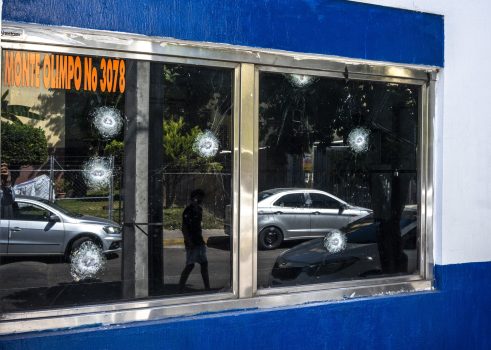
Members of Jalisco New Generation Cartel blocked roads and set fire to vehicles and businesses after their leader Nemesio Rubén Oseguera Cervantes was killed Sunday in a shootout with the Mexican military. Known as “El Mencho,” he was in charge of one of Mexico’s fastest-growing criminal networks, notorious for trafficking fentanyl, methamphetamine and cocaine to the United States.
At least 73 people, mostly security officials and suspected cartel members, died in the attempt to capture Oseguera Cervantes, according to the Associated Press.
Chicagoans visiting Mexico described the tense moments they spent hiding or running away from men carrying guns. Meanwhile, others with roots in western Mexico said the violence hits close to home.

“The fact that (the attack) happened in a very large city in plain daylight and also in tourist areas made it unprecedented,” said Emilio Kourí, a history professor and director of the Katz Center for Mexican Studies at the University of Chicago. “The panic was massive.”
The wide-ranging violence from tourist areas like Puerto Vallarta to Guadalajara, Jalisco’s state capital and Mexico’s second-largest city, demonstrates the reach of the cartel. Kourí likened the cartel to a “militia” that is able to come out of the woodwork quickly.
‘Running at us with a gun’
This swift mobilization was something Yoni Pizer witnessed firsthand. The 62-year-old Lakeview resident left his Puerto Vallarta condo around 8 a.m. to go on a whale-watching expedition with his husband and two friends. As he was driving, the car in front of him did an abrupt U-turn and he saw a truck parked in the middle of an intersection.
“Before I knew it, there was a young man running at us with a gun … He banged on the window, pointed the gun at my head, and said in Spanish, ‘Get out of the car, get out of the car,’” said Pizer, a community liaison for U.S. Rep. Mike Quigley, 5th District.
The cartel member — who Pizer described as being in his early 20s and having “a lot of energy” — then got into his rented SUV. He drove it a short distance before getting out and throwing an incendiary device at it, Pizer said. It immediately caught on fire as the explosion went off. He then did the same thing to the truck.
Cartel members continued attacking other cars that approached the intersection, Pizer said. When a bus pulled up, they shot into the bus to force people to get off. They then set it on fire as well, Pizer said.
“It was terrifying,” Pizer said. “Not every day you have a gun pointed at your head.”

Pizer and his group started running in all directions, and he was separated from his husband. Luckily, Pizer said a good Samaritan let Pizer, his friend and two other strangers catch a ride with him. He drove probably 80 miles an hour back into downtown Puerto Vallarta.
While Pizer was able to make it back to the condo, his husband and other friend, meanwhile, sought shelter at a church. They spent eight hours hiding out in an orphanage at the back of the building with around 35 kids and staff, listening to gunshots and explosions.
Pizer was constantly texting updates to his husband, trying to decide when it would be safe to drive home. He even watched livestreams from downtown hotels to see if the streets were clear.
“Finally, they just decided that, as the sun was setting, it’d be better for them to try to get home and here to our secure condo building than to stay at the orphanage,” he said, adding that everyone is now out of harm’s way.
Kourí, the University of Chicago professor, said he wouldn’t be surprised if there’s an effect on tourism in Mexico, at least in the short run. He said he even got a call from his daughter this morning asking whether it was safe for her friend to travel there.
But if Mexico does a good job of beefing up security in tourist areas, it will just be a blip in the long term, he said. Apart from this experience, Pizer said he felt safe in Puerto Vallarta, calling it a “beautiful” and “wonderful” place.
“If Mexico does a good job of reassuring people, it should not (have an effect). Because this was a flare-up, a very ugly and very public, a very visible flare-up,” he said. “But everybody who’s there knows that these underlying structures are there.”

Reyna Torres Mendivil, the consul general of Mexico in Chicago, said she recommends people use “good judgment” in deciding whether to travel to Mexico or postpone their trips. She said travelers should verify that their flights are still active because some airports are operating with limitations. About 100 flights were canceled at Puerto Vallarta’s airport Monday, according to FlightAware, a flight tracking website.
Cartel violence not unusual
For Torres Mendivil, the killing of “El Mencho” is a positive development for families on both sides of the border. It also represents a “great example” of collaboration between Mexico and the U.S., which helped provide intelligence to support the operation.
“Every time there is an action against these criminals, it is always good news,” she said.
Cartel violence against innocent people isn’t “necessarily new,” especially after a top leader is killed, she said.
Illinois state Rep. Norma Hernández, D-Melrose Park, said Mexican cartels are heavily financed by drug demand in the U.S. and armed by firearms purchased in the U.S. and trafficked south across the border. Any serious response to combat cartels must confront those cross-border drivers of violence, she said.
“A bilateral strategy centered primarily on military intelligence and force will likely intensify instability if it is not paired with meaningful efforts to combat corruption, strengthen democratic institutions and rebuild public trust,” she said.
Dulce Guzmán, executive director of Alianza Americas, said the violence underscores a reality many Mexican families know too well. Based in Chicago, the organization analyzes and advocates for policies to understand migration to the U.S.

“Many Mexican families have been forced to flee the violence in Mexico, only to continue to be threatened once again when they arrive in the U.S.,” Guzmán said, noting that extortion and threats often follow families across borders even after fleeing. Some continue receiving calls demanding money under threat of kidnapping or harm to loved ones. In parts of Mexico, she said, hardworking families, including elderly vendors and small-business owners, are forced to pay monthly “fees” to cartels just to continue earning a living.
Melrose Park-based Casa Jalisco and the International Brotherhood of Jalisiences said in a statement that they would continue operating as normal and are providing guidance to those seeking information on their relatives.
“We stand in heartfelt solidarity and send all our support during these difficult moments to the families facing uncertainty, with the hope that calm will soon prevail in our state and that Jaliscienses families can return to their daily lives,” the statement said.
A calmer city
While Miranda sheltered in place — as the U.S. Embassy urged U.S. citizens in many parts of Mexico to do — he said he tried to stay positive. He considered renting a car and leaving the area, but the burned cars on the roads made it too risky to drive. Cartel members also burned many convenience stores, he said.
AI-generated videos and fake news heightened the fear, Miranda said. For example, one fake video appeared to show a cartel member saying they would start killing civilians at 5 p.m., he said.
“I’m always about confirming the sources one or two times, if not three,” Miranda said. “But when you’re in that moment, you just don’t think about it. You’re like, ‘What? What’s going on?’”
But on Monday, he woke up to a calmer city, although some shelves at the grocery stores are bare and many restaurants are closed. He’s now waiting to get a flight out.
“There’s no danger from the looks of the lay of the land,” he said.
The Associated Press contributed reporting