
Between 1934 and 1945, Edward Weston traveled throughout California and the West, shooting some of the most consequential photographs ever made of the American landscape. With him was his lover, Charis Wilson, who modeled for him, drafted his successful Guggenheim application and wrote the texts for his photographic books.
Wilson has never entirely gotten her due, partly because that’s the way art history and the art market work. Collaborative relationships are ignored, the impact of women and other minority partners dismissed, all in the interest of tidy legacies, strong sales and lone geniuses. It took decades for Jeanne-Claude to be named alongside Christo, ditto Coosje van Bruggen vis-à-vis Claes Oldenburg. It didn’t help that Wilson was only 20 when she met the 48-year-old Weston. Thankfully, she was a writer, and a good one, who would go on to author her own memoir of that time.
Enter Kelli Connell.
Connell, who was born in Oklahoma City in 1974 and has lived in Chicago since 2007, became fascinated with Wilson after noticing similarities between a famous Weston nude and one that Connell had taken of her own wife, Betsy Odom, three-quarters of a century later. Wilson is sprawled out on a sand dune; Odom lays on a bed in an inn. Wilson appears in sharply delineated black and white, her form flat and alien against the placeless, rippled sand; Odom is in full color, stretched out like anyone on wrinkled sheets, a plate of breakfast pastries just visible on the nightstand in the top left corner. Weston titled his simply “Nude on Sand, Oceano,” keen on location but not identity; Connell chose “Betsy, Lakeside,” noting both. The two photos could not be more different, but they also echo one another — in composition; in the romance between photographer and sitter; and in the fact that both models are themselves artists, one a writer, the other a sculptor.
The result, after a decade of research, residencies, and travel, is Connell’s “Pictures for Charis.” An extraordinary series of 80 photographs and accompanying texts by Connell, it involved her and Odom visiting the same locations as Wilson and Weston to create photographs that examine the complicated relationships between humans and the landscape, photographers and their models, and pairs of lovers. Gender figures strongly, too.
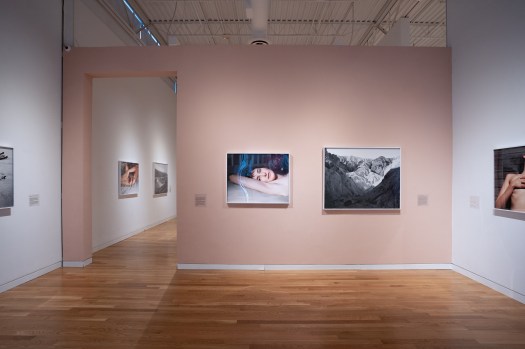
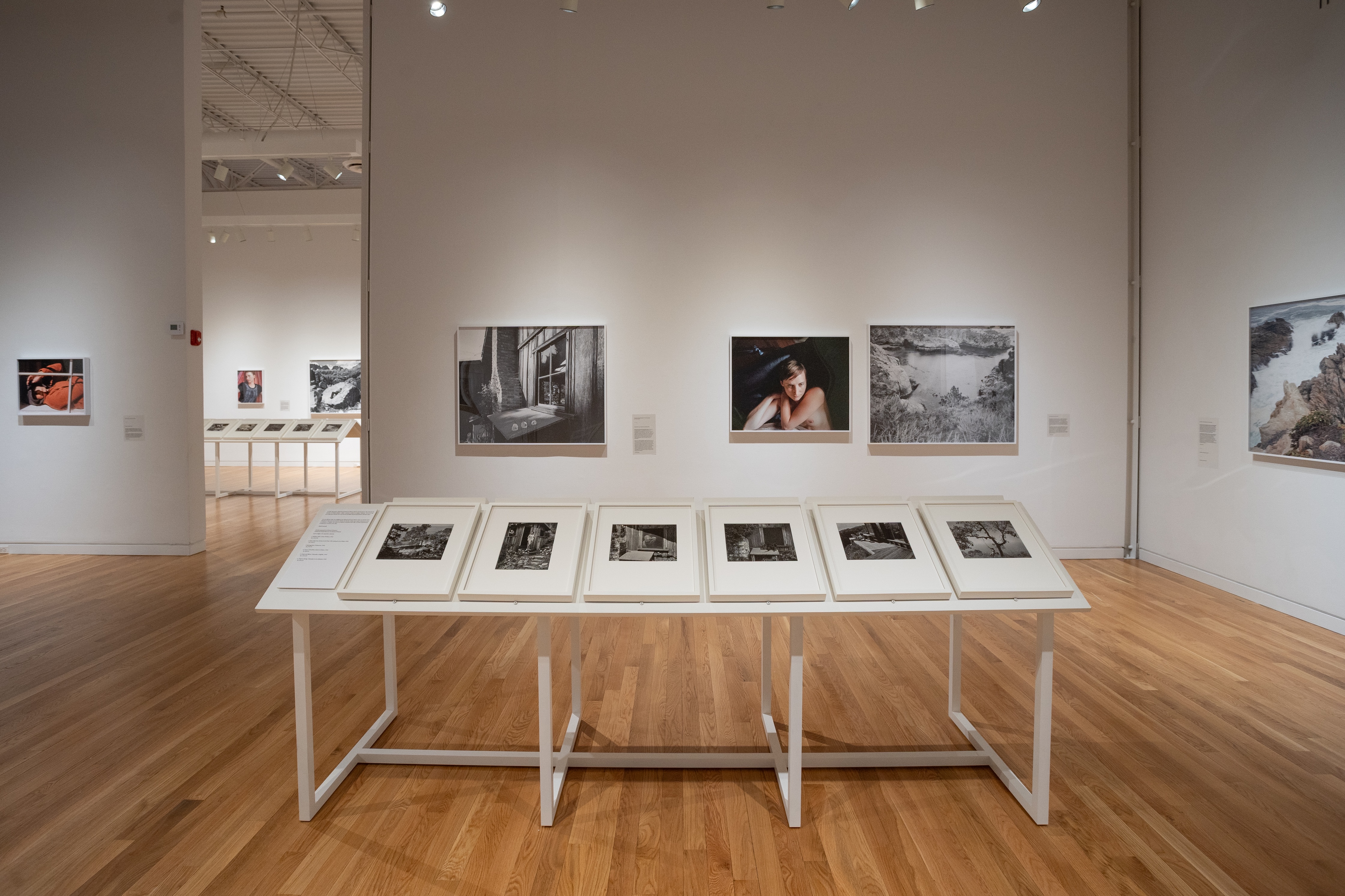
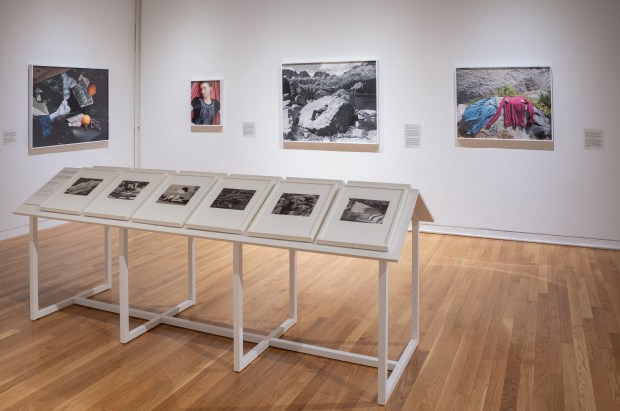
Aperture published it as a book in 2024; an equally beautiful traveling exhibition, “Living with Modernism,” makes its final stop at the Elmhurst Art Museum now through the end of April. Both versions incorporate a selection of prints by Weston with clarity and elegance, and a background color of pink — on book pages, on gallery walls — that picks up a hue ever-present in Connell’s pictures, some female life force asserting itself as rosy cheeks, sunburned skin, magenta blooms, a high garden wall painted bubble-gum, dusty rose desert hills.
Comparison between Connell and Weston is endlessly rewarding. And encouraged, thanks to the installation of Weston’s small gelatin silver prints on display tables in the center of most galleries, surrounded by walls filled with Connell’s large- and medium-size color images. A scattering of black-and-whites by Connell is the exception that proves the rule, the rule being that although some of her photographs might look like Weston’s, fundamentally, they are not. This is true even when they are of literally the same subject: a pair of gnarled, entangled junipers that Weston and Wilson found near Lake Tenaya, in Yosemite National Park, magically rediscovered decades later by Connell and Odom. Both photographers center the trees, emphasizing grandeur and age, but Weston’s evergreens are timeless and untouched, Connell’s the site of human encounter, with rucksacks and sunhats piled at their base. In a second photo, not included in the exhibition, Odom is there, too, resting against their trunks.
For Weston, a dune is a cloud is a hip, and all are studies in pattern and shape. Connell captures those motifs very differently, as undeniably real places, things and people, complete with histories and complications. In the Mojave, Weston saw Joshua trees as majestic extraterrestrials; Connell documents a nameless stump decorated with sneakers. Wilson in a hammock is a convenient surface for the play of shadows; Odom on a bed, equally criss-crossed in shadow, is a person in a dark bedroom, taking a nap. Revealingly, the photograph by Connell that feels most like one of Weston’s nudes is not a nude at all. Her “Mother Nature,” a tightly cropped boulder crevassed like a vagina and overgrown with pubic wildflowers, shares the erotics of Weston’s close-up studies of Wilson’s naked, fragmented body, but minus the objectification.
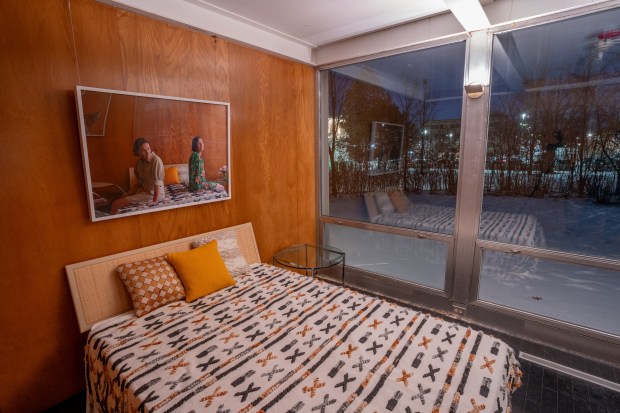
By 1945, Weston and Wilson had split. Connell and Odom are no longer together, either. That could have been a tidy, if unhappy, conclusion. But Connell offers an alternate ending with the latest installment of “Double Life,” a separate series ongoing since 2002. Staged and installed in the museum’s McCormick House gallery, a 1950s bungalow designed by the modernist architect Ludwig Mies van der Rohe, the photographs depict intimate moments in the lives of two women. Or life — the women are played by the same model, digitally edited together, and their relationship shifts continuously from the uncanny to the revelatory to the taboo. Are they a same-sex couple, identical twins, two halves of a single self, or some of her potential other existences?
An answer of sorts is suggested by Isabella Gardner, the house’s original inhabitant and writer of the seven poems that inspired Connell’s seven photographs. In “Mathematics of Encounter,” she notes: “love is resolved / to one-plus-one, dissolved again to two, these two absolved, / and the equation solved.”
If you go
“Living with Modernism: Kelli Connell’s Pictures for Charis and Double Life” runs through April 26 at the Elmhurst Art Museum, 150 S. Cottage Hill Ave., Elmhurst, more information at 630-834-0202 and elmhurstartmuseum.org
Lori Waxman is a freelance critic.