
Despite calls from residents of the Del Webb community in Aurora asking for the neighborhood’s developer to address existing issues before further construction, the Aurora City Council has approved plans for the project’s next phase.
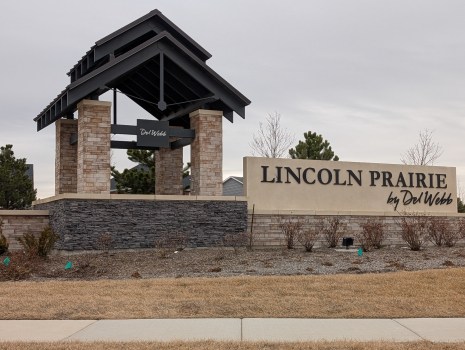
Currently at roughly 550 homes, the age-restricted Del Webb community called Lincoln Prairie is already facing issues with landscaping, security and overburdened amenities, residents of the neighborhood have said at recent city meetings.
A committee of the Aurora City Council previously delayed its consideration of the proposal to give developer Pulte Homes and the residents time to meet and come up with solutions, and Pulte has made some concessions to residents over the course of the approval process.
On Tuesday, the Aurora City Council formally approved four resolutions that gave Pulte the go-ahead to build the fourth phase of the neighborhood, which is planned to hold over 90 homes. Aurora Mayor John Laesch said at Tuesday’s meeting that the city can’t legally hold the next phase of development up to address issues in the first three phases, but that residents made their voices heard.
Paula Helberg, a resident of Lincoln Prairie who has spoken at multiple city meetings about landscaping issues impacting her neighborhood, told The Beacon-News that she and other residents appreciate the city and Pulte for listening to their concerns and supporting efforts towards resolving them. But, they also believe that the city “holds the authority to explore additional solutions for the unresolved issues” and that Pulte should “further expand the concessions already made.”
“Pulte’s representatives have shown interest in continuing the dialogue, and we remain committed to advocating for common-sense solutions,” Helberg said.
Located on the far southeast side of the city, the Lincoln Prairie Del Webb neighborhood has been under development for the last several years. It was first proposed in 2021, a ribbon cutting for the first phase was held the next year and plans for phase three were approved in 2024.
The neighborhood’s low-maintenance ranch homes come in multiple styles ranging from two to three bedrooms and from around 1,500 to 2,750 square feet, officials have said. Designs include large kitchen islands, tall sliding glass doors, suites with spa-like baths and storage space.
The community is promoted as having “resort-style amenities,” including an 18,000-square-foot clubhouse with meeting spaces, billiard rooms, indoor and outdoor pools and outdoor recreational areas with tennis and pickleball courts.
In addition to the Lincoln Prairie Del Webb neighborhood, the development also includes Lincoln Crossing, which is a separate, smaller neighborhood of market-rate, single-family houses.
The Del Webb portion of the development was marketed as being gated, according to materials provided to the City Council by Pulte, which is now included online with Tuesday’s meeting agenda. Residents have said they too were told during the homebuying process that the main entry gate would be closed after a secondary access was completed — but now that it is done, all the gates still remain open.
The gates are staying open because it is impractical to close them during construction and while houses in the community are being sold, as there are so many people coming and going, said a lawyer representing Pulte Homes, Russ Whitaker, during past meetings.
Pulte has since agreed to lower the gates at night, although the plan will need to be approved by the Pulte-controlled homeowners association board, Whitaker and other company officials have said. Pulte’s Division Director of Land Planning and Entitlement, Matt Brolley, told the Aurora City Council on Tuesday that the work needed to get the gates operational would likely be completed by June.
Residents have also been concerned about non-residents entering the community and using common areas and infrastructure, resident Suzi Smith has said at multiple city meetings. By not having “No Trespassing” signs at the entrance to the neighborhood, she said, police are not able to enforce trespassing laws throughout common areas and infrastructure, except at the clubhouse and sports courts.
The neighborhood’s sidewalks, however, are open to the public, according to city Director of Zoning and Planning Tracey Vacek. And language in the original agreement, shown by Whitaker at a past meeting, said the gates are meant to give a sense of security, not to create exclusivity.
So then, Smith said, Lincoln Prairie should have never been marketed or referred to as a private community.
“Rather, it is a community of senior residents who paid for, are liable for and must maintain what is essentially a 550-acre public parkland,” she said during the public comment period of Tuesday’s City Council meeting.
Another of the residents’ concerns was around landscaping. Helberg has said that established plans are not being followed and that plantings were not being installed properly.
“If you vote ‘yea’ on phase four without firm commitments to by-the-book, new landscape installation and by-the-book repairs to existing landscape, you are saying that plans don’t matter, that doing things correctly doesn’t matter and that doing things right in the first place doesn’t matter,” she said at a meeting of the Aurora City Council’s Committee of the Whole last week.
Aurora city staff still need to do many inspections of the development’s landscaping, said Vacek. All projects within the city get their landscaping inspected, she said, and so far Pulte has fixed issues that city staff have found.
Helberg also previously spoke about parks that were discussed to be included within the community but never were, and said she knows at least one person who bought a home within the neighborhood because of these promised parks.
Another concern that was previously raised by residents, but was not specifically mentioned during Tuesday’s meeting, is that they believe the neighborhood’s amenities are at-capacity. The clubhouse is not even big enough to accommodate those who are already residents, so with more homes on the way, the amenities will be overburdened, resident Barbie Sawyer said at a past meeting.
The clubhouse has the development’s sale center in it right now, but after the project is complete, that space will be turned over to the homeowners association, Pulte officials have said. Plus, additional amenities or an expanded clubhouse may be coming later in the development.
There’s always tension between a developer and the residents of a project before the homeowners association board is turned over to the residents, according to Ald. Mike Saville, 6th Ward. That’s what the City Council was really hearing about, since the residents don’t really have a voice on the board yet, he said at the Committee of the Whole meeting last week.
So, he urged Pulte to do more to communicate with residents to resolve issues before they reach this point.
Currently, Pulte appoints people to the HOA board. One resident sits on the board right now, company officials have said, and they’ve also agreed to open up another seat for a resident — but like all other seats, that person will be appointed by Pulte.
Residents can request the HOA be turned over to them, but Pulte also currently pays off the HOA’s yearly budget shortfall, according to company officials. They have said that the HOA would be turned over to residents once most of the homes in the community have been built and sold, but that the company’s financial support of the HOA will end once it is turned over.
rsmith@chicagotribune.com