
Aurora is moving forward with hiring a company to design a new sound wall for Orchard Road, which is a project that has been in the works for many years.
The sound wall is set to shield residents living near the busy road on the far West Side of Aurora between Prairie Street and Indian Trail from the well-documented vehicle noise. The exact details of the wall will now be designed by Thomas Engineering Group, LLC, of Aurora, after a nearly $169,000 contract with the company was approved by City Council on Tuesday.
“This has been a long time coming,” Ian Wade of the city’s engineering division told a committee of the Aurora City Council earlier this month. “This project has been ongoing for the better part of a decade now.”
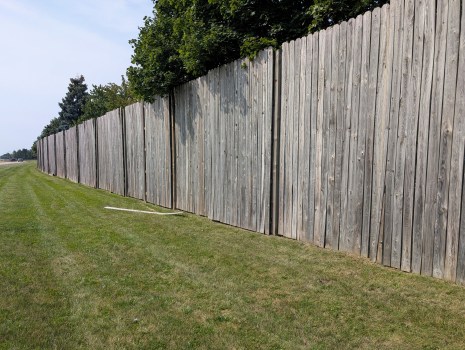
The city’s plan has been to replace the existing wooden fence along the road with a concrete wall that would be something between the current fence and the full Illinois Department of Transportation sound walls used along expressways and interstate roadways. But through research, city staff have found other types of materials that Thomas Engineering will explore, Wade said at the Infrastructure and Technology Committee meeting on Feb. 9.
As part of the engineering of the wall, noise testing will be done along the roadway to make sure that the wall is built using the proper material and at the right height, he said.
The project is expected to cost $6 million, according to the city’s 2026 budget. Thomas Engineering took a preliminary look at the city’s cost estimate and found it was reasonably accurate, Wade said, so the city is confident that it won’t be blindsided by higher-than-expected costs.
A portion of the new sound wall’s construction cost, around $100,000 of the previously-estimated $4 million price tag, was set to be paid for by residents through a special service area property tax, similar to how many other capital projects within the city have been funded. The property owners in the affected area would have gotten the chance to vote on the 25-year tax, and if a majority agreed, the special service area would have been established.
However, the city found out last year that it would have needed to establish multiple different special service areas to help fund the project, according to Ald. Carl Franco, 5th Ward, who represents the part of Aurora where the sound wall is set to go. While that situation was being worked out, the city also learned it had lost $500,000 in state funds previously committed to the project, Franco previously said.
Now, the project is expected to get $800,000 in grants from the state, the 2026 city budget shows. Plus, the 2024 intergovernmental agreement between Aurora and Kane County has the county contributing just over $1 million.
Franco is contributing $645,000 of his own aldermanic ward funds to the project, according to a staff report included online with Tuesday’s City Council meeting agenda. The rest of the cost, roughly $3.6 million, could come from the city’s capital improvement fund, the city’s 2026 budget shows.
However, the more-recent staff report notes that some of the project’s cost could be paid by the 74 adjacent homeowners through a special services agreement to be proposed later this year.
While Franco has been in favor of using a special service area to pay some of the sound wall’s cost, Aurora Mayor John Laesch has been against the idea.
In 2024, when the intergovernmental agreement was before City Council for approval, Laesch suggested the city look into using gambling taxes rather than a special service area to cover the gap. As an alderman at-large at the time, he introduced an amendment to the agreement that said the city would look into other ways to fund the wall in the future, but it was voted down.
When talking about the topic with The Beacon-News last year, Laesch mentioned that the city would hopefully be seeing a “sizable” increase to its gambling tax after the opening of the under-construction Hollywood Casino-Aurora resort.
Construction on the sound wall project is on track to break ground before the end of 2026, city staff have previously said. That work may carry over into early next year, according to Wade.
Once built, the city would be responsible for basic maintenance of the wall while Kane County would do any capital maintenance needed, per an agreement between the two governments that was approved by the Aurora City Council in 2024. The approval of that contract was a major step towards construction, which officials hoped would take place last year but hit delays around its funding.
The current wooden privacy fence that sits along certain portions of Orchard Road was first built as part of the 2004 project to widen the road, according to city staff’s report on the project. The city has been responsible for ongoing maintenance of the fence since then, but now both the city and county believe that those repairs are no longer enough, staff said in the report.
So, the city is now looking to replace that wall because of the ongoing maintenance and safety concerns with the wooden fence, the staff report said, and because of the “considerably increased noise levels in the corridor which have generated persistent complaints from adjacent residences.”
rsmith@chicagotribune.com