

When Shruthi Ayyagari was about 10 or 11 years old, she asked her mother for a dictionary.
“I was like, ‘Oh my god, I really want to familiarize myself more with spelling and English and language,” Shruthi said.
The Indian Prairie School District 204 eighth-grader attributes that first dictionary, which included a thesaurus and vocabulary builder, to spurring her interest in spelling but it was not until she watched the 2022 Scripps National Spelling Bee that she started taking the skill more seriously.
“It was like second nature to them,” Shruthi said of the competitive spellers. “I wanted to be more like the winner, and I wanted to see how far I could get.”
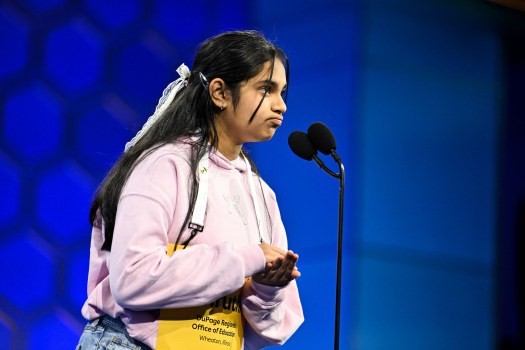
The 14-year-old Francis Granger Middle School student will find out May 27 when she heads to the Scripps National Spelling Bee in Washington, D.C., for the second consecutive year.
She secured her slot at the 2026 DuPage County Regional Spelling Bee on Feb. 19, where her correct spelling of the word “telegnosis” (perception or knowledge at a distance) gave her a first-place win in the regional competition.

Every year, hundreds of the best spellers from across the country and the globe, all of whom are in eighth grade or younger, compete at the Scripps National Spelling Bee.
“It still kind of hasn’t registered to me that I’m going to Scripps for the second year in a row,” Shruthi said. “I feel very proud of myself that I’m going to Scripps but I also feel nervous to attend and spell there in front of hundreds of people.”
Last year’s competition — the 100th year Scripps hosted the contest — featured 243 participants facing off against each other at the Gaylord National Resort & Convention Center in National Harbor, Maryland. Spellers traveled from as far as Ghana, Nigeria and Kuwait to spell words like “tirak” (a physiological disease of Indian cotton), “tekke” (a dervish monastery) and “éclaircissement” (a clearing up of something obscure — last year’s winning word).
When Shruthi qualified for Scripps last year, she said she couldn’t believe it.
“At first, it was very surreal,” she said. “I hadn’t gotten out of that mindset that I was still a little speller who doesn’t know anything about spelling.”
One of her favorite parts about attending was meeting so many different contestants.
“It was so cool seeing all of these spellers from all of these different walks of life and how they studied and what was so impressive about them,” she said. “(One reason) why Scripps was always so cool to me was that every speller had worked equally as hard as I had to come to this particular point.”
Shruthi tied for 89th place, losing in fourth round of the competition. Although she had successfully spelled the word “sravaka” (a direct disciple of the Buddha) and gave the correct definition of the word “anserine” (something resembling a goose), it was the word “coolth” (the state or occasion of being cool) that led to her elimination. She misspelled it as “coulth.”
“I was very nervous on stage, but it’s kind of like the opposite of warmth,” Shruthi said, recounting the moment she realized made a mistake. “I didn’t quite make that connection in my head when I got that root though.”
Regardless, she said she was happy with her placement and this year expects to place higher.
“I’m aiming for finals this year, and I think that’s achievable,” Shruthi said.
The Aurora resident participated in her first bee when she was in sixth grade.
“It was super nerve-wracking to compete in my first spelling bee but as I got the hang of it more, it started to become easier and now I am way more well-versed in the art of spelling,” she said.
Even studying for her first spelling bee was something she said she greatly underestimated.
“I thought that if I had just kind of skimmed through the study list, or asked my friends to quiz me a couple times, I would be good,” Shruthi said. “But turns out, there’s actually so much more nuance than just knowing the words. It’s like you have to be familiar with every single aspect of the word and what makes the word spelled the way it is.”
That includes being familiar with the language the word comes from “because certain languages follow different rules from spelling” and have “different ways of representing the same sound,” she said.
“The very first word that I ever messed up on in a spelling bee was craquelure,” Ayyagari said. “I was unfamiliar with it at the time because I was very scared of words from French. And since then, I’ve become a lot more familiar with words from French and it was also like an art thing, and I was not very well-versed in words from the art world.”
Shruthi has two dictionaries from which she studies: one is an online subscription to the Merriam-Webster unabridged dictionary and the other is a physical dictionary that she said is “the size of five books put together.”
As for her studying strategy, most of the time she studies by herself but on occasion asks her parents or friends to quiz her on words. When she studies, she doesn’t just look at individual words but groups them together in categories like Japanese or German.
“I take those words and I look at them and I see what is in common among all of those words and I see, ‘Oh, German spells this sound in this particular way,’” Ayyagari said. “So instead of looking at individual words and being like, ‘Oh, this word is hard,’ I instead take a look at what is hard about the language as a whole and then try to see if I can make it easier for myself in any way.”
One of the favorite words she’s learned is “kaffeeklatsch,” which means an informal gathering with another person over coffee.
“I like this word a lot because it looks like such an intimidating word at first, but it’s actually really cool,” she said. “And there’s a lot of words that don’t have a specific word in English that can be described by a lot of other languages and this is one of those words. It comes from German actually.”
Getting to learn the meaning behind the words her interested in spelling, Shruthi said.
“You can learn a lot about the world just by studying spelling because spelling is such a vast topic,” she said. “There’s so many different words from so many different niches and fields of study that are covered, like you can learn a lot about science and the arts, architecture, cooking.”
Because Shruthi will age out of the Scripps bee next year, she hopes to keep her spelling interest alive by either starting a spelling bee club at her local elementary school, Gwendolyn Brooks Elementary, or coaching younger students who are interested in spelling.
cstein@chicagotribune.com