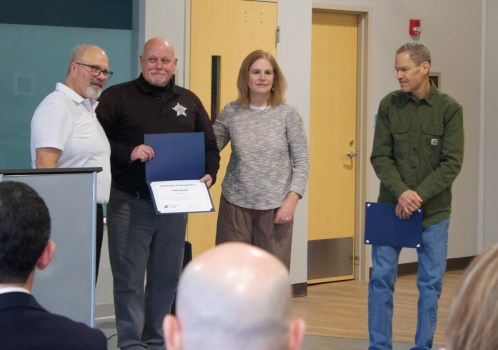

Dozens of people gathered Feb. 21 at the Bernard Weinger JCC in Northbrook to hear how quick-thinking bystanders saved a local resident who went into cardiac arrest during his daily swim, and to learn the same life-saving skills.
“I barely remember getting in the pool,” Michael Kreda, 61, of Deerfield, recalled in an interview with the Pioneer Press. “Next thing I know, I am waking up in the hospital.”
On Aug. 4, two days before his 61st birthday, Kreda went for his daily swim and suffered a cardiac arrest in the deep end of the pool when Jim Pines, a swimmer in the next lane over, noticed something was wrong and notified a security guard and other bystanders.
Todd Kosloske, a security officer at Northbrook JCC, had just started his shift when Pines alerted him that there was a medical emergency in the pool. He said it took him and three other bystanders to pull Kreda out of the water.
“We got him on his back and his face was purple,” he said. “I checked for a pulse very quickly, and I said to myself, I can’t let him sit here and die. So I started doing CPR.” Kosloske performed chest compressions for about seven minutes until police took over, continuing until EMTs arrived.

“The brain starts to get damaged after about four to five minutes without oxygen, so having a calmness was key, ” he added.
Cardiac arrest survival rates are low, with about 10% of patients surviving a cardiac arrest outside of the hospital, according to the American Heart Association. However, the survival rate increases significantly if someone performs CPR within the first 10 minutes.
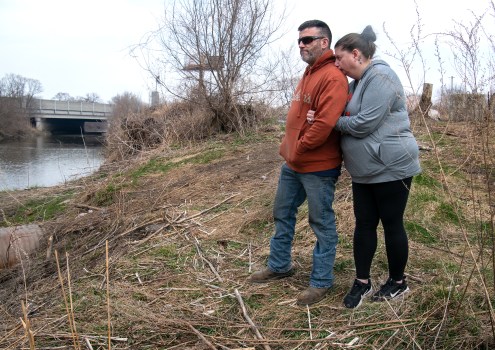
While bystanders and emergency responders were working to revive him, Kreda’s wife Noreen, who is originally from Winnetka, was at home when her phone started ringing. She answered, thinking it was a reminder for a doctor’s appointment, she said. The last thing she expected was to be told to rush over to Highland Park Hospital.
“I thought it was a joke,” Noreen said. “And then I realized it wasn’t.” For the next few days, Noreen remembered not knowing if her husband would survive or if he had suffered too much brain damage.
While at the hospital, she learned how quickly bystanders stepped in to save her husband’s life. After hearing about the events that unfolded to save him, she started to realize how this story could also help others.
The Saturday event, organized through Endeavor Health with the help of Kreda, who grew up in Wilmette, and his wife, aimed to give recognition to the life-saving bystanders and to help other residents learn cardiac arrest preparedness skills.
The program included remarks from State Senator, Julie. A. Morrison, D-29th, who praised the bystanders’ quick actions and called for more CPR preparedness.
During the presentation, organizers also emphasized that taking any action, even if imperfect, could be a matter of life or death.

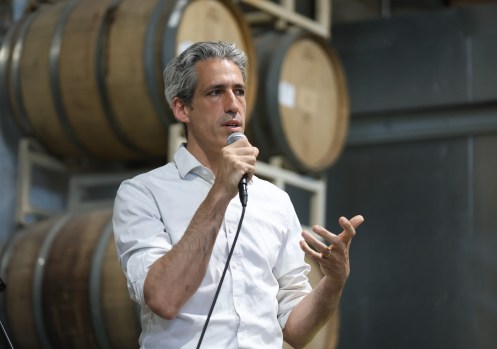
“The bystanders are the most important thing,” Jonathan Rosenberg, a cardiologist at Endeavor Health, said during the event. “If you don’t do your job up front, we can’t do our job on the back end. The quicker the bystanders are to do CPR and to call EMS, the better outcome the patient’s going to have.”
Near the end of the event, a demonstration was given by a member of Endeavor Health’s Simulation Center, teaching residents how to perform chest compressions on mannequins and use automated external fibrillators. After the demonstration, attendees were able to practice for themselves.
Kreda said the one thing he hopes attendees take away from the event is to be prepared to act if a situation presents itself where someone needs life-saving care. If it wasn’t for the bystanders who decided to act that day, he expressed, he wouldn’t be alive today.
“Don’t stand by the side and do nothing,” he said. “Just do something.”