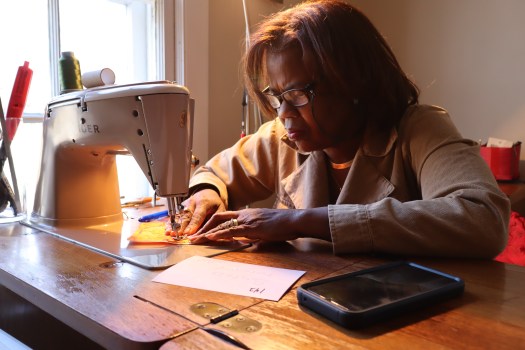

Seated at a Singer sewing machine at her home in Chicago’s Beverly community, Dorothy C. Straughter worked with extreme focus and intensity. Under her command, the machine spontaneously spelled out “Sisters Forever” on a patch of bright yellow fabric.
The square is one she will include in a quilt she’s constructing as part of a fundraising effort for Woman Made Gallery in Chicago.
Straughter began quilting in earnest in 2014, after a neighbor showed her an Underground Railroad quilt she was working on.
Since then, the retired occupational therapist has created more than 40 colorful and sometimes massive fabric renderings that have been featured at The Art Institute of Chicago, Griffin Museum of Science and Industry, Hyde Park Art Center, Zhou B. Gallery, Beverly Arts Center, Bridgeport Art Center and elsewhere. Her Midnight Sky quilt is on permanent display at the Adler Planetarium.
The quilt Straughter is making for Woman Made Gallery includes more than 142 phrases inspired by gallery contributors. Those words include “Children Laughing,” “When a Stranger Smiles,” “Trust Yourself,” “Faith, Peace, Love,” “Family,” and “Harmony.”
While those concepts are pleasant, Straughter realizes that may not be the case for messages sewn into some of her other works of art.
Along with her artist statement, she posted a red-letter “WARNING!” introducing her one-woman “Pathology of Truth,” exhibition, which runs through March 23 at the Forshey Gallery at the Chicago Temple, First United Methodist Church, 77 W. Washington in Chicago.”
“The items within your view are racist,” her warning states. “This artist exposes the truth that blatant racism is learned and indorsed…”
Indeed, her six finely crafted quilts — as well as accompanying historic objects — refuse to lie. They also resurrect painful and often ignored historical realities related to slavery, the Underground Railroad, the Great Migration and racist advertising.
Straughter’s “Honney Child” quilt features images of Black children once used to boost sales of candy and soap products.

One quilt block portrays a baby on the brink of being eaten by an alligator. The image harkens back hunters using Black children as alligator bait, a practice portrayed in old illustrations and recorded in oral histories.
Straughter’s machine-sewn image replicates an old advertisement for Little American Licorice Drops, which promoted the candy treat as “A Dainty Morsel,”
“This is offensive, but it’s the history we have to know,” said Straughter, who was born before her parents were granted the right to vote.
Another quilted image builds on a circa 1920s ad for LUX soap featuring two small Black children with afros. The ad and quilt segment both say, “Won’t Shrink Wool.”
Still another image features the Gold Dust Twins from Gold Dust washing powders.
And another entire quilt replicates an ad for Pickaninny Brand produce.
Having taught classes in neuroscience and disease processes at Chicago State University, Straughter designs her works to draw people in with attractive patterns and colors. She’s intent on educating people and encouraging dialog. And she’s conducted exhaustive historical research with the support of the Stony Island Arts Bank.
“We should learn the history of all people so we can know each other’s pain, and so we can also appreciate our resilience,” Straughter said.

Another image in the exhibit represents Ruby Bridges, one of six Black children in New Orleans to pass a test that determined they could attend William Frantz Elementary School.
As a child, Bridges became an iconic symbol of school desegregation as she was escorted to and from the school by federal marshals. To discourage her from attending, crowds protested. One woman constantly threatened to poison her. Her family could no longer shop at the local grocery store, and her father lost his job.
Bridges later established the Ruby Bridges Foundation to promote respect and appreciation for people’s differences. She also worked to save William Frantz Elementary School after Hurricane Katrina.
Aside from history, Straughter draws from her own experiences and family history. “My relations were picking tobacco in Kentucky, but I can still relate to those forced to pick cotton,” she said.
One square in Straughter’s “Freedom to Liberty” quilt depicts enslaved people working in cotton fields, pulling long, puffed-out white sacks that dwarfed them.
Referring to the sacks, Straughter recently showed visitors a cotton pick sack suspended from the gallery’s tall ceiling. The extreme length of the sack caused one person to say, “Wow! I had no idea they were that huge.”
“And the taller you were, the longer the sack you had to carry,” Straughter said. “Some of these were 10 feet long.” Packed full, a cotton sack could weigh 100 pounds or more.

Other quilted images portray shackled brown hands, a lynching, nameless Black World War I soldiers, and a World War II soldier bidding farewell to his wife.
In a nearby glass case, iron shackles, raw cotton, vintage soap boxes and a 1920s Topsy Turvey Doll affirm stories told by the quilts.
The doll has a black upper body fused to a white upper body and sports a reversible skirt at the waist. It was constructed to enable Black children to quickly flip the forbidden white doll to black when they were playing. Harriet Beecher Stowe mentioned such a doll in her book Uncle Tom’s Cabin.
Yet another quilt depicts a blackface minstrel as a reminder of whites who masqueraded as Blacks on Vaudeville and perpetuated demeaning stereotypes.
“This is American history,” Straughter said. And with so much American history to share, Straughter has loaded her quilts with images both front and back.
Other hallmarks she includes is a monogrammed cross, to represent her maiden name, and a small patch of fabric printed with an African mask to represent her African ancestors.
She’s also quilted images of Black inventors and included images of math codes and the periodic table of elements in baby quilts. “So, when kids go to school, they know what they’re looking at,” she said. “I want them to be smart.”
Susan DeGrane is a freelance reporter for the Daily Southtown.