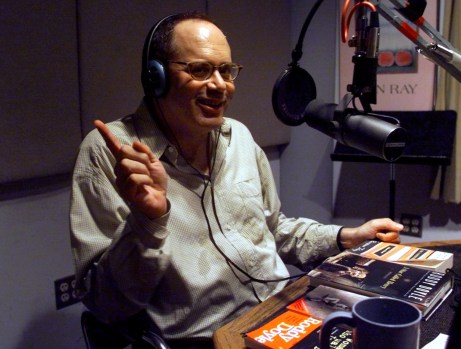

I have always endeavored to be a good citizen and support my local public radio station — WBEZ when I lived in Chicago, obviously — but for a period of five years in the early to mid 2000’s I was also a donor to KCRW in Los Angeles.
I’ve been to Los Angeles maybe five times in my entire life, but KCRW was the home of Michael Silverblatt and his author interview show “Bookworm,” the first thing I ever streamed over the internet.
As reported by the Los Angeles Times, Michael Silverblatt died Feb. 14, at home after a long illness. He was 73. Silverblatt’s show ran on KCRW from 1989 to 2022, and it was thanks to the advent of online streaming in the early aughts that I was able to dip into the archives and catch up with the previous two decades of his work.
The quintessential Silverblatt moment is a 1996 interview with David Foster Wallace about “Infinite Jest” where Silverblatt opines on what he has discerned about the famously long and elaborate novel’s structure, “It occurred to me that the way in which the material is presented allows for a subject to be announced in a small form… and then it comes back in a second form containing the other subjects… and then comes back again… and I don’t know this kind of science, but I said to myself, this must be fractals.”
There is a stunned pause from Wallace, after which he confirms that he structured the novel as a Sierpinski gasket (whatever that is).
Silverblatt’s particular genius was not in what a novel or story said, but how it went about saying it. His ability to unpack the way a narrative works was perhaps shaped by his time as a student at the State University of New York at Buffalo, where some of the greatest names of postmodernism were working at the time: Donald Barthelme, Michel Foucault, John Barth, J.M. Coetzee.
Wherever it came from, the Silverblatt moment — when he stopped a writer in their tracks by revealing something about the book that the author either thought was hidden, or which, sometimes, they didn’t know themselves — happened frequently.
Silverblatt was different from one of the other all-time great book conversationalists, Chicago’s Studs Terkel. Terkel was eager to dive into the human side of the books and authors, the way the writing reflected and shaped the culture. Terkel’s fascination with books was part of his overall fascination with people.
Silverblatt was also distinct from current master Terry Gross, who is a great conversationalist. Many of Silverblatt’s best moments come not in conversation but in his soliloquies delivered to the author who is ostensibly being interviewed. For some, this makes the “Bookworm” conversations an acquired taste, but once you recognize the apparent appreciation the authors have for the quality of Silverblatt’s thinking, you realize why he was so special. David Foster Wallace once said he wished for Silverblatt to “adopt” him.
Consider this column an appreciation of Silverblatt’s work and an encouragement to others to check out his archive, but consider it also as something of a lament for a time when we seemed to have more space for the brilliant oddball that Silverblatt was. Even as podcasts have filled the internet, there’s no one like him.
As consumer culture has become culture writ large, it’s harder to find the people and places that just want to go deep, to the idiosyncratic places inside their own minds.
I’m grateful for my time to have intersected with Michael Silverblatt’s.
Book recommendations from the Biblioracle
John Warner tells you what to read based on the last five books you’ve read.
1. “Twelve Months” by Jim Butcher
2. “Shakespeare’s Sisters” by Ramie Targoff
3. “Pendergast” by Douglas Preston and Lincoln Child
4. “Dark Renaissance” by Stephen Greenblatt
5. “Sherlock Holmes and the Real Thing” by Nicholas Meyer
— Kenneth C., Chicago
This is a little off plumb from some of the mysteries in this list, but I think its underlying themes on the power of language will be a good fit: “Lexicon” by Max Barry.
1. “James” by Percival Everett
2. “Pride and Prejudice” by Jane Austen
3. “A Children’s Bible” by Lydia Millet
4. “Trust” by Hernan Diaz
5. “The End of the End of the Earth” by Jonathan Franzen
— Billie N., Lockwood
Some interest in environmental narratives here. How about the first book in Margaret Atwood’s MaddAddam trilogy, “Oryx and Crake.”
1. “Vigil” by George Saunders
2. “So Far Gone” by Jess Walter
3. “Brief Interviews with Hideous Men” by David Foster Wallace
4. “Norwegian Wood” by Haruki Murakami
5. “When We Cease to Understand the World” by Benjamin Labatut
— Boyd P., Darien, Connecticut
David Mitchell’s “Cloud Atlas,” with its elaborate structure and world-spanning scope, feels like a good mix of the books on Boyd’s list.
Get a reading from the Biblioracle
Send a list of the last five books you’ve read and your hometown to biblioracle@gmail.com.
John Warner is the author of books including “More Than Words: How to Think About Writing in the Age of AI.” You can find him at biblioracle.com.