This is a story where the little guy wins. And we could all use one of those narratives – where David prevails over Goliath.
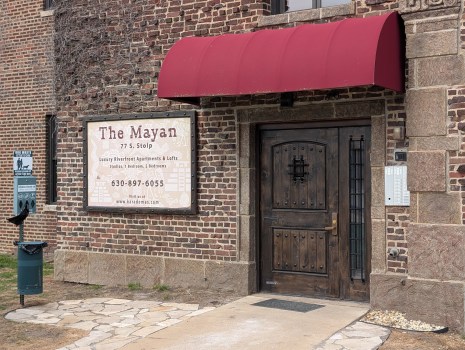
In this case our unlikely hero is Jerry Skinner, an 84-year-old retired special education teacher from Aurora with a soft voice and equally soft heart. His opponent: the city of Aurora’s Division of Property Standards, which charged Skinner nearly $30,000 in fines for code violations over his historic property at 429 W. Downer Place.
But Skinner, with the encouragement of other property owners, decided to fight back. After a failed attempt in December of 2024 to get a circuit court judge to reverse the city’s administrative officer’s decision, he filed an appeal in February of 2025 with the Second District Appellate Court, with his lawyer arguing his client had been denied due process.
“I was shocked by it,” said his attorney Matthew Robinson. “You can’t take $30,000 from a resident and not allow them to defend themselves. This is not how you treat people.”
According to an audio recording of the arguments presented before the Second District Appellate Court on Dec. 9, 2025, three appellate judges seemed to agree. They not only called into question the number of violations and how the fines were determined, but the process itself, including how the administrative hearing was conducted.
In addition to the city’s attorney Bernie Weiler arguing that Skinner was given ample opportunity to cure the violations, he insisted that “whether there are four or three or two (violations), the city has the right to impose fines to gain complete compliance … and that’s what this is about,” according to the audio recording.
When Weiler told the court “we don’t want to indict the entire process” because there are some issues with the case, Judge Christopher Kennedy replied, “I think there is certainly cause for doing so,” also noting, “however this case comes out, I would hope that you take the message back that these procedures are lacking.”
The point seemed to be taken by the city. Skinner received all his money back on Jan. 26, including half his attorney fees, a move that cost the city plenty but seemed to allow the powers that be to save face.
After asking several times about the case, the email response I received from the city’s legal department stated “the city of Aurora is pleased to announce a settlement agreement” with Skinner that “reimburses the plaintiff for previous standard violations that have now been fully rectified.”
Which could beg the question, if the violations had to be taken care of before Skinner could sell the property in June of 2024, why did he just now get that refund?
You may remember this drawn-out narrative first taking shape from a column I wrote back in August of 2023. That’s when, in the wake of a new rental licensing program to lower density, Skinner was hit with a slew of violations. The longtime landlord, however, was not so much concerned about the financial position that officials had put him in. Rather, he worried about his tenants – some were disabled, one a veteran – who all had to find new homes on such short notice, a tough goal when rents are climbing and affordable housing is scarce.
Fortunately, those people eventually found places to go, which gave Skinner peace of mind. But he was still left with a string of code violations he insists he worked hard to remedy. Still, when he tried to argue his case in front of the city’s administrative officer in February of 2024, he was slapped with a bill for $28,200, the result of a $200 a day fine for 20 violations and another $500 per violation.
The city collected the money from him as a condition of being able to sell his property, Skinner said, which he “had no choice” but to do for financial reasons in June of that same year, at $100,000 below a previous offer.
In his arguments in front of the appellate court, Skinner’s attorney claimed his client was deprived of his rights on a number of issues. Those, Robinson said, included the hearing officer starting the procedure without the presence of Skinner’s attorney, who was on a Zoom call in the hallway; interrupting the landlord when he tried to defend his case; not allowing Skinner or his contractors to present evidence that the violations had been taken care of; and that the case was decided before Skinner could present evidence.
In response to Weiler’s defense of how the city handled Skinner’s situation, Judge Margaret Mullen said she was “concerned the process that you are defending” includes fining them whether they know it’s happening or not, adding that residents should be given notice and “an opportunity to be heard … or did I miss that in law school?,” according to the audio recording.
Mullen also asked how “hard it would have been” to keep track of new violations or to “set them for a hearing.” The process in Aurora’s building and zoning department, she continued, seemed to indicate a “court hearing set for status can be converted to a trial,” which meant “a trial could break out at any moment.”
All three justices were concerned about the way the administrative hearing started while Skinner’s attorney was in the hallway dealing with another case, with Judge Ann Jorgensen asking, “was there a reason that (the attorney) wasn’t given just a modicum of consideration?,” according to the audio recording.
In its email response, the city noted that, as with all property code enforcement cases, the city’s ultimate goal is compliance … to ensure “that neighborhoods stay safe, supported and attractive for residents.”
Robinson, however, has a different take, maintaining that the way the city dealt with his client is a “sign of the disdainful lens through which a city looks at its own citizens.”
What officials did, he insisted, was “trampling over the rights of regular law-abiding citizens for no apparent reason.”
With a $35,000 check in hand, Skinner is just glad to put this frustrating chapter of his life behind him, yet also noting how tough it was to deal “with the inconsistency, attitudes and different interpretations of the rules,” not to mention the “disrespect” he said he felt from city officials.
“I’m just happy,” he added, to “move on with my normal positive good life.”
dcrosby@tribpub.com