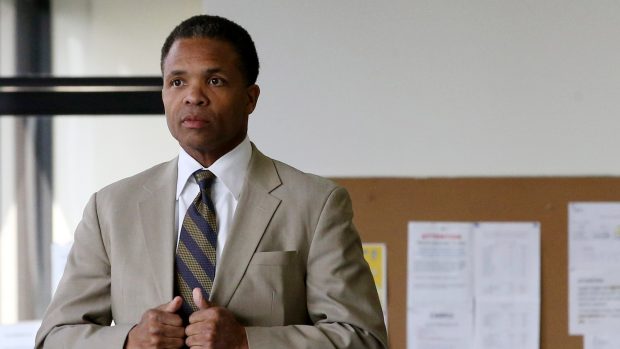





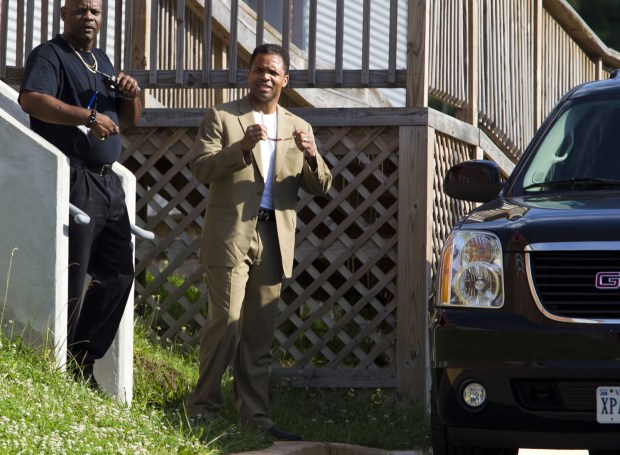
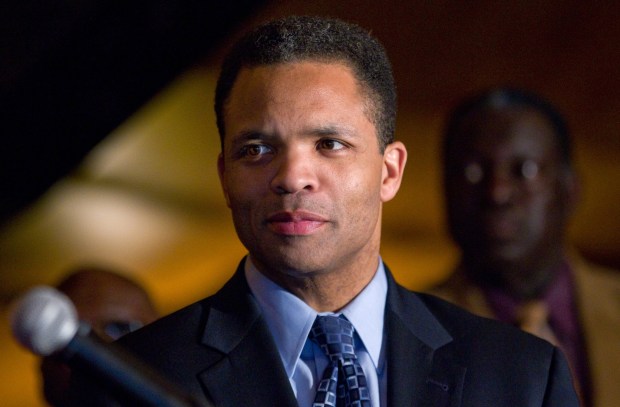

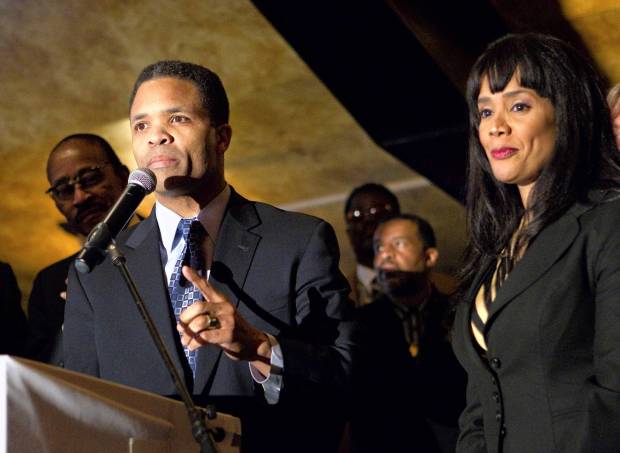


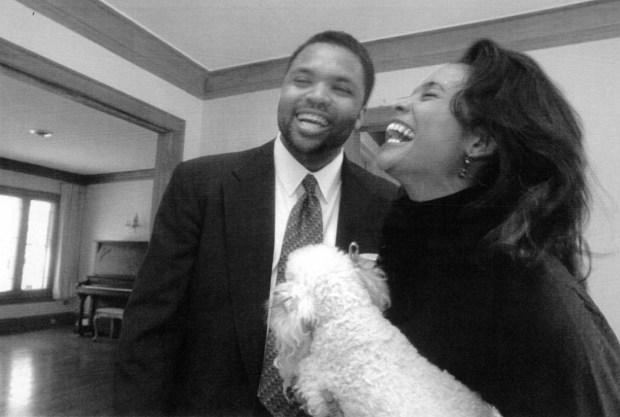
















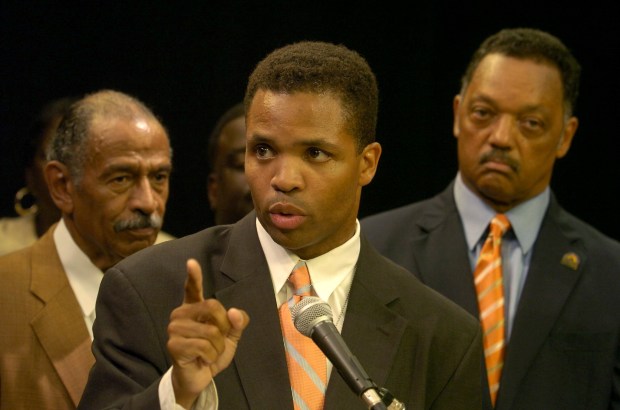

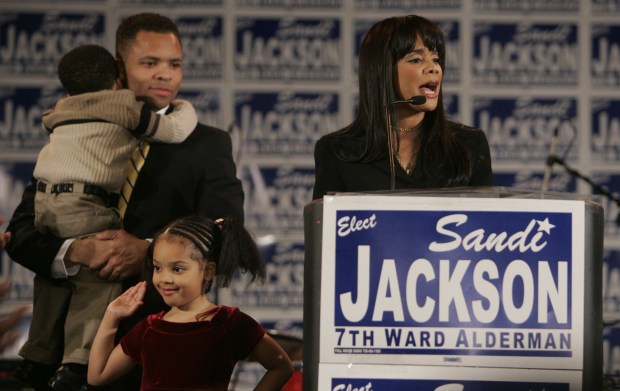



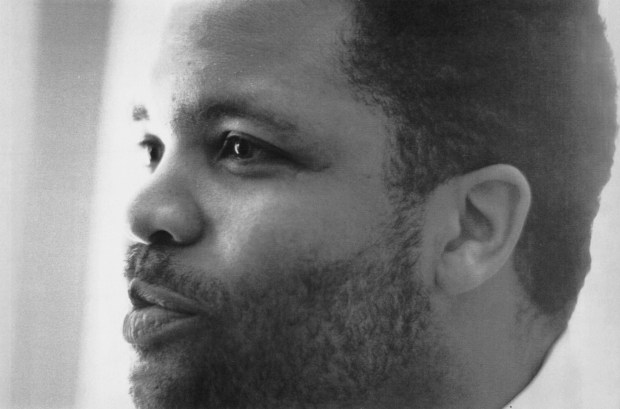

The day Jesse Jackson Jr. was sworn into Congress in 1995, he asked a reporter to sum up where politicians go wrong.
The answer, he recently recalled: “hubris.”
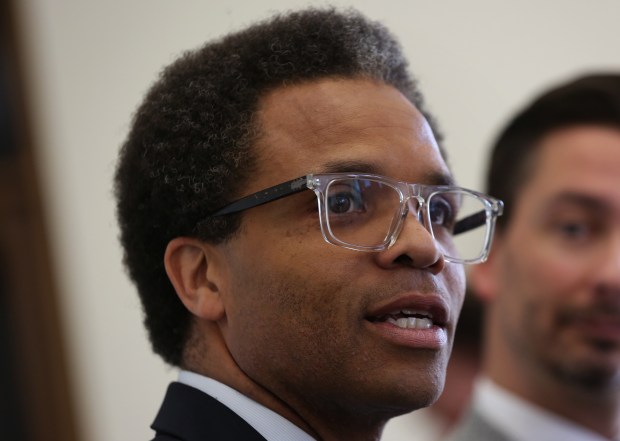
More than a decade after finishing his 17-month stint in federal prison for a campaign finance scandal that drew national headlines, Jackson — with more greyed hair and now sporting thick glasses — says he has learned his lesson and wants that old seat back.
“I own my behavior. I pled guilty, I accepted responsibility, I paid my debt to society in full,” Jackson told the Tribune. “I don’t owe America anything else.”
Whether voters in the March 17 Democratic primary agree is the biggest question looming over the race to represent Illinois’ 2nd Congressional District.

Jackson, who held the seat for 17 years, is buoyed by a recent influx of over $1 million in supportive spending from an artificial intelligence-focused political action committee. And he is being thrust into the national and local spotlight following the Feb. 17 death of his civil rights leader father and namesake, the Rev. Jesse L. Jackson.
But as Jackson renews his political career, he continues to face questions about his finances and the mental health struggles he has publicly grappled with.
According to his campaign, the former congressman continues to receive money annually from taxpayer-funded disability programs tied to his past mental health issues, most notably being diagnosed with bipolar disorder that years ago was described by his attorney as a temporary, total disability.
The amount was previously reported as $138,000, and the campaign said it is now “around” that amount. In a statement, Jackson promised that, if elected, he would be “one of the country’s leading champions for the rights of disabled Americans.”
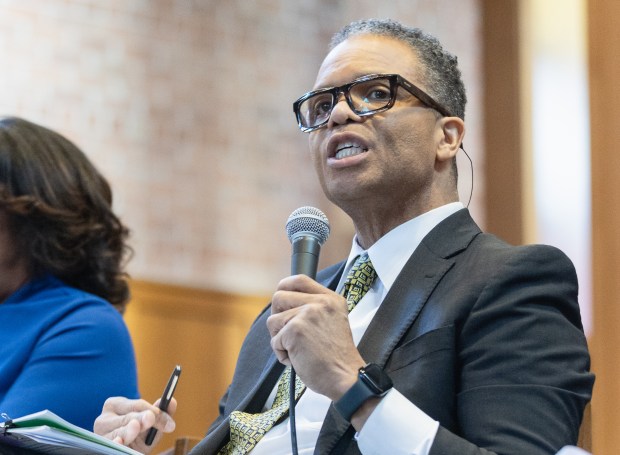
Wherever they land, voters will certainly recognize candidate Jackson, who now carries the air of an animated professor as he tries to sway debate halls toward his lofty political visions.
December polling by opponent Cook County Commissioner Donna Miller showed the former congressman with an advantage in name recognition, but weaker support when voters are reminded of his past and learn about his opponents.
The strongest challengers trying to convince voters to opt for a fresh start: Miller, state Sen. Robert Peters, state Sen. Willie Preston and Metropolitan Water Reclamation District Commissioner Yumeka Brown.
They are competing to represent a uniquely diverse district that runs from Chicago’s South Side lakefront neighborhoods and suburbs such as Harvey and Dolton, south to the downstate towns of Danville, Kankakee and Pontiac.

At recent forums, the 10 Democratic candidates have often shown broad policy overlap, making their backgrounds, campaign tactics and tone critical for voters choosing among them.
Jackson casts his candidacy as a story of experience as much as redemption. In a meeting with the Tribune editorial board this month, he noted that with veteran U.S. Reps. Danny K. Davis and Jan Schakowsky retiring, he would become the dean of Illinois’ congressional delegation if elected again.
“History matters. My knowledge of the institution, my knowledge of how to get things done on day one matter for this district,” he said in a separate Tribune interview. “There is no learning curve here.”
‘This isn’t a dream’
Like Democrats and Republicans nationwide, Jackson — who hosts a talk show for a radio station, KBLA-AM 1580, based in Santa Monica, California — has zeroed in on affordability as a top priority across a range of policy ideas.
And while he’s pitching a new, better version of himself this time around, he’s leaning on an old idea that has long failed to hit its target as a way to bolster the district’s economy: He wants to secure a new international airport near Peotone, 40 miles south of Chicago.
While the idea is supported by other candidates, the Peotone plan has been discussed for decades and has gone practically nowhere. First proposed as a third passenger airport for the Chicago area, it has progressed in fits and starts over the years as plans changed, with the recent 2023 proposal focused on air cargo amid the area’s flourishing e-commerce warehouses and logistics facilities.
Jackson argues the airport would open the area to the global economy and present a needed bold change for the struggling district. He also takes credit for getting past governors to buy the land needed to build.
There is now better alignment among local leaders near the site, a strong path toward private-sector financing, appropriations to build needed infrastructure and stretched capacity at other Chicagoland airports, he said.
“If elected, we will put the appropriate heat on the governor and the Department of Transportation,” he said. “This isn’t a dream. This is something that I need to finish.”
On national issues, he has also said he would push for expansions of the Affordable Care Act, such as adding vision and dental plans and more mental health and maternal care support, and has called for a new constitutional amendment labeling healthcare a “fundamental right.”
He’s also calling for a more lenient pardon process for people who are convicted and complete their sentences, citing his own experience in prison — and conversations with voters who want a clearer path to redemption. Some of his “low moments” come as he struggles to find employment because of his felony conviction, often reaching the end of hiring processes only to be rejected for his past, he said.
And he cites his experience as a caregiver for his late father to call for a “Caregivers Protection Act” that would provide support and stipends or tax credits to people doing similar, uncompensated work.
“Morally, we owe dignity to those who keep loved ones safe at home. Pragmatically, supporting caregivers prevents hospital readmissions, delays costly institutionalization and keeps experienced workers attached to the labor market,” he wrote in a USA Today op-ed on his stance.
But above all, he points to his past work on behalf of constituents. His record, he says: homes saved, clean water secured, voters registered, bar mitzvahs and funerals preached.
“These people know me. They don’t know half these candidates’ names,” he said. “I earned my record of service in this district.”
A death reshapes the race
News of the death of Jackson’s father has already reshaped the dynamics of the race.
Jackson cleared his campaign schedule after being at his father’s bedside when he died, and the pall of that loss lingered over a candidate forum in Kenwood just days later.
“There are no endorsements in this race,” host Jay Travis said to start. “But if anybody wanted to expand access to be able to elect accountable political representation and build the coalitions to do it, he was that person.”
No candidate mentioned Jackson’s past scandal, a stark contrast to earlier forums.
“I want to make sure I’m paying respects, and at some point we are going to still have to have a conversation,” Peters said later. “I’m fully able to separate father from son, I just think, let’s give some grace.”
The numerous celebrations of his father’s life are pulling the younger Jackson into the public eye through television interviews, receiving line visits and eulogies, giving the best-known candidate even more visibility as Chicagoans grieve the leader.

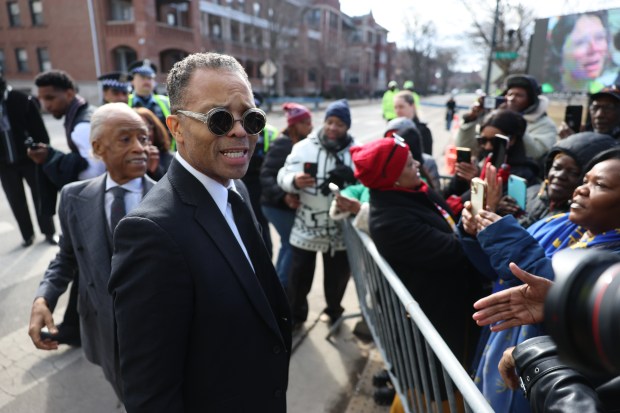
Jackson Jr. stood with his siblings outside the family home a day after their father’s death, recalling the moment he told his mother, Jacqueline, that her husband, his father, had stopped breathing. Speaking to reporters, he invited “liberals and conservatives, right wing, left wing” to his father’s funeral. He also took the moment to call on his brother, U.S. Rep. Jonathan Jackson, who represents Illinois’ 1st Congressional District, to find ways to support caregivers in Congress.
After promising his father’s “last breath is not his last breath,” Jackson Jr. jabbed at legacy media institutions for creating “a caricature” of the civil rights titan.
“Institutional media has historically controlled the narrative,” he said. “You’ve made him to be more controversial than he is.”
A sudden wave of more than $1 million behind Jackson in outside spending is also reshaping the race.
The Think Big political action committee, a group that says it supports Democratic candidates “dedicated to advancing AI innovation,” shared notice on Feb. 13 that it is spending over $1.1 million in digital advertising to support the former congressman.

That money narrows the massive fundraising and supportive expenditure lead Miller had, potentially forcing her and her allies to pivot from introducing her candidacy to countering Jackson. And it is a critical boon to Jackson, who had raised only $206,000 through December, far less than Miller and Peters.
Asked about the spending on the day it was first reported two weeks ago, Jackson said he “woke up to the news this morning” and was “grateful for the help,” noting federal election laws prevent the PAC from coordinating with his campaign. He attributed the support to questionnaire responses and an op-ed he wrote supporting the use of artificial intelligence in caregiving, and also described the technology as an economic opportunity for the district.
He has not made commitments to AI industry representatives, he said.
Beyond the scandal
Jackson Jr. has brushed off opponent attacks tied to his past scandal. He is focused on the economy, while “all they have left is character and the perceptions of character,” he said.
The 60-year-old pleaded guilty in 2013 to illegally using $750,000 in campaign funds for personal items.
The illegal expenditures included two stuffed elk heads from Montana, furs, a $43,350 gold Rolex watch, vacations and a fedora worn by Michael Jackson, as well as a home renovation project, kitchen appliances and more.
Asked why voters should trust him now, Jackson challenged the use of the word “stole” to describe his actions, calling the word a media “interpretation of my offense.”
“My offense is over a 10-year period, $75,000 a year. My interpretation is I lived in my campaign over that time period,” he said. “I have opponents in this race who support the Clean Slate Act for Illinois offenders, but when it comes to me, they don’t support ‘clean slate.’ Hell with you.”
To argue that he has paid his dues, Jackson said he has served “more time than Donald Trump” for his 34 felony convictions in New York in 2024 and the Jan. 6, 2021 rioters, who Trump later pardoned. Jackson paid a $750,000 restitution to the federal government by refinancing his D.C. home and lost that home to foreclosure, he added.
Jackson acknowledged the “bells and whistles of Congress” as draws for his bad behavior, citing “a driver, the cigars, the social life.”
“I missed when it went to my head,” he said. “Ultimately, it deteriorated some parts of my soul and my spirit, and it’s been 13 years of rebuilding, and I feel very good about it now.”
Jackson said he has won back voters by criss-crossing the district to have “authentic conversations” focused less on talking points and more on emotional connection. He said he has learned how common his incarceration experience is in a district where, he says, the busiest building is the Markham Courthouse.
One of the lessons he learned in prison, he said, was that others had it worse, just as he thought his own experience “was the worst story on God’s earth.”
“Right when I had come to terms that I shamed my family and embarrassed the hell out of myself, I met other men whose problems were worse than mine,” he said. “And they began telling me, ‘Get over yourself.’”
The former congressman, who was diagnosed with bipolar disorder in 2012 amid a monthslong leave of absence before his resignation, said his doctor told him years ago his condition had improved. He added that he now manages the condition well and in part credited broader acceptance of discussing mental health.
“I never stopped therapy while I was in Congress. It was no one’s business,” he said. “Now I’m saying I don’t have a problem talking about it.”
Lawyers for his ex-wife, former Ald. Sandi Jackson, said in 2017 that Jackson at that time received almost $138,000 a year in taxpayer-funded workers’ compensation and Social Security Disability Insurance payments tied to bipolar disorder and depression.
Jackson’s campaign manager, John Digles, said Tuesday the former congressman still receives about the same amount in workers’ compensation and Social Security Disability insurance payments and added that his eligibility is reviewed each year. Digles said Jackson would stop receiving the money if elected.
Altogether, if Jackson received the money each year in the last decade, it would exceed $1 million, most tax-free and a result of his having been a member of Congress and, therefore, a federal employee.
In a statement, Jackson defended the money he receives and argued the mental health condition that qualifies him for it does not make him less able to be a successful representative in Congress. He also promised to “fight hard” for disabled Americans if elected.
“Americans who manage a disability every day have to work three times as hard to get the recognition they have earned. It is insulting to diminish their ability to contribute because of a disability,” he said.
The Federal Employees’ Compensation Act gives workers’ compensation benefits for disability “due to personal injury or disease sustained while in the performance of duty,” the Labor Department said.
Jackson’s foreclosed-upon D.C. home, held in a trust controlled by him and his ex-wife, received a homestead exemption in 2023. Such exemptions lower property taxes but can only be taken at one primary residence.
Jackson also received a homestead exemption at his South Shore Chicago home. He pinned the two exemptions on the fact that he and she have lived separately for a decade and said he was unaware of the D.C. exemption, which records showed had not been recently taken before 2023. The exemption would have been made without his involvement, he said.
“Whatever Sandra applied for or does over there is her own business, has nothing to do with me,” he said. “As it relates to my house in Chicago, I applied for everything… I apply for everything I can get to make ends meet.”
The home sold at foreclosure auction last March for $1.39 million, records show.