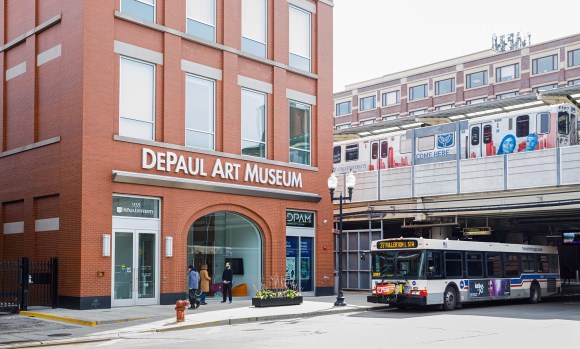

Days after top administrators at DePaul University announced it would be “re-imaging the arts” by permanently closing its on-campus museum at the end of June, a number of DePaul faculty members have signed an open letter asking the university to reconsider.
“Leaving aside the Orwellian invitation to ‘re-imagine’ the arts by closing the building that houses them,” the letter says, “it seems to us that those making the decision must not be fully aware of the multifaceted and widespread value that the DePaul Art Museum (DPAM) has for our academic community.”
The letter has more than 1,500 signatures, suggesting that many people outside of DePaul — or not currently affiliated with the university — have signed it as well.
Sean Kirkland is a philosophy professor at DePaul and is part of the group that spearheaded the open letter.
“It’s true philosophy is one of those disciplines where that connection is not so self-evident,” he said. “But the reason that so many of us in other (non-art) disciplines find the museum space to be so thought-provoking and experientially rich for the students is that those works of art are always, by definition, confronting students and challenging them with something they’re not used to. Something that goes outside the ordinary.”
Universities across the country are contending with budget shortfalls. The cuts have to happen somewhere.
“Things that seem like a luxury — the humanities, arts, things that are not so immediately monetizable — have enormous value in the actual education aims of the university.” Kirkland said. “Under these economic constraints, it can be tempting to think of the school as a vocational school. And there are good reasons for that. We have students paying a lot of money for a degree and they want to get their money’s worth. That’s a business model universities have adopted and those pressures cause institutions of higher education to focus on practicalities and areas of study that are more immediately and tangibly seen as monetizable.”
But, he said, “That creates a tension in the project of education that the university is committed to, which is to teach our students how to think for themselves and to ask questions and to provide them with the experiences and knowledge base that allows them to imagine the world in really radically new ways. Making students think in these unfamiliar ways and engaging with questions about about values and how human life should be lived is what the university is ultimately aiming at. And the ultimate punchline is that it will make them better workers and employees and more successful at whatever profession they pursue.”
In recent years, many of the museum’s exhibits focused on social issues concerning race, gender and climate change. “It’s been a place for students to focus on and contemplate the complexities of these issues,” said Kirkland.
The university currently has plans to build a $42 million basketball practice facility.
“It’s my understanding that the money funding that building is all donor based,” Kirkland said. “My concern is that this seems to be the way all sports investment at institutions of higher education work. You get (wealthy) people interested in sports at their alma mater and we make investments in those sports and that generates enthusiasm. But that enthusiasm only seems to produce donations back to the support of those sports. We don’t seem to hear about people getting jazzed about the basketball team and then donating $1 million to the museum.”
The open letter, Kirkland said, is an effort to convince the university’s administration to reconsider the museum’s closure.
“What we’re hoping is that the administration, in its deliberations, hadn’t anticipated the commitment the DePaul community and the larger Chicago community have to this institution. So we’re hoping that this is evidence of a miscalculation. That they hadn’t realized how passionate people were about what the museum provides.”