Cook County prosecutors on Wednesday dismissed 21 cases that were filed against protesters at the U.S. Immigration and Customs Enforcement processing center in Broadview, including charges for 15 moms who hopped concrete barricades in a highly publicized act of civil disobedience.
During a short court appearance at a branch courthouse in Maywood, prosecutors referenced extenuating circumstances when dropping the misdemeanor cases, according to an attorney for the women, Nick Albukerk. The decision was lauded by the women, who gathered with coffee and donuts outside the courthouse after the proceedings.


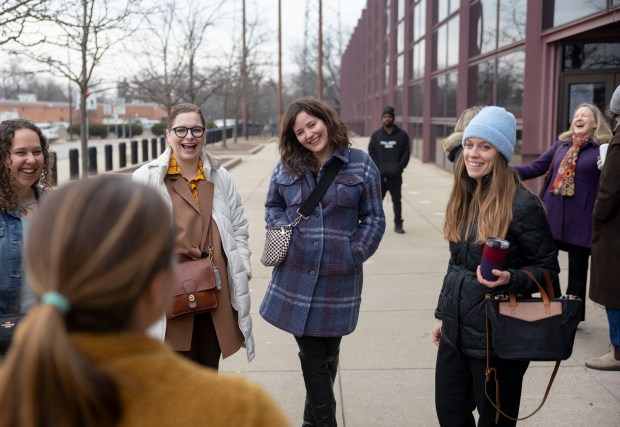

“Their job is not just to prosecute blindly, the job is to do what’s right,” Albukerk said.
In a statement, the Cook County state’s attorney’s office said it supports people’s right to peacefully protest and is “committed to exercising prosecutorial discretion to ensure just outcomes at every stage of a criminal proceeding, based on the law, the evidence and the responsible use of the office’s resources.”
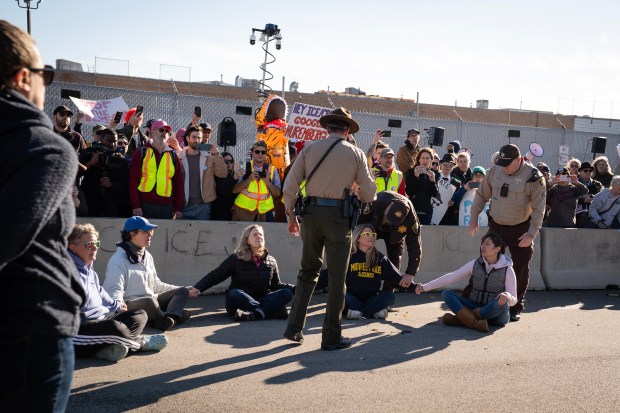
Just after 9:30 a.m. on Nov. 7, the women, mostly moms from Oak Park and River Forest who know each other through their children’s schools, jumped over a concrete barrier, sat down in the middle of the street and held hands.
The facility in west suburban Broadview became a focus of resistance to the Trump administration’s aggressive immigration enforcement efforts during Operation Midway Blitz in the fall.
Disturbed by the tactics of federal immigration agents in the Chicago area, the self-identified “soccer moms” said they planned the act of civil disobedience and sought to use their white privilege to make a statement.
“We wanted to bring attention to what was happening in Chicago,” said Sarah Slackert, one of the protesters whose cases was dismissed. “We were in crisis mode here in Chicago, and our family and friends from out of town were like, ‘what’s going on there.'”
Nikki Kidd, 44, talked to her third grader ahead of time, letting her know that she would likely be arrested. She sought to find an age-appropriate way to talk about the resistance, describing it in terms of standing up to bullies.

“She understood that as a third grader,” Kidd said.
After violent encounters between protesters and federal agents who used tear gas on the crowds, the state stepped in to secure the protest scene with personnel from the Illinois State Police, Cook County sheriff’s office and Broadview Police Department.
Though the local agencies said they set up a unified command to promote safe First Amendment activity, their tactics have also been criticized by protesters.
Throughout October and November, local authorities arrested more than 100 people outside the immigration facility, most on misdemeanor offenses involving allegations of disobeying police officers or obstructing or resisting, raising questions about how the state’s attorney’s office would handle the cases once they go up before a judge.
The office has a policy that sets out guidelines for prosecutors when making decisions in cases that result from First Amendment activity, requiring them to consider factors such as whether a civilian or law enforcement officer was injured, whether a weapon was used and other aggravating or mitigating circumstances, among other issues.
Local prosecutors “must also recognize that the First Amendment right to free speech is a fundamental right that prohibits government from hindering expression based on subject matter content,” the policy says. “The law is clear that criminal statutes cannot criminalize speech. However, the right to freedom of speech is not absolute and does not protect against prosecution for criminal conduct.”
Most of the cases are still pending, though prosecutors have also dismissed charges against a batch of around 19 other protesters. At least two cases have been resolved through guilty pleas.
Some of the pending charges involve low-level felonies and include allegations of battery against police officers, including a University of Chicago professor who is accused of spitting at a trooper.
The attorney for the women whose cases were dismissed on Wednesday, though, noted that these cases didn’t involve any allegations of violence or resisting.
“All the cases they dismissed were people clearly exercising their right to peacefully protest,” Albukerk said.