
On United Airlines’ commuter affiliates this summer, you will be able to fly 10 times a day from Chicago to South Bend, 11 times a day to Grand Rapids, Michigan, and seven times a day to Peoria, a greater number of flights to Central Illinois than at any point in the last 20 years.
So what’s going on, exactly? Does this reflect a sudden massive increase in the number of Central Michiganders or Peorians wanting to fly in and out of Chicago, as distinct from taking the relatively short trip by road or rail? Does it reflect a surge in the number of flyers wanting to play in Peoria?
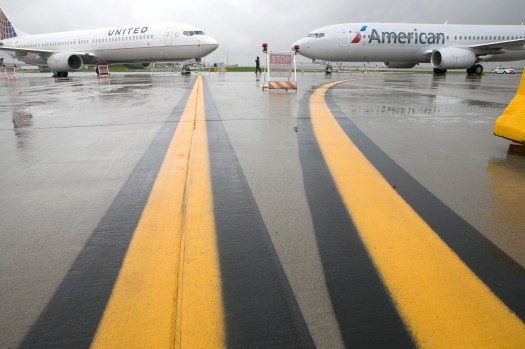
Absolutely not, said the clutch of highly prepared and riled up American Airlines executives who marched into our editorial board room last week, charging that Chicago’s hometown airline was, in essence, engaged in a predatory action that was designed to overwhelm its chief competitor with flights that existed for no other reason than to secure more gates at O’Hare International Airport with the long-term goal of making American’s O’Hare hub no longer viable, ensuring United’s future domination.
As our visitors told it, replete with charts, specifics and a very good case, this was morphing from a desirable competitive battle with Chicago flyers as the big winners, thanks to increased flight options and lower fares, into an unfair and anti-competitive action likely to kick American to the curb in Chicago and stifle competition here in the long run.
The airline industry is a complex beast, and O’Hare is byzantine itself. So let’s pause to explain.
Whereas most U.S. cities fight for more air service and some, such as Pittsburgh and St. Louis, lament the debilitating loss of historical hubs, Chicago is in the fabulous position of having two of America’s three biggest airlines running hub and spoke systems at O’Hare (not to mention Southwest’s heavy flight menu at Chicago Midway). As we’ve previously noted, the battle between American and United might not be ideal for either airline’s shareholders, but it serves the interests of this city because it avoids monopoly-driven fares (in the airline industry, fares have far more to do with market share than actual costs) and means that the plethora of connecting passengers at ORD increases the options for us locals who wouldn’t otherwise fill those planes on our own. There are knock-on advantages too: everything from more local flight-attendant hires to the money flowing to the companies who put up the billboards wherein United tweaks American.
But we sense two festering problems here.
One is that the battle to add flights is driven by a problematic city of Chicago gate-allocation system that divvies up those all-important gates based on the number of departures, not the quality thereof or the number of passengers therein. Ergo, a trio of flights to Grand Rapids gets United far more future benefit than a wide-body 787 departure to Paris, even though the latter benefits the city far more when it comes to tourism, local spending and global standing. That archaic system badly needs updating, both of these airlines have told us. You can’t take a train from here to London or Rome.
The second is that the airport is now undergoing major construction with a huge new terminal being built slap in the middle of the airfield.
The new runways put in place over several years by former Mayor Rahm Emanuel are generally seen as a roaring success, making arrival delays at ORD now very rare (not the case before). But the taxiways are another matter now. As Omar Idris, United’s vice president in charge of O’Hare, told us, there is no way to complete the airport reconstruction without some pain, but pain is not pleasant. The American executives noted that it was vital that the airlines were given accurate construction timing details in order to plan, which has not always been the case.
We regular O’Hare flyers are becoming familiar with lengthy taxi times, which costs the airlines money and prompts gags from the cockpit about landing in Wisconsin. Which is how it sometimes feels.

All of this has led the Federal Aviation Administration to begin in-person meetings with both airlines Wednesday in Washington, D.C., with a view to reducing the planned flights at O’Hare this summer, thus pre-empting what could be a summer of pain, especially in the likely event of bad weather. You can expect American and United, who operate the vast majority of those flights, to fight tooth and nail over who loses and keeps what. Clearly, American is happy that the FAA is stepping in to intervene.
We should note that United rejects American’s core argument and says it was forced into adding these flights because American had itself added flights in December to similarly close-in destinations: Erie, Pennsylvania; Lincoln, Nebraska; and the obscure Tri-Cities airport in Eastern Tennessee, among others. United says that American did this at short notice merely as an aggressive “gate play” and not because it expected those flights to be full or economically viable, otherwise it would have planned further ahead in order to secure advance bookings. Ergo, United had no choice but to respond to keep its leading market position and protect its own gate allocation.
Meanwhile, American’s executives say that all they wanted to do was maintain the kind of pre-existing detente that existed at O’Hare prior to the pandemic, with American operating about 80% of the departures as its somewhat bigger rival. As they describe it, that percentage is enough for American still to have a viable hub (and keep its many loyal Chicago business travelers from defecting to United for more choices), but that if it fell meaningfully below that scale of operation due to the loss of gates, that would no longer be the case. They describe it this way: once that domino falls, it won’t easily be stood up again. They note too that United executives have been reported by airline bloggers as openly discussing their desire to chase AA out of ORD (we’ve seen that too). The American executives claimed they did not want passengers to be used as a political football but merely wanted fair competition.
We’re the Tribune editorial board and our client is our readers, very many of whom use O’Hare. To our minds, it is in the city’s interests to have both these fine U.S. airlines operating viable hubs here, competing with the force and vitality you can discern from the above. Indeed, it’s vital to our city. But you can’t expect United to care about American’s fortunes, or vice versa, and that is where the city and the federal government have to come in.
The city needs to come up with a more sophisticated gate-allocation process that doesn’t favor all these low-distance flights (which have disproportionate environmental costs) and does favor the kind of long-range international flying that asserts this city’s identity. And the FAA has to ensure the airlines can actually operate the flights they are selling both safely and on time (both airlines discussed in detail here say they never will allow competitive juices to compromise their focus on safety).
It seems to us that whatever reduction in flying is deemed necessary and put in place by the FAA for this summer should be proportionately allocated between American and United based on their levels of flying before both airlines suddenly added flights purely for gate-allocation purposes (one viable option would be to base things on the pre-pandemic scenario). That way, both airlines are encouraged to maintain the hubs we badly need, especially for a city where the meeting business, such as political conventions, is so vital. And we hope that O’Hare’s crucial international offerings are protected.
Lastly, while there is doubtless a tradeoff between construction costs and operations, a smooth operation at the big airport this coming summer — the busiest travel season — sure as heck needs to be a priority.
All of this short-term competition is great. But Chicago needs American and United to thrive here in the long term. They’re both essential to our city’s future.
Submit a letter, of no more than 400 words, to the editor here or email letters@chicagotribune.com.