
Aurora’s Planning and Zoning Commission on Wednesday voted to recommend the city adopt regulations around data centers that are stricter than were originally presented by the city staff.
Under current Aurora city code, data centers are considered warehouses so have no special requirements and can be built in certain areas without Aurora City Council approval. The proposed changes would give the City Council the ability to approve or deny proposed data center developments and would set requirements around energy use, water use, noise and other emissions.
However, most of these proposed rules would apply only to new data centers looking to get approval after the city lifts its current moratorium on these types of developments, or those that get substantially renovated after the moratorium.
Although some of the proposed changes to city code have been recommended for approval by the Planning and Zoning Commission, they all still have to be approved by City Council. The earliest a final vote could take place is March 24, which is also the day the moratorium is set to end.
The Aurora City Council put the data center and warehouse moratorium in place last September to give the city staff the chance to create the now-proposed regulations in response to an increased number of data center applications and residents’ concerns with existing facilities.
In addition to the restrictions that have been proposed by the Aurora city staff, the Planning and Zoning Commission also recommended barring data center developments from two of the three zoning districts warehouses are currently allowed in.
If the Aurora City Council adopts the commission’s recommendation, data centers would only be allowed in general industrial zones, not in limited industrial zones or in office, research and light industry districts.
The idea of limiting data centers only to general industrial zones was put forward by some of the residents who spoke during the public hearing portion of Wednesday’s meeting. Many who spoke at the public hearing argued that the proposed regulations do not go far enough in protecting the community, and some wanted the city to outright ban all new data centers or to continue the moratorium.
Aurora Chief Development Services Officer John Curley said a total ban would not stand up to legal challenges. However, included in the new proposal is the same process through which Naperville recently was able to shoot down a data center project proposed for that city, he said.
In the rules proposed by the city staff, noise is a key area of focus. Data centers are not allowed to produce sound louder than 59 decibels during the day or 49 decibels at night, as measured at the facility’s property line, and the city would require data centers monitor their sound around the clock.
Currently, city regulations around sound reference state regulations, but those are difficult to measure and to enforce, Curley has said.
The currently proposed sound requirements are the lowest levels city staff have said they found communities to require through their past few months of research.
The proposal package would also not allow data centers to install roof-mounted chiller units within 1,500 feet of residential, educational or hospital uses. Similar space requirements would be set for ground-mounted chillers and backup generators, which would need to be at least 1,000 feet away from residential, educational or hospital uses.
Minimum distances between sound-producing units and sensitive uses like residential are there to help mitigate the sound but also vibration, according to Curley.
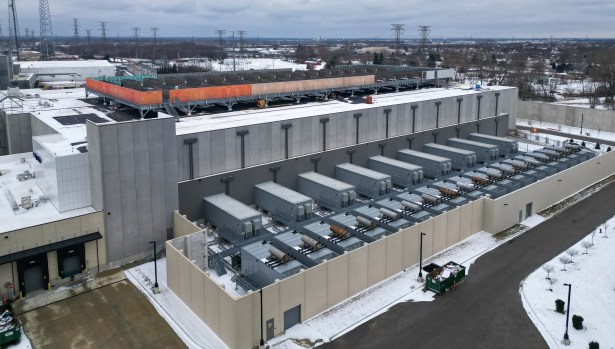
Sound coming from both chillers and backup generators has been making life difficult for those living near the CyrusOne data center at the corner of Eola and Diehl roads on Aurora’s far East Side near Interstate 88, these homeowners have said.
Residents’ advocacy around this issue is one of the reasons the city has been working to create these recently proposed regulations, according to Curley. Although these new rules won’t directly address residents complaints about the existing data center, the city and CyrusOne have been working together to address the ongoing noise issues.
Under the proposed regulations, both roof- and ground-mounted chiller units as well as ground-mounted generators would be required to have sound walls around them, similar to what is being built at the CyrusOne data center. Plus, rooftop generators would not be allowed.
Incoming data centers would be required under these proposed regulations to do sound studies and modeling at several points in the development process. This would include a baseline sound study before anything is built on the site, a sound modeling study showing that the planned data center would not go over maximum sound levels and a study of the sound the data center actually produces once it is built.
Additional studies would be required if the data center sees major renovations.
If a data center is shut down and the building is set to become something else, the data center’s owner would be required to remove all obsolete equipment like chillers and generators from the site. It is unlikely another type of facility would have use for these things — but if it did, far fewer would be needed, Curley has said.
The newly proposed regulations would also require new data centers to meet certain energy efficiency levels, to provide energy modeling reports before they can be approved and to follow a number of established energy codes.
Data centers would also be required to either have renewable energy generation on-site, enough to power 25% of the facility at peak demand, or battery storage with the capacity to power up to 50% of the facility for 15 minutes, which is to stabilize the energy grid and help during brownouts. Curley said on Wednesday that a third option has now been added: Data centers can simply buy renewable energy credits.
As for water, the proposed regulations would set a similar efficiency standard to energy usage. Aurora would also ban evaporative cooling, which staff have said is the most water-intensive type of cooling, and would require modeling and reporting on water usage.
Aurora is also proposing what is basically a copy of the state’s Biometric Information Privacy Act, which adds restrictions around biometric data.
While it doesn’t add onto state law, it does create local protections in the case that the state repeals its own restrictions, Aurora Director of Sustainability Alison Lindburg told the City Council’s Rules, Administration and Procedures Committee on Tuesday.
The portion of the proposed changes to city code related to zoning were recommended for approved by the Planning and Zoning Commission in a 5-1 vote on Wednesday, while the other parts of the proposal package were discussed and moved forward by the Rules, Administration and Procedures Committee.
Ald. Shweta Baid, 10th Ward, at the Tuesday meeting made several recommendations to strengthen the proposed requirements, which she said was based on the experiences of her residents. The ward she represents contains all of the city’s existing data centers.
Baid’s recommendations, some which had also been made by residents during recent public meetings, included increasing minimum distances between data centers and residents to 2.5 miles, lower sound minimums and stricter fines for those who don’t comply.
At Wednesday’s meeting, Curley said several of those suggestions, including the drastically increased minimum distances and the lower sound minimums, likely wouldn’t hold up to legal challenges.
Now that the Planning and Zoning Commission has formally recommended some parts of the proposal for approval, and the Rules, Administration and Procedures Committee moved the other parts forward without a recommendation, the whole package is set to go before the City Council Committee of the Whole on March 18.
That committee sets the agenda for the following week’s City Council meeting, so the proposed data center regulations in whole could be up for a final vote on March 24.
The Building, Zoning and Economic Development Committee could also hear the proposal, but not vote on it, at its meeting on March 11.
rsmith@chicagotribune.com